SKU 98672 For technical questions, please call 1-800-444-3353. Page 10
3. NOTE: The threads inside the Cylin-
der (13) are plastic. Do not exert too
much twisting pressure or they can
be damaged.
4. To remove, or change chisel heads,
simply reverse steps 1 and 2.
Work Piece and Work Area Set Up
1. Designate a work area that is clean
and well-lit. The work area must not
allow access by children or pets to
prevent injury and distraction.
2. Route the air hose along a safe route
to reach the work area without creat-
ing a tripping hazard or exposing the
air hose to possible damage. The air
hose must be long enough to reach
the work area with enough extra
length to allow free movement while
working.
3. Secure loose workpieces using a vise
or clamps (not included) to prevent
movement while working.
4. There must not be hazardous ob-
jects (such as utility lines or foreign
objects) nearby that will present a
hazard while working.
General Operating Instructions
1. If an automatic oiler is not used, add
a few drops of Pneumatic Tool Oil
to the airline connection before use.
Add a few drops more after each
hour of continual use.
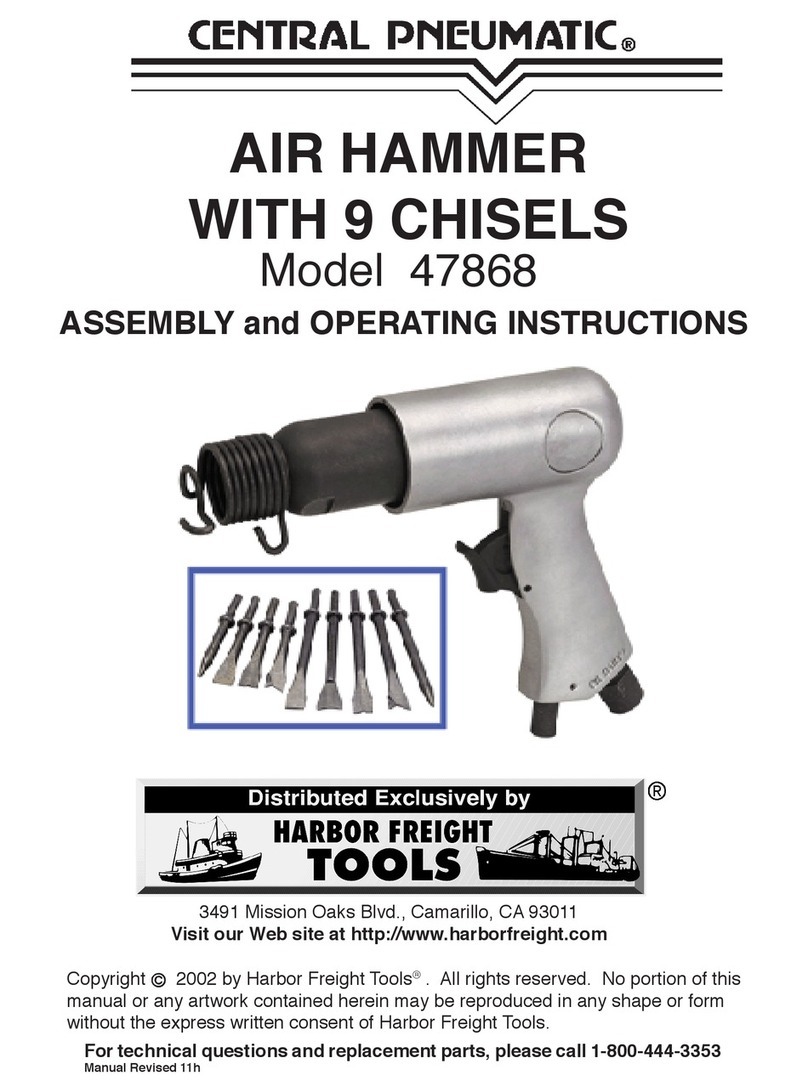
2. With the proper chisel attached to the
Air Hammer, attach your air supply to
the Air Inlet (10) at the base on the
Housing (1).
3. Turn on the air supply. Carefully place
the chisel against the surface of the
project you are working with.
4. Make sure the workpiece is in a vise
or attached to something that holds it
securely so it cannot be moved out
of position.
5. Set the Air Regulator (not included,
located on your air compressor) to 90
PSI.
6. Use a light touch on the Trigger (3).
Never force the Air Hammer against
the surface you are working with.
Easy, light pressure works best.
7. If the tool requires more force to
accomplish the task, verify that the
tool receives sufcient, unobstructed
airow (CFM) and increase the
pressure (PSI) output of the regulator
up to the maximum air pressure
rating of this tool.
8. CAUTION! TO PREVENT TOOL
AND ACCESSORY FAILURE,
RESULTING IN INJURY: Do not
exceed the tool’s maximum air
pressure rating.
9. If the tool still does not have sufcient
force at maximum pressure and
sufcient airow, then a larger tool
may be required.
10. To prevent accidents, detach the air
supply, safely discharge any residual
air pressure in the tool, and release
the throttle and/or turn the switch to
its off position after use.
11. Clean external surfaces of the tool
with clean, dry cloth, and apply a thin
coat of tool oil. Then store the tool
indoors out of children’s reach.