Warranty
All professionally installed, unaltered devices are covered by warranty during the
statutory warranty period from the day of purchase by the end user. The warranty
is not applicable to damage incurred during transport or caused by short-circuit,
overloading or improper use. In the event of defects in workmanship or material
being discovered within the warranty period, the company will provide repair or
replacement free of charge. The warranty will be rendered null and void if the device
is opened without authorisation.
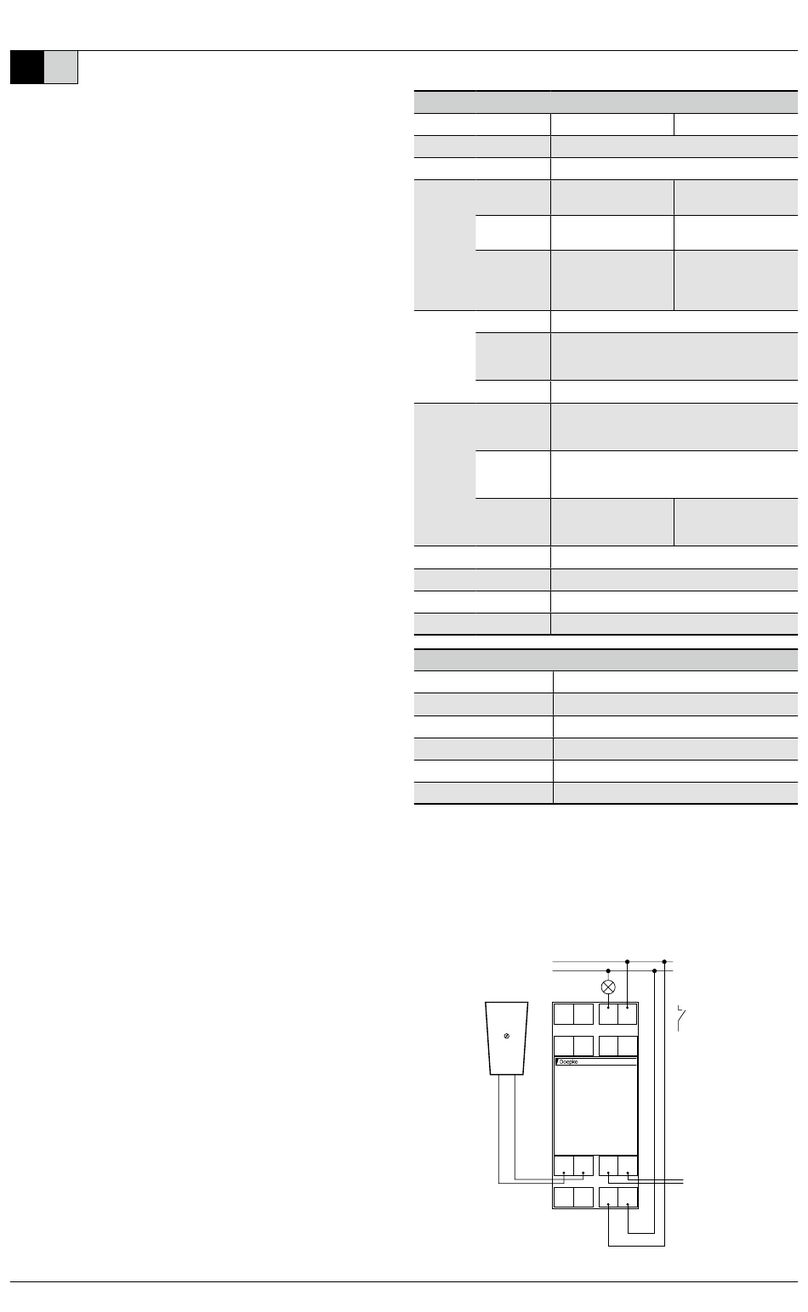
Wiring diagram
8
N46
~
12 14 11
S 21 S 22
Not-Aus-Kreis
emergency off circuit
VFour-pole, neutral conductor on the left
VWiring of multiple DHS 4 NA connected to one emergency switch circuit
Installation and operating instructions
for switch-disconnectors
in the DHS 4 NA series
electrical specialists. The installation of devices of this type is not
appropriate for electrical laypersons due to the considerable potential
dangers. These installation and operating instructions must be
retained, so that they can be referred to at a later stage. The operator
of the electrical system must be informed about the application and
function of this protective device.
Application instructions and warnings
Devices with visible damage must not be installed or used.
gases in order to preserve the correct function in the long term. Corrosive gases
include chlorine, ammonia and sulphur gases.
If the device cannot be switched on, even if the consumer network is not
connected and the emergency switch circuit is not active, the device must be
replaced.
The switch-disconnector provides FELV (functional extra-low voltage) to the
emergency switch circuit. For this reason the emergency switch circuit must be
rated for a voltage of 230 V AC.
Intended use
Switch-disconnectors conforming to IEC 60947-3 are particularly well suited for
use in main and sub-distribution boards. In combination with the emergency stop
function, system parts can be safely disconnected under load or overload in the
remotely using a compatible emergency switch.
The emergency switch circuit must be tested regularly. This will increase the
endurance of the switch-disconnector, as the mechanism is moved when tripped.
The integrated auxiliary switch signals the switching status and is designed as a
potential-free changeover contact.
Mounting and installation
They are designed as modular DIN rail components for integration in distribution
boards or unit housings for installation on mounting rail TS 35 as of EN 60715.
Protection against direct contact according to protection class 2 must be ensured
with the assistance of the associated distribution board or device covers.
Assembly occurs by means of snapping on to the mounting rail. The connection must
be made in accordance with the wiring diagram. Terminals N, 3, 5 and 7 are used for
the supply.
Emergency switch equipment function
The emergency switches are connected at terminals S 21 and S 22. It is possible to
use either one single switch or several switches (switched in series). The emergency
in the event of wire breakage. The emergency switch equipment is ready as soon as
a single-phase supply voltage of at least 50 V AC is applied. If the emergency switch
engaged') lights up, and the switch-disconnector is open and cannot be switched
on. If multiple DHS 4 NA devices must be operated via an emergency switch circuit,
terminals S21 and S22 of the devices must be connected in parallel.
Testing and functional check
All tests are covered by the prescribed inspection test. Tests should be carried out
according to DGUV Regulation 3 (BGV A3) depending on the location. When an
insulation test of the electrical system is performed using test devices in accordance
insulation test when the device is switched on or an insulation test on the input side
(terminals N, 3, 5 and 7) can lead to erroneous measurement values as a result of the
internal adaptor.
Troubleshooting
continuously even though the emergency switch equipment has been reset, either
directly on the device. If the red LED continues to light up after the supply voltage is
reconnected, the device is faulty. If the red LED no longer lights up, the cause of the
fault lies in the system.
Technical data
DHS 4 NA
Rated current
Rated impulse withstand voltage
Internal consumption
Utilisation category
Rated voltage
Rated short-circuit current
Dissipation power Pv (typ.)
per current path
Short-circuit back-up fuse SCPD,
utilisation category gG, as per
Shock resistance
Installation position optional
Max. operating altitude
Input terminals
Resistance to climatic changes
Maximum number of
conductors per terminal
Connecting capacity
solid
stranded
Tightening torque
Endurance mechanical
electrical
Design requirements
Ambient temperature
Vibration resistance >>30 min.)
Mounting Mounting rail
Housing type Distribution board housing
Housing material Thermoplastic
Protection class
distribution board installation)
Sealable Yes
Weight
Dimensions (W x H x D in mm)
Technical data for emergency switch equipment
Connecting capacity,
solid and stranded
Tightening torque
emergency switch circuit
Type of output voltage
for signalling the switching status
Min. operating voltage
for emergency switch equipment function
Maximum cable length
of emergency switch circuit
Doepke
||
DE EN