manuals.online logo
Brands
  1. Home
  2. •
  3. Brands
  4. •
  5. Dymond
  6. •
  7. Test Equipment
  8. •
  9. Dymond M24 GOLD TESTER User manual

Dymond M24 GOLD TESTER User manual

Other Dymond Test Equipment manuals

Dymond Electronic Touchstone ET18 User manual

Dymond

Dymond Electronic Touchstone ET18 User manual

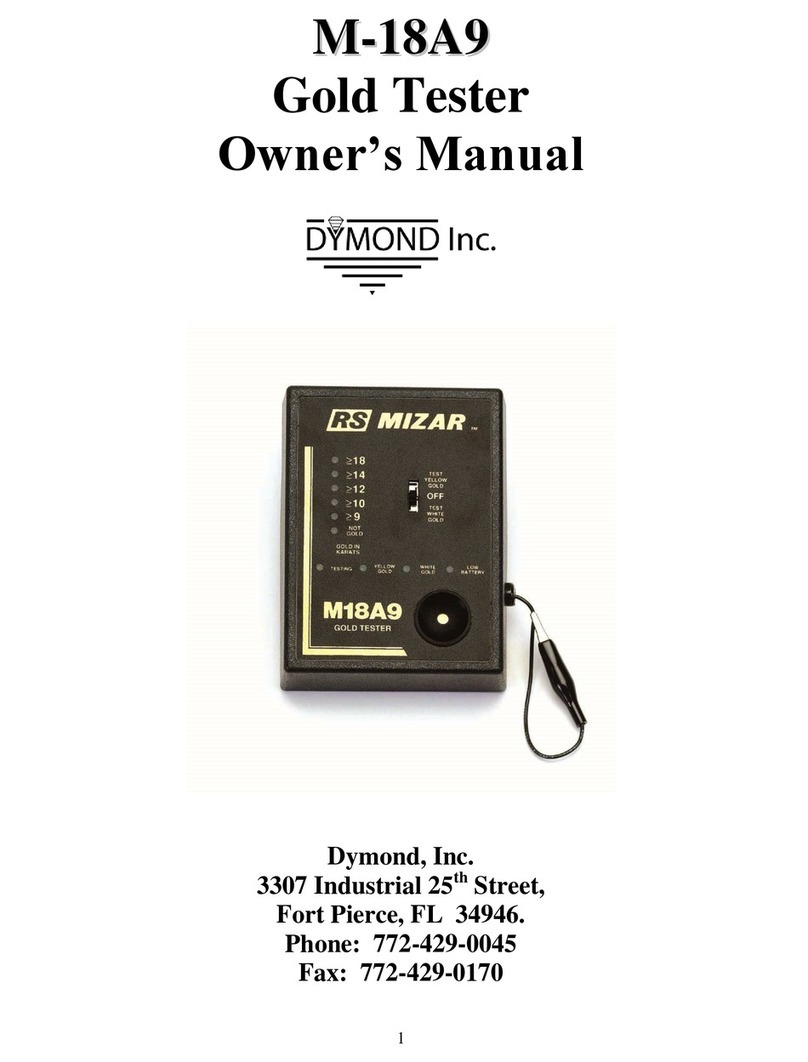
Dymond M-18A9 User manual

Dymond

Dymond M-18A9 User manual

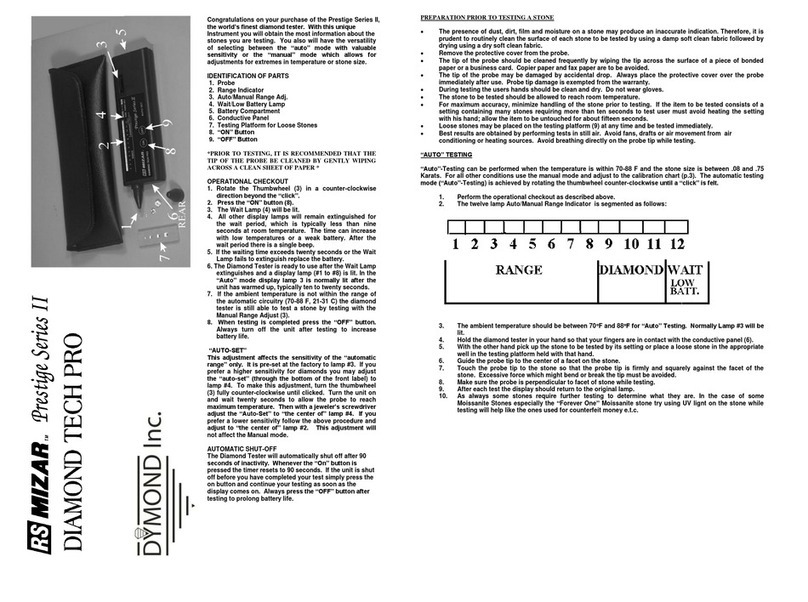
Dymond RS Milzar Prestige II Series User manual

Dymond

Dymond RS Milzar Prestige II Series User manual

Popular Test Equipment manuals by other brands

Ambit P.F. Series instruction manual

Ambit

Ambit P.F. Series instruction manual

Megger BMM500 Series user guide

Megger

Megger BMM500 Series user guide

RJG Lynx Sensor Tester operating instructions

RJG

RJG Lynx Sensor Tester operating instructions

Mark-10 TT02 Series user guide

Mark-10

Mark-10 TT02 Series user guide

Martel 3001 Operator's manual

Martel

Martel 3001 Operator's manual

ElproSys DiagProg4 instruction manual

ElproSys

ElproSys DiagProg4 instruction manual

Redtech TRAILERteck T05 user manual

Redtech

Redtech TRAILERteck T05 user manual

Venmar AVS Constructo 1.0 HRV user guide

Venmar

Venmar AVS Constructo 1.0 HRV user guide

Test Instrument Solutions SafetyPAT operating manual

Test Instrument Solutions

Test Instrument Solutions SafetyPAT operating manual

Hanna Instruments HI 38078 instruction manual

Hanna Instruments

Hanna Instruments HI 38078 instruction manual

Kistler 5495C Series instruction manual

Kistler

Kistler 5495C Series instruction manual

Waygate Technologies DM5E Basic quick start guide

Waygate Technologies

Waygate Technologies DM5E Basic quick start guide

StoneL DeviceNet CK464002A manual

StoneL

StoneL DeviceNet CK464002A manual

Seica RAPID 220 Site preparation guide

Seica

Seica RAPID 220 Site preparation guide

Kingfisher KI7400 Series Training manual

Kingfisher

Kingfisher KI7400 Series Training manual

Kurth Electronic CCTS-03 operating manual

Kurth Electronic

Kurth Electronic CCTS-03 operating manual

SMART KANAAD SBT XTREME 3G Series user manual

SMART

SMART KANAAD SBT XTREME 3G Series user manual

Agilent Technologies BERT Serial Getting started

Agilent Technologies

Agilent Technologies BERT Serial Getting started

manuals.online logo
manuals.online logoBrands
  • About & Mission
  • Contact us
  • Privacy Policy
  • Terms and Conditions

Copyright 2025 Manuals.Online. All Rights Reserved.

RS MIZAR.
THE GOLD TEST EXPERTS
M24 OWNERS MANUAL
IMPORTANT WARNING
BEFORE USING PROFESSIONAL MODEL M24,
READ ALL INSTRUCTIONS AND SAFETY DATA
AT THE END OF THE DOCUMENT.
This manual covers the operation of the M24 Electronic Gold Tester.
RS MIZAR, INC. has been issued two Patents for its development on
the M24 full range Gold Tester. This new process gives accurate and non-
destructive test results all the way to 24K gold. It can help determine Gold
Karat value in as little as 2 seconds.
This process can distinguish non-gold and gold plate from true “Karat Gold”
without the destructive Fire Assay testing, which would change the value of
the jewelry.
RS Mizar now brings you the fastest and easiest Gold Analyzer for all the
trades where jewelry and “Karat Gold” have to be quickly and accurately
evaluated.
The M24 Gold Tester: U.S. PATENTS 5080766, 5128016
OTHER U.S. AND INTERNATIONAL PATENT RIGHTS PENDING
1 
CONTENTS OF PACKAGE
1. M24 ELECTRONIC GOLD TESTER
2. ERASER
3. TESTING SOLUTION [No. 1995]
4. OWNERS’ MANUAL
5. ERASER PENCIL
OPERATING INSTRUCTIONS
OPERATING INSTRUCTIONS FOR TESTING GOLD FROM 20K TO 24K
When testing Gold from 9K to18K, go directly to instructions below for 9 to
18 Karat testing. When testing Gold from 20K to 24K, a buildup of test
solution on the Reference Gold will have to be removed to obtain the proper
results.
3 
ITEM 5 When “TESTING” Light goes out, remove Test Gold. Read LED
Display of Karat Value. Clean Test Gold thoroughly with soft paper towel.
Thoroughly wipe the Test Solution from the Test Well using a paper towel
followed by a Q-Tip. If re-testing is desired, see “DO’S & DON’TS”, items
“8” and “11”.
ITEM 6 Check to be sure that there is not excessive air in the bottle and that
the cap is tightened firmly.
PRECAUTIONS
•After testing Gold item, it should be cleaned with a buffing wheel.
However, it must be cleaned with the gray eraser before any new test
because of the residue left on the Gold from the previous test.
•Improper of insufficient cleaning of the test Gold before testing can
increase the karat value readings.
•Your unit is operating correctly if occasionally you do get a reading in the
next range. This can happen when the karat value of the Gold you are
testing is very close to the odd karat value, i.e. 17K, 19K, etc. Your unit is
operating correctly when this occurs and indicates the Gold you are testing
is very near the in-between value.
•The excess air must be squeezed out of the test solution bottle between
tests or when stored. Squeezing out the excess air keeps the solution
fresh. When all of the air cannot be squeezed out it needs to be replaced.
In any case, the bottle must be replaced 6 months after first opening! “Un-
fresh” test solution can cause the karat readings to go lower by one range.
You should always have a fresh bottle of test solution available. Record
here the date the bottle was opened:______________________
5 
SPECIFICATIONS
M24 GOLD TESTER
M24 Range: 9, 10, 12, 14, 16, 18, 20, 22, and 24 Karat
Automatic Shutoff after each test: Approximately 14 seconds
Test times: 2 seconds from 9-14 Karats
2-15 seconds from 16-24 Karats
Delay before beginning test: 12 seconds
Display time: 12 seconds
Gold colors: Yellow, White, Red, Green (see “Gold Composition”)
Non-destructive testing
Distinguishes Gold Wash and Flash from Solid Gold Can be used to
distinguish Gold Plate from Solid Gold (see “Testing for Gold Plate”)
Dimensions:
Length ....................................................................................... 6.3”
Width..........................................................................................4.0”
Depth..........................................................................................1.5”
Weight: With Battery..................................................................8.0 oz.
Operating Temperature: 65°F to 90°F (19°C to 32°C)
Battery: One (1) standard 9 Volt
2 
STEP A - Sharpen the Pencil Eraser and then cut off the end with a sharp knife or razor
so that it is flat and round (about .160” or 5/32”). Then place the eraser into the Test Well
and firmly rotate back and forth for about four seconds. Then brush debris from the Test
Well. This preparation will eliminate the excess buildup on the Reference Gold. For all
tests of 20K to 24K Gold do this step of removing excess buildup on the Reference Gold
with the sharpened and blade-cut Pencil Eraser. A dirty Eraser tip will not sufficiently
clean Test Well.
STEP B - Go to “item 1” below.
OPERATING INSTRUCTIONS FOR TESTING GOLD FROM 9K TO 18K.
ITEM 1 Thoroughly clean immersible area of Test Gold with the Gray Eraser (see
“DO’S & DON’TS”, item 5.) Attach Alligator Clip to Test Gold away from immersible
area.
ITEM 2 Loosen the cap of the Test Solution and have a soft paper towel and some Q-
TIPS handy.
ITEM 3 Press “TEST YELLOW GOLD” or “TEST WHITE GOLD” (to match the type
of Gold that you are testing) and within two seconds, put three or more drops of Test
Solution into the Test Well. Quickly squeeze all of the air out of the Test Solution Bottle
and tighten cap firmly. (See “item 6”)
ITEM 4 Observe that one of the Karat Value Lights is on. Any Karat Light may be lit;
this is determined by a previous test or length of time that the unit has been off. After the
Light goes out, (within one second), carefully immerse enough of the Test Gold into the
liquid to start the “Testing” Light being careful not to touch the reference Gold at the
bottom of the Test Well and being careful not to touch the Alligator Clip to the liquid.
Hold the Test Gold without moving it until “TESTING” Light goes off. This will take 2
to 15 seconds, depending on the Karat value of the Test Gold. User should brace the
“heel” of his hand on the unit or on the same surface as the unit rests on. When possible,
brace the Test Gold on the inside of the Test Well just under the surface of the liquid and
be very careful not to touch the Reference Gold at the bottom of the Test Well.
It is important that the Test Gold not be moved about in the Test Solution until a reading
is obtained.
4 
DO’S & DON’TS
1) Don’t use Testing Solution for more than one test; errors will result.
2) Don’t touch Test Gold or Alligator Clip lead to Reference Gold at bottom of Test
Well. If this happens remove liquid and re-do test procedure.
3) Don’t let Alligator Clip touch liquid.
4) Don’t leave liquid in test well. This will void your warranty.
5) Do clean Test Gold before testing if it isn’t bright and shiny. Unclean Gold may
result in inaccurate readings.
6) Do keep Gold chains very tight (link to link) during testing. Use the fewest number
of links (one if possible) between the Alligator Clip lead and the Gold link to be
immersed in to the liquid. Three problems can exist with testing chains:
a. There may be dirt or contamination between links that would require intensive
cleaning (i.e. ultrasonic) before testing.
b. Some chains, especially certain European manufactured chains have a thin
non-metallic coating that must be removed from an area before testing. The
eraser pencil may be used to remove this coating.
c. When testing chains, remember that the solder often used at the link(s) is of a
lower Karat than the rest of the chain. Therefore, avoid testing in that area.
7) Do make sure good contact is achieved between the Test Gold and the Alligator
Clip lead. If the object to be tested is too large to fit in the clip lead, simply hold
the clip lead lightly against the Test Gold during test.
8) Do always clean the Test Gold with the Gray Eraser before retesting in the same
location. Pink eraser can be used but it requires considerably more pressure and
effort for accurate readings.
9) Do replace the Testing Solution every 6 months after opening.
10)Do use only within Operating Temperature 65°F-90°F.
NOTES
1) In the event the Alligator Clip contacts the testing solution, the Alligator
Clip must be rinsed thoroughly with water and dried before using again.
2) WARNING: Eye Hazard -- Read warning label on bottle of Test Solution.
3) IMPORTANT: The Testing solution is sensitive to exposure to air. Minimize the
time cap is loose on bottle.
6 
TESTING FOR GOLD PLATE
INTRODUCTION
Probably most of the Gold plated items referred to as “costume jewelry” or
“fashion jewelry” contain Gold at the surface, which is no thicker than eight
millionths of an inch. Such a Gold plate is referred to as Gold flash. A large
percentage of Gold flash is sufficiently thin and/or porous (microscopically) that
the M24 Gold Tester will “read through” the plate and indicate “NOT GOLD”. A
thicker plate will read as Karat Gold unless a portion of the surface being tested is
erased with the eraser pencil or filed to expose the metal underneath. The eraser
should be used as first choice since it is easier to use and non-destructive.
However, the eraser will not work on thick Gold plate.
GENERAL DESCRIPTION OF PROCEDURE
To determine that an item is Gold plated “non-Gold”, the user of the M24 Gold
Tester must take at least two different readings, one reading of a surface, which
has not been erased or filed. The reading of the erased or filed surface will be
lower if the metal underneath is not gold. (To be sure the metal underneath is
not Palladium, see the section on “TESTING FOR PALLADIUM”.) The M24
Gold Tester will read as “NOT GOLD” if a sufficient area of non-Gold is exposed
to the liquid but the un-erased or un-filed Gold plate exposed to the liquid does
have some effect on the reading, this is why point 2 of the following section under
“PRECAUTIONS” is important.
When testing for heavy Gold plate, it may be necessary to use a fast drying
lacquer or material such as a clear fingernail polish. The area to be tested must be
coated with the lacquer and allowed to dry. Next, make a file mark in the center
of the coating deep enough to expose the base metal. Then test the exposed base
metal with the M24 Gold Tester. Do not allow the Testing Solution to touch any
part of the Gold that has not been coated.
7 
GOLD COMPOSITION
There are four basic colors of Gold:
1) Yellow..................................................................most common
2) White....................................................................second most common
3) Red(Pink/Rose)...........................................……..uncommon
4) Green....................................................................veryuncommon
The colors are obtained by the use of two or more varied quantities of base metals.
These base metals are Silver, Copper, Zinc, and Nickel.
Not only are there four basic colors but each color can and does vary the percentages
of the base metals. As such, there is no specific formula for each color of Gold. This
makes for a range of readings in each color plus a variation of each color at any
specific Karat mixture.
The M24 Gold Tester can distinguish between Karats of the two popular colors,
Yellow and White, by means of color selector buttons. Most red color Gold can be
determined by using the White range selector button. Most green color Gold can be
determined by using the Yellow range selector button. There are no ranges that are
compatible for use on dental Gold alloys.
CAUTION: The M24 Gold Tester is a highly accurate, precision instrument for
determining Gold Karat values. However, should any disagreement arise with its use,
it is recommended that confirmation be obtained with a Fire Assay examination
process. This device, although highly accurate, should be used as a guide to Gold
Karat values. The exactness of the device depends on adherence to the instructions
provided in this manual and the knowledge of the base metal alloys which are
involved.
9 
When the “Low Battery” indicator flashes, it is necessary to replace the battery before
operating the unit. Simply remove the 4 small screws located under the rubber feet
on the rear of the Gold Tester. Carefully remove the rear cover. Locate the 9 Volt
Battery and replace with a new one. Replace the rear cover, being very careful not to
pinch the wire leads with the cover. Replace 4 rubber feet.
TROUBLE SHOOTING GUIDE
PROBLEM CAUSE/SOLUTION
_____________________________________________________________________
•“Yellow Gold” or “White Gold” light •Replace Battery
does not light.
•Low battery light is flashing.
_____________________________________________________________________
•The testing light does not flash •Clean test Gold in area to be tested.
•Alligator clip not connected to test Gold.
•Reference Gold coated. See note at end
of document.
_____________________________________________________________________
•24 Karat indication for all tests. •Test Gold removed before testing light
goes out.
•Test Gold or clip being shorted to
Reference Gold at bottom of Well.
____________________________________________________________________
•Misread on high Karats •Temperature not within 65°F to 90°F.
____________________________________________________________________
•NOT GOLD reading for all tests. •Alligator clip in liquid during test.
11 
PRECAUTIONS
1) When testing the un-erased or un-filed portion, be sure that the test area has been
relatively unaffected by wear. Flat or thin Gold plated items will tend to be worn at the
edges. If it is difficult not to expose a worn area when testing an un-erased or un-filed
area, the user may wish to selectively mask any area in question with fast drying lacquer.
The reason for masking a worn surface is that if you test a worn surface first, you may
obtain the lower Karat reading before any erasing or filing has been accomplished. You,
therefore, may not get a lower Karat value on your second test and not be able to
determine that you are testing Gold plate.
2) When testing the erased or filed portion, be sure that enough of the surface area
immersed in the liquid is erased or filed down to expose the suspected “base metal”
underneath.
MORE DATA ON TESTING FOR GOLD PLATE
The vast majority of Gold plate is 22K or better. Most Gold plated jewelry is flash Gold
plate and most flash Gold plate is less than 5 millions of an inch (1/8 micron). The M24
Gold Tester will read right through the 22K Gold plate and indicate anywhere from not
Gold to 12 K Gold. Any time you get a 12K or lower reading, Gold plating should be
suspected. To determine Gold plate simply use the gray flat eraser on the test sight and
then inspect for the presence of base metal.
In addition, inspect the Gold color of items reading 9-12 K Gold. If they are really 9-12
K they would not have that “rich” color of a 22K Gold plated item.
FINAL POINT
It is strongly recommended that users of the M24 Gold Tester practice testing for Gold
plate on a few items believed or known to be Gold plated. A few sets of practice runs
described under “General Description of Procedure” will impart confidence to the point
that the user will find testing for Gold plate to be fast and easy.
8 
TESTING FOR PLATINUM
Platinum is indicated when the test-item reads 22K or higher. That is because white Gold
above 18K is virtually non-existent.
TESTING FOR PALLADIUM
Both Palladium and Platinum will indicate Karat Gold if tested. Platinum jewelry is usually
traded at a higher price than Gold jewelry, so Platinum is seldom marked as Gold.
Palladium, however, is one-quarter to one-third the price of pure Gold, so it should be noted
that pure Palladium may read as medium Karat Gold. Palladium prong settings are
sometimes soldered into diamond solitaire White Gold rings. If Palladium is suspected, it is
easily distinguished from Gold as nitric acid will quickly turn Palladium dark, Gold is not
affected in this way.
TABLE OF STANDARDS
Karat
Decimal Gold
Gold %
Part Per 1000
24 K
1.000
100.0
1000
22 K
0.917
91.7
917
20 K
0.833
83.3
833
18 K
0.750
75.0
750
16 K
0.667
66.7
667
14 K
0.583
58.3
583
12 K
0.500
50.0
500
10 K
0.417
41.7
417
9 K
0.375
37.5
375
MAINTENANCE OF THE M24
The most important step to consistently have accurate results using your gold tester, is the
cleaning of the, ”Well & Clip”. Also included with your unit is a standard “Q-Tip”, which is
to be used for the cleaning of the well. Do your test as normal, when the test is complete or
changing chemical solution use one end of the Q-Tip to absorb the chemical, then use the
other end to remove any remaining residue. Dispose of the Q-Tip when complete. Never
leave any chemical solution in the well when not testing. If any chemical happens to come in
contact with the clip, clean immediately with a clean paper towel.

10

SERVICE
Before returning unit for service or repairs, you MUST obtain a RETURN
MATERIAL AUTHORIZATION (RMA). An RMA may be obtained by writing:
TESTING SOLUTION [No. 1995]
Replacement of the Testing Solution and Cleaning Solution can be obtained from
your supplier or:
Dymond, Inc.
3307 Industrial 25th Street
Fort Pierce, FL 34946
Phone (772) 429-0045
Fax (772) 429-0170
WARRANTY
Dymond, Inc. provides that each M24 Gold Tester System will be free from defects in
material and workmanship for a period of 2 years from the date of purchase. This
Warranty becomes void by:
1) Unauthorized repair, misuse, modification, alteration, tampering or breaking any
factory seal.
2) Accidental damage, neglect or improper use.
3) Leaving Testing Solution in Test Well.
(Battery and solutions are not included in warranty.)
Dymond, Inc. shall not be held legally liable or responsible for any error in
determining the Gold content of any object using the M24 Gold Tester.
12 