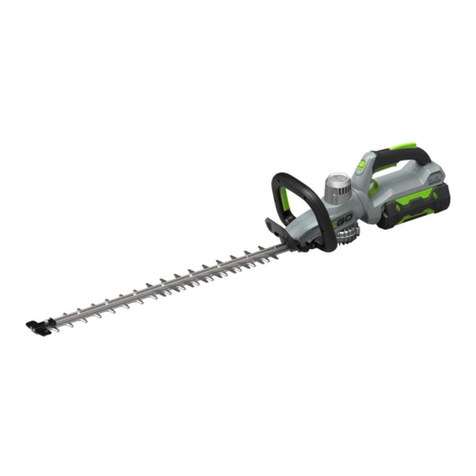
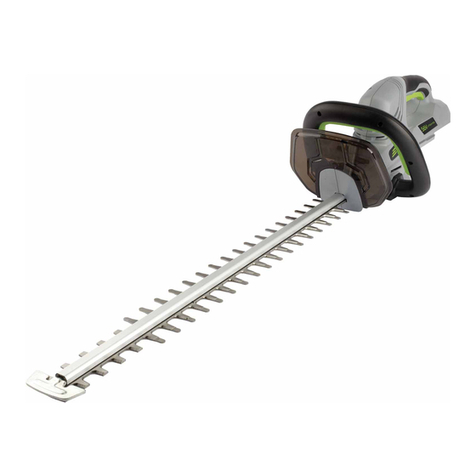
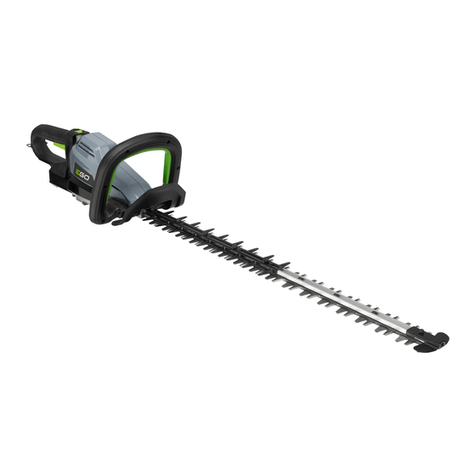
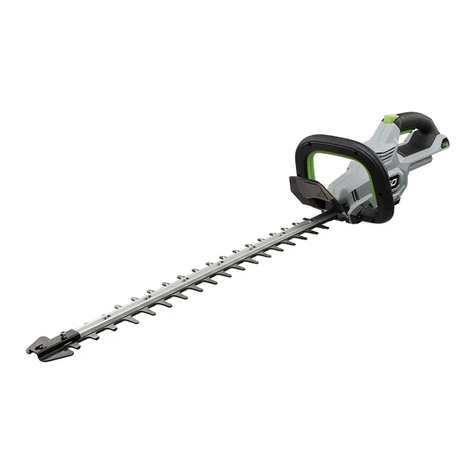
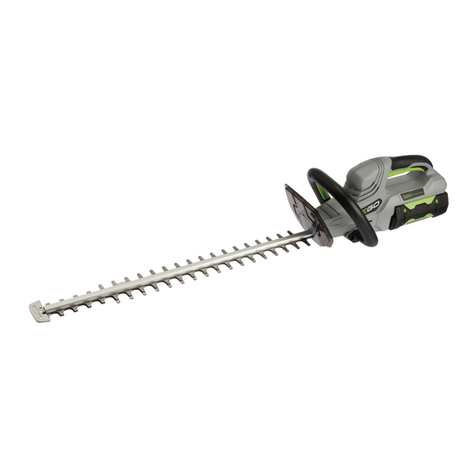
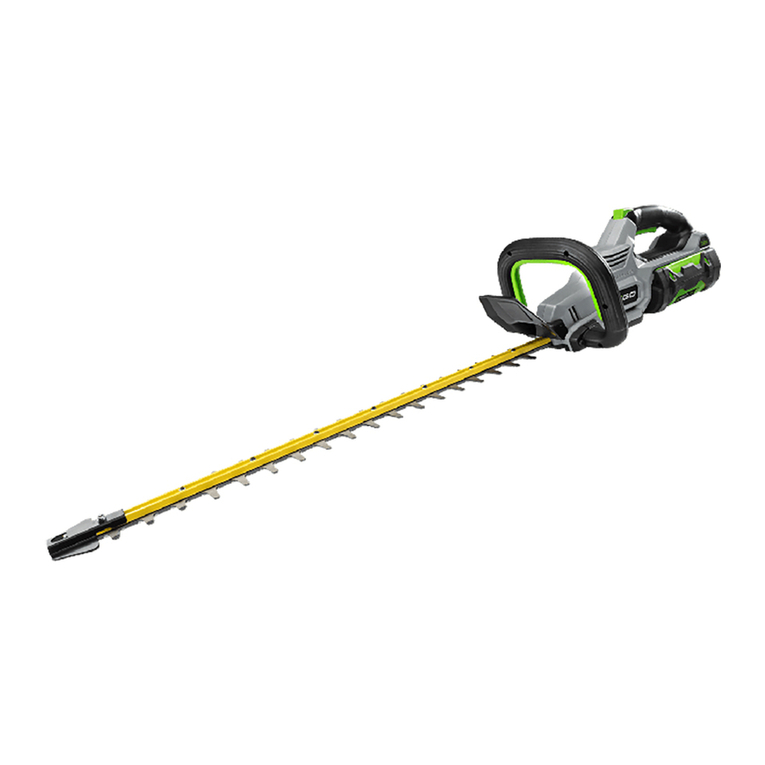
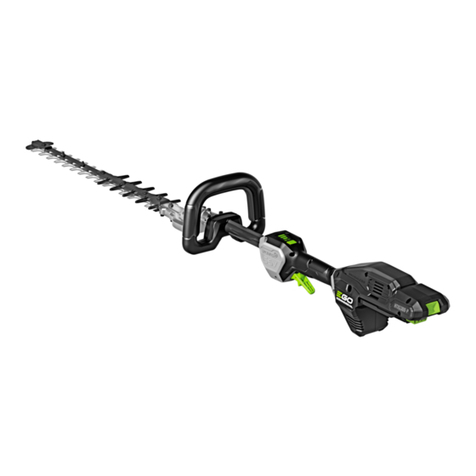
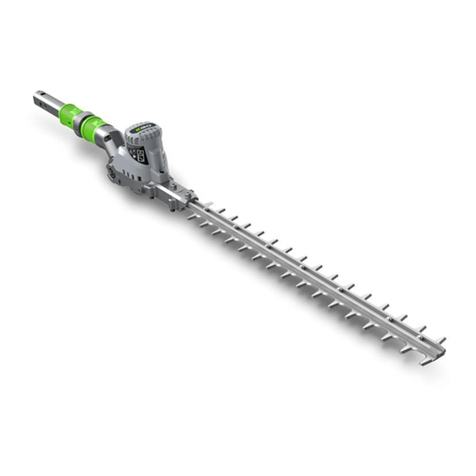
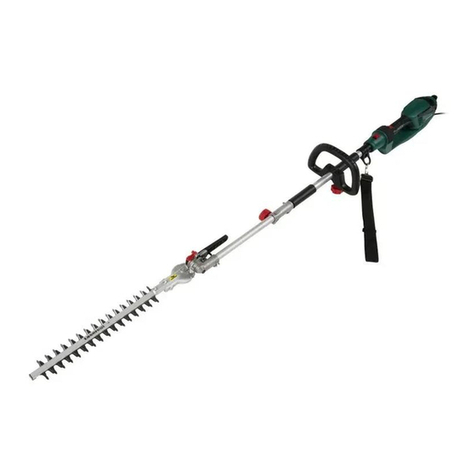
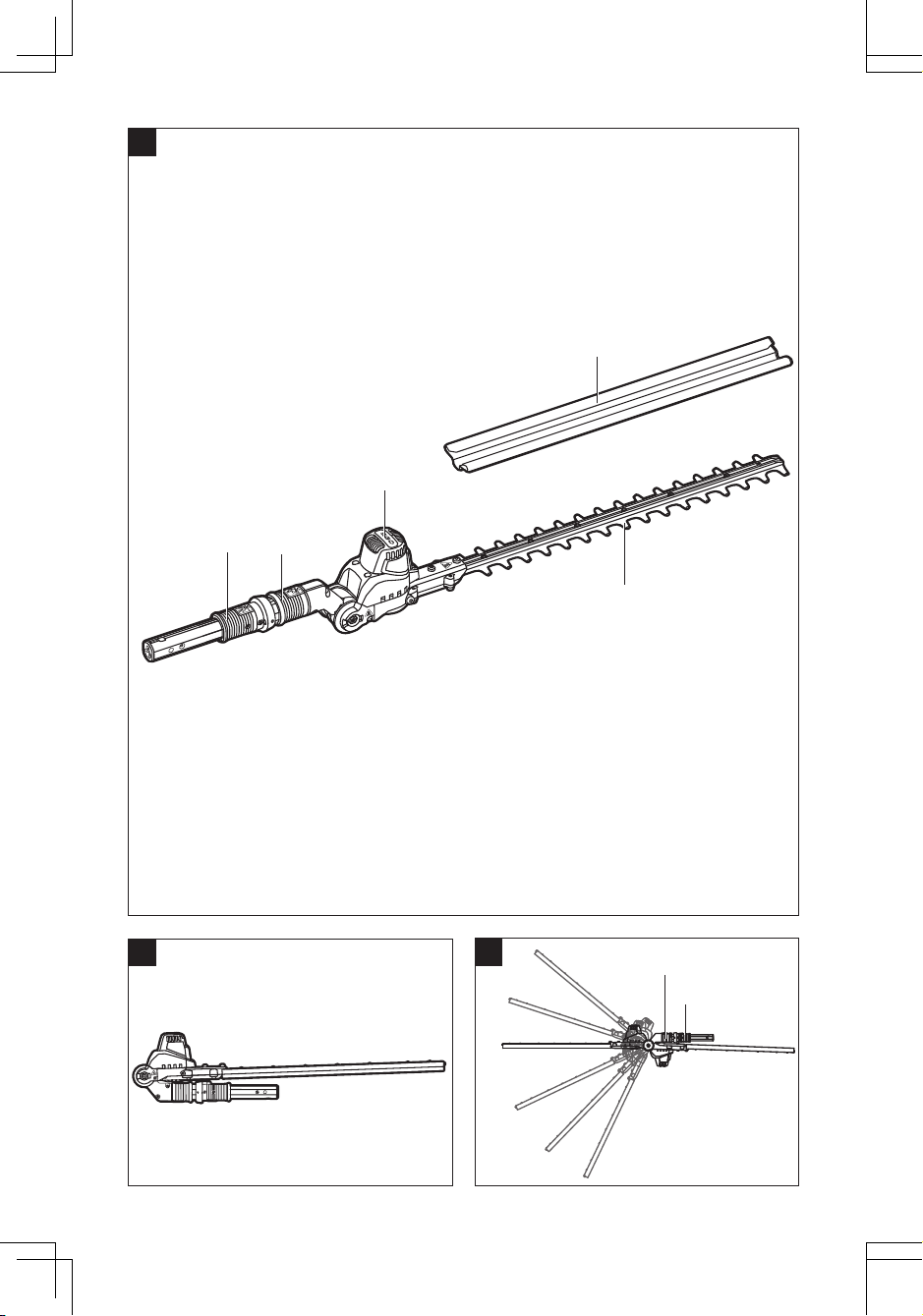
56-VOLT LITHIUM-ION HEDGE TRIMMER ATTACHMENT — PTX51008
USING THE HEDGE TRIMMER WITH TELESCOPIC
POWER POLE
WARNING: Dress properly to reduce the risk of
injury when operating this tool. Do not wear loose clothing
or jewelry. Wear eye and ear/hearing protection. Wear
heavy, long pants, boots, and gloves. Do not wear short
pants or sandals or go barefoot.
PREPARATION FOR CUTTING:
1. Adjust the cutting head to the desired working
position.
2. Remove the blade sheath from the cutting blade.
3. For safe and better operation, put on the shoulder
strap across the shoulder. Adjust the shoulder strap
into a comfortable operating position. Following
the instructions in the section “MOUNTING THE
SHOULDER STRAP” in PPX1000 operator’s manual
to attach the shoulder strap onto the power pole.
WARNING: The shoulder strap is also a quick
release mechanism in hazardous situation. When an
emergency occurs, take it off your shoulder immediately,
no matter what way the strap is in.
WARNING: Always use two hands when operating
the extended-reach hedge trimmer. Hold the extended-
reach hedge trimmer with both hands to avoid loss
of control. Following the instructions in the section
“HOLDING THE TELESCOPIC POWER POLE” in PPX1000
operator’s manual
WORKING TECHNIQUES
◾Horizontal Cutting (with cutting head at an angle)
Cut close to the ground from a standing position, e.g.
for trimming low shrubs. Swing the cutting head right
and left as you move along the hedge-use both sides
of the blades and do not rest the cutter blade on the
ground (Fig. H).
◾Horizontal Cutting (with straight cutting head)
Hold the cutting head at an angle of 0°as you slowly
swing the hedge trimmer horizontally. Swing the
cutting head in an arc towards the outsides of the
hedge so that the cuttings are swept to the ground
(Fig. I).
Recommendation: Cut hedges that are no more
than chest height in this working position.
◾Vertical Cutting (cutting head at an angle)
Cutting without standing directly next to the hedge, e.g.
flowerbed between operator and hedge.
In this cutting position, for your better control of the
hedge trimmer, it is recommended that connect the
hedge trimmer with the cutting head at the side cutting
position.
Swing the cutting head up and down in an arc as you
move along the hedge – use both sides of the cutting
blade (Fig. J).
◾Vertical Cutting (with straight cutting head)
Extra long reach without the need for other aids. Swing
the cutting head up and down in an arc as you move
along the hedge – use both sides of the cutting blade
(Fig. k).
◾Overhead Cutting (with cutting head at an angle)
Hold the hedge trimmer vertically and swing it in an
arc to make maximum use of its reach (Fig. L1&L2).
For extreme high hedge, the extension pole is suitable
for aids in trimming.
WARNING: Any working position above head height
is tiring. To minimize the risk of accidents, work in such
positions for short periods only. Set angle of adjustable
cutting head to maximum so that the tool can be held in a
lower, less tiring position (with shoulder strap) while still
providing adequate reach.
TO START/STOP THE TOOL
See “STARTING/STOPPING THE TELESCOPIC POWER
POLE” section in the power pole PPX1000 operator’s
manual.
MAINTENANCE
WARNING: When servicing, use only identical
replacement parts. Inspect and maintain the machine
regularly. To ensure safety and reliability, all repairs should
be performed by a qualified service technician.
WARNING: Before inspecting, cleaning or servicing
the unit, stop the motor, wait for all moving parts to stop,
and remove the battery pack. Failure to follow these
instructions can result in serious personal injury or
property damage.
NOTICE: Before each use, inspect the entire product
for damaged, missing, or loose parts such as screws,
nuts, bolts, caps, etc. Tighten securely all fasteners and
caps and do not operate this product until all missing or
damaged parts are replaced. Please contact customer
service or a qualified service technician.
GENERAL MAINTENANCE
Avoid using solvents when cleaning plastic parts. Most
plastics are susceptible to damage from various types of
commercial solvents and may be damaged by their use.
Use clean cloths to remove dirt, dust, oil, grease, etc.