FIXING THE APPLIANCE
Remove any protective film coatings from the finished/decora-
tive surfaces of the appliance. After having selected the final
mounting position of the appliance, taking into account the
requirements as specified in sections 3 and 4 of these instruc-
tions, the integrity of
the wall, and the feasi-
bility of the proposed
supply pipe routing,
the firebox of the appli-
ance may be secured to
the wall. To ensure
customer safety, be
sure to design the
installation so that the
strength of both the
wall and any wall fix-
ings used are sufficient. Focal Point Fires plc. assumes
absolutely no responsibility for injuries and/or damages that
may occur due to improper installation or handling. The appli-
ance should not be
installed until all wet plastering and/or dry wall sanding and wall
painting has been completed. Do not block the ventilation holes of
the appliance. The wall onto which the appliance is installed must
be flat. Install only on a vertical surface. Avoid sloped surfaces.
Installation onto anything other than a vertical wall may result in
fire, damage or injury. If the appliance is to be mounted on the inner
leaf of a conventional cavity brick wall,
or a solid wall, then the wall plugs and
fixing screws provided may be used.
Depending on the condition of the wall it may be necessary to use additional
fixings. In this situation, any additional fixings and wallplugs should be of the
same size and type as the ones provided. At the appropriate stage of the
installation, drill four holes using only a 8mm masonry bit to a depth of
42mm. Insert the wallplugs provided ensuring they are flush to the wall.
If the appliance is to be mounted on a dry lined wall or a timber framed construction wall then efforts
should be made to fix in at least two positions vertically, into one of the wooden studs, or supporting wood-
en members of the wall using two of the fixing screws provided. If this is not achievable then the wall should
be strengthened using appropriate building materials.
If there is no alternative than to rely on some plasterboard fix-
ings then special cavity screw fixings or hollow wall anchors
will be required which are not supplied with this product. These
should be constructed from metal and not plastic and of the
design shown in figure 4. For further guidance for wall fixing in
timber framed buildings refer to any relevant local codes of
practice.
Flat Wall Fixing - All Models
To assist with fixing the appliance, a template is provided as
shown in figure 3. Mark the positions shown as “Fixing points”
on the wall. If a concealed gas connection is to be made ensure
the gas supply pipe is in its final position and can enter the
appliance in the correct position when the appliance is hung on
the wall.
Drill the wall as appropriate for the type of wall as previously described in this section, and insert the cho-
sen type of wall fixings. Insert the wall fixing screws into the top wall plugs, taking care to leave the screws
protruding approximately 5mm from the wall.
Now hang the appliance onto these screws through the two keyhole shaped holes in the upper brackets on
the back panel of the appliance. Insert the lower fixing screws into the lower wall plugs through the corre-
sponding fixing holes in the lower part of the back panel.
Do not tighten fully. Before tightening the wall mounting screws fully, at this stage it is recommended to
check the horizontal alignment of the appliance with a spirit level, as small adjustments can still be made
if necessary. When this has been checked, tighten all four fixing screws fully.
To access the upper fixing screws insert a screwdriver through the round access holes in the front face of
the outlet grille (as shown in figure 5). These access holes are located in the same position on all models.
CHECKING THE BURNER
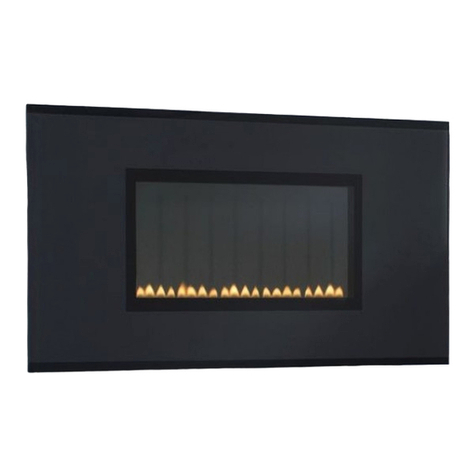
There are no imitation fuel bed components to install. The appliance features a ribbon burner which is
designed to produce a continuous band of flame over it’s length.
The burner should be visually inspected to ensure it is free from any foreign matter.
If it is necessary to clean or dust off the burner then the glass door should be removed by removal of the
four retaining screws. Re-fit the glass door after cleaning or inspection, ensuring a good seal.
5
7.0
7.1
The wall where the appliance is
to be installed must be capable
of long-term support of the total
load of the appliance. Measures
should also be taken to ensure
sufficient strength to withstand
the force of earthquakes, vibra-
tion and other external forces.
WARNING
Plasterboard alone is not consid-
ered to be a structural material.
It is not recommended to rely on
plasterboard fixings alone to
support the weight of the appli-
ance.
WARNING
©2011 Focal Point Fires plc.
Figure 4
Figure 5
Figure 3