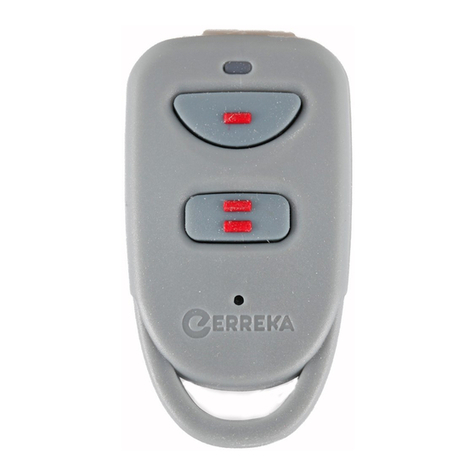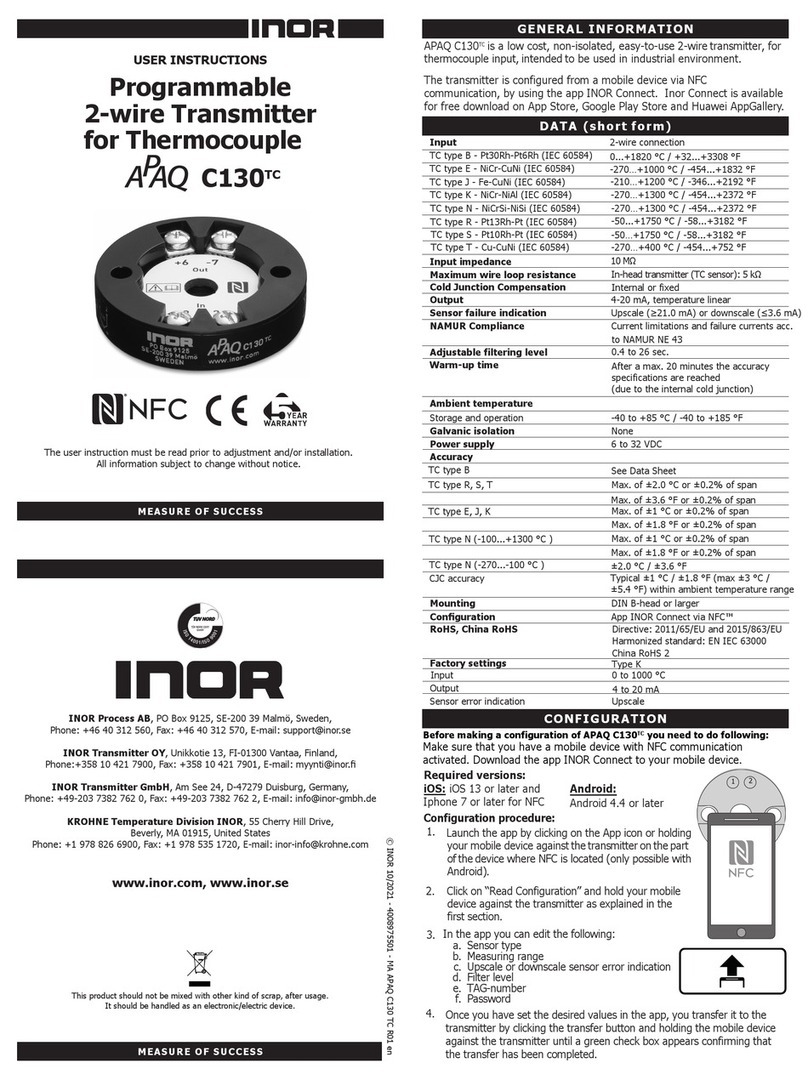
Este emissor está previsto para ser utilizado em portas de garagem com
funcionamento não contínuo. Pode ser utilizado sem restrições em todos os
estados da União Europeia.
Utilize este emissor apenas conforme é descrito nestas instruções e não realize
modicações ou manipulações que não estejam consideradas nestas
instruções.
Características
• Classe: código xo (trinário)
• Temperatura de funcionamento (ºC): -20 / +55
• Alimentação: 1 pilha de 12 V do tipo 23A
• Frequência: 433,92MHz (LU02, LU03); 315MHz (LU02/315, LU03/315)
• Número de canais: 2 (LU02, LU02/315) ou 3 (LU03, LU03/315)
I: canal 1, II : canal 2, III : canal 3
• Potência de emissão: <10 mW
Ligação da pilha
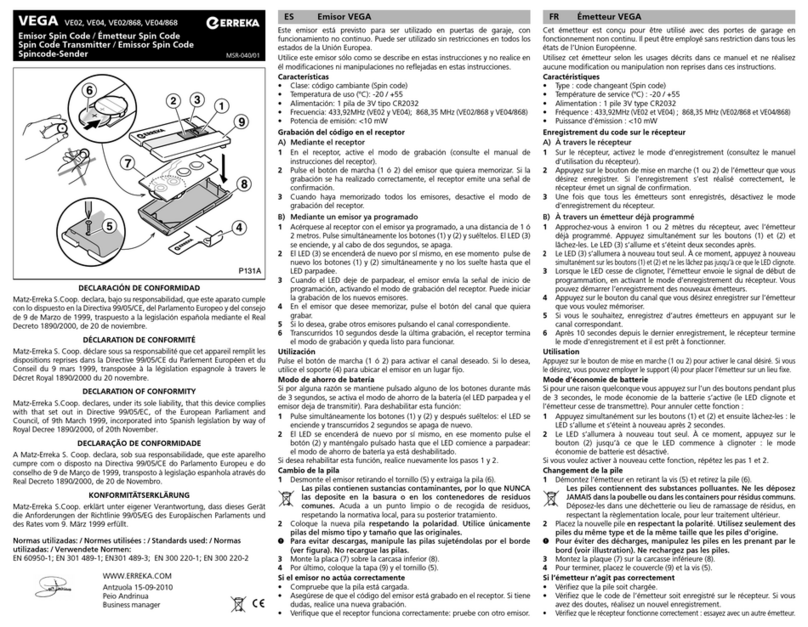
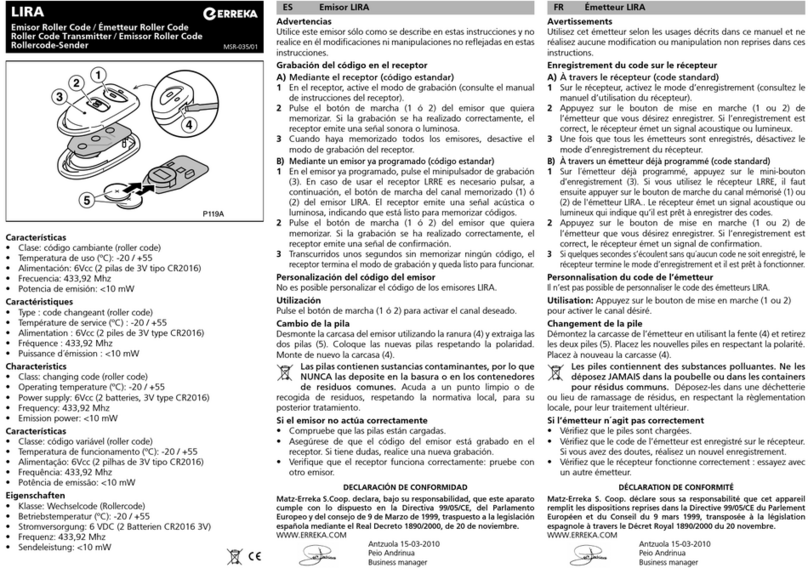
Abra a tampa (1) e retire a lâmina isolante (2).
Gravação do código no receptor
1Seleccione o código, colocando os DIPs (3) na posição pretendida. Cada
DIP tem três posições possíveis (código trinário).
2No receptor, active o modo de gravação (consulte o manual de instruções
do receptor).
3Prima o botão de funcionamento do emissor que pretende memorizar, até
que o receptor indique que memorizou o código (geralmente o LED RUN/
OK ilumina-se de forma intermitente; consulte o manual do receptor para
obter mais detalhes).
4Depois de memorizar o código desactive o modo de gravação do receptor.
Utilização
Prima o botão de funcionamento para activar o canal pretendido.
I: canal 1, II : canal 2, III : canal 3
Troca da pilha
1Retire a tampa (1) e depois a pilha (4).
Como as pilhas contêm substâncias poluentes, NUNCA as deposite
no lixo ou nos contentores de resíduos comuns. Recorra a um
centro de limpeza e de recolha de resíduos para o seu posterior
tratamento, respeitando as regulamentações locais.
2Coloque a pilha nova respeitando a polaridade. Utilize apenas pilhas
do mesmo tipo e tamanho das originais.
OPara evitar descargas, manipule as pilhas prendendo-as sem tocar
nos pólos (ver gura). Não recarregue as pilhas.
3Coloque novamente a tampa (1).
Se o emissor não funciona correctamente
• Verique se a pilha está carregada. Para o fazer, pressione qualquer botão
do emissor: se o LED (5) não se acender, a pilha está descarregada; se se
acender com pouca intensidade, a pilha tem pouca carga; se se acender
com intensidade normal, a pilha está completamente carregada.
• Verique se o receptor funciona correctamente: verique isto com outro
emissor.
• Grave novamente o código do emissor para assegurar-se de que está
correctamente gravado.
DECLARAÇÃO DE CONFORMIDADE
Sob sua responsabilidade, a Matz-Erreka S.Coop. declara que este aparelho
cumpre as disposições da Directiva 99/05/CE, do Parlamento Europeu e do
Conselho de 9 de Março de 1999, transpostas para a legislação espanhola
através do Real Decreto 1890/2000, de 20 de Novembro.
PT Emissor LUNA
Dieser Sender ist für die Verwendung mit Garagentoren mit Intervallbetrieb
vorgesehen. Er kann ohne Beschränkungen in allen Ländern der Europäischen
Union verwendet werden.
Verwenden Sie diesen Sender nur gemäß dieser Anleitung und führen Sie keine
Veränderungen oder Eingriffe durch, die nicht in dieser Anleitung erwähnt sind.
Eigenschaften
• Klasse: Festcode (trinär)
• Betriebstemperatur (ºC): -20 / +55
• Stromversorgung: 1 12V-Batterie Typ 23A
• Frequenz: 433,92MHz (LU02, LU03); 315MHz (LU02/315, LU03/315)
• Anzahl der Kanäle: 2 (LU02, LU02/315) bzw. 3 (LU03, LU03/315)
I: Kanal 1, II : Kanal 2, III : Kanal 3
• Sendeleistung: <10 mW
Batterieanschluss
Abdeckung (1) öffnen und Isolierstreifen (2) entfernen.
Speichern des Codes im Empfänger
1Den Code wählen, indem die DIPs (3) auf die gewünschte Position gestellt
werden. Jeder DIP hat drei mögliche Positionen (Trinärcode).
2Aktivieren Sie den Speichermodus des Empfängers (siehe
Gebrauchsanleitung Empfänger).
3Drücken Sie die Starttaste des Senders, der gespeichert werden soll, bis der
Empfänger anzeigt, dass der Code gespeichert worden ist (im Allgemeinen
leuchtet die LED RUN/OK blinkend auf; für weitere Einzelheiten siehe die
Anleitung des Empfängers).
4Nach dem Speichern des Codes deaktivieren Sie den Speichermodus des
Empfängers.
Verwendung
Drücken Sie die Starttaste, um den gewünschten Kanal zu aktivieren.
I: Kanal 1, II : Kanal 2, III : Kanal 3
Batteriewechsel
1Nehmen Sie die Abdeckung (1) ab und entnehmen Sie die Batterie (4).
Die Batterien enthalten giftige Stoffe, deshalb dürfen Sie NIEMALS
in den Hausmüll oder andere normale Abfallbehälter geworfen
werden. Geben Sie sie bitte in die speziall dafür vorgesehenen Behälter.
2Setzen Sie die neue Batterie unter Berücksichtigung der Polarität ein.
Verwenden Sie ausschließlich Batterien des gleichen Typs und der
gleichen Größe wie die Originalbatterien.
OUm Stromschläge zu vermeiden, fassen Sie die Batterien bitte so an,
dass die Pole nicht berührt werden (siehe Abbildung). Laden Sie die
Batterien nicht wieder auf.
3Setzen Sie die Abdeckung (1) wieder auf.
Wenn der Sender nicht ordnungsgemäß funktioniert
• Prüfen Sie, ob die Batterie geladen ist. Drücken Sie hierfür eine beliebige
Taste des Senders: leuchtet die LED (5) nicht auf, ist die Batterien entladen;
leuchtet die LED nur schwach auf, ist die Ladung der Batterie schwach;
leuchtet die LED normal auf, ist die Batterie korrekt geladen.
• Prüfen Sie, ob der Empfänger ordnungsgemäß funktioniert: Versuchen Sie
es mit einem anderen Sender.
• Speichern Sie den Code des Senders erneut, um sicherzustellen, dass er
korrekt gespeichert ist.
KONFORMITÄTSERKLÄRUNG
Matz-Erreka S.Coop. erklärt unter eigener Verantwortung, dass dieses Gerät
die Anforderungen der Richtlinie 99/05/EG des Europäischen Parlaments und
des Rates vom 9. März 1999 erfüllt.
DE Sender LUNA
This transmitter is designed for use in garage doors with non-continuous
operation. It can be used without restriction in all European Union Member
States.
Use this transmitter only as described in these instructions, and do not modify
or manipulate in any way unless indicated.
Features
• Class: xed code (Trinary)
• Operating temperature (ºC): -20 / +55
• Power supply: 1 12V battery, type 23A
• Frequency: 433,92MHz (LU02, LU03); 315MHz (LU02/315, LU03/315)
• Number of channels: 2 (LU02, LU02/315) or 3 (LU03, LU03/315)
I: channel 1, II : channel 2, III : channel 3
• Transmission power: <10 mW
Battery connection
Open the cover (1) and remove the isolating strip (2).
Programming the code in the receiver
1Select the code, placing the DIPs (3) in the required position. Each DIP has
three possible positions (trinary code).
2Enable programming mode in the receiver (see the receiver instructions
manual).
3Press the start button for the transmitter to be memorised, until the
receiver indicates that it has memorised the code (the RUN/OK LED usually
ashes; check the receiver manual for further details).
4After memorising the code, disable receiver programming mode.
Use
Press the start button to enable the required channel.
I: channel 1, II : channel 2, III : channel 3
Changing the battery
1Remove the cover (1) and extract the battery (4).
The batteries contain contaminating substances and must NEVER
be discarded along with common waste. Batteries must be taken to
a suitable collection facility, in line with local regulations, for subsequent
treatment.
2Position the new battery, respecting the polarity. Only use batteries of
the same type and size as the originals.
OIn order to avoid electrical shocks, handle the batteries without
touching the poles (see gure). Do not recharge the batteries.
3Return the cover (1).
If the transmitter does not work correctly
• Check that the battery is charged. This can be done by pressing any
transmitter button: if the LED (5) does not light up, the battery is at; if it is
dim, the battery is nearly at; if it has normal intensity, the battery is
correctly charged.
• Check that the receiver works correctly: check using another transmitter.
• Programme the transmitter code again, in order to ensure it is correctly
programmed.
DECLARATION OF CONFORMITY
Matz-Erreka S.Coop. declares, under its sole liability, that this device complies
with that set out in Directive 99/05/EC, of the European Parliament and Coun-
cil, of 9th March 1999, incorporated into Spanish legislation by way of Royal
Decree 1890/2000, of 20th November.
EN LUNA Transmitter