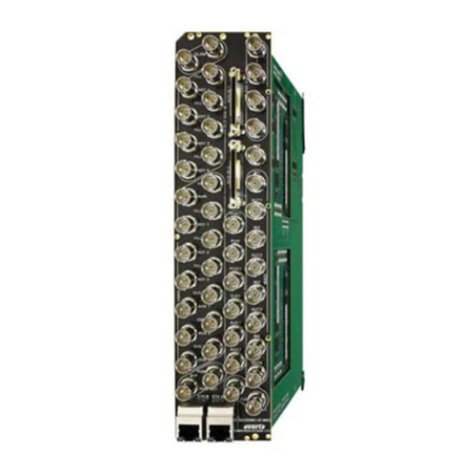
evertz 7707BPX User manual

7700 MultiFrame Manual
7707BPX Optical Bypass Protection Switch
Revision 1.6
TABLE OF CONTENTS
1. OVERVIEW.......................................................................................................................................... 1
1.1. TYPICAL CONFIGURATIONS................................................................................................... 2
1.1.1. Uni-Directional Bypass Switch ........................................................................................ 2
1.1.2. Bi-Direction Bypass Switch ............................................................................................. 2
1.1.2.1. Bi-Directional Setup Procedure .................................................................................. 3
2. INSTALLATION................................................................................................................................... 5
2.1. GPIO I/O.................................................................................................................................... 6
2.2. CARE AND HANDLING OF OPTICAL FIBER ........................................................................... 7
2.2.1. Safety.............................................................................................................................. 7
2.2.2. Handling And Connecting Fibers .................................................................................... 7
3. SPECIFICATIONS............................................................................................................................... 8
3.1. OPTICAL INPUT/OUTPUT......................................................................................................... 8
3.2. GENERAL PURPOSE INPUTS.................................................................................................. 8
3.3. GENERAL PURPOSE OUTPUTS.............................................................................................. 8
3.4. ELECTRICAL............................................................................................................................. 8
3.5. PHYSICAL.................................................................................................................................. 8
4. STATUS INDICATORS AND DISPLAYS ........................................................................................... 9
4.1. STATUS INDICATOR LEDS ...................................................................................................... 9
4.2. DOT-MATRIX DISPLAY........................................................................................................... 10
4.2.1. Displaying the Optical Power of Input A and Input B..................................................... 10
4.2.2. Displaying the GPI1 and GPI2 State............................................................................. 10
4.2.3. Displaying the GPO State ............................................................................................. 11
4.2.4. Displaying the Active Channel....................................................................................... 11
4.2.5. Setting the Optical Power Threshold for Auto Mode Switching..................................... 11
4.2.6. Changing the Orientation of the Text on the Display..................................................... 11
4.2.7. Selecting the Channel (Remote Mode Only)................................................................. 11
5. DIP SWITCHES................................................................................................................................. 13
5.1. CONTROLLING THE OPTICAL SWITCH OPERATING MODE .............................................. 13
5.2. CONTROLLING WHETHER GPIS ACTIVATE WHEN HIGH OR LOW ................................... 14
6. JUMPERS.......................................................................................................................................... 15
6.1. SELECTING WHETHER LOCAL FAULTS WILL BE MONITORED BY THE GLOBAL
FRAME STATUS...................................................................................................................... 15
6.2. SELECTING WHETHER MODULE WILL BE CONTROLLED FROM THE LOCAL
CONTROLS OR THROUGH THE VISTALINK®INTERFACE................................................... 15
6.3. CONFIGURING THE MODULE FOR FIRMWARE UPGRADES.............................................. 16

7700 MultiFrame Manual
7707BPX Optical Bypass Protection Switch
Revision 1.6
6.4. SELECTING THE GPI PULLUP VOLTAGE............................................................................. 16
7. VISTALINK®REMOTE MONITORING/CONTROL........................................................................... 17
7.1. WHAT IS VISTALINK®?............................................................................................................... 17
7.2. VISTALINK®MONITORED PARAMETERS.............................................................................. 18
7.3. VISTALINK®CONTROLLED PARAMETERS........................................................................... 18
7.4. VISTALINK®TRAPS.................................................................................................................. 19
Figures
Figure 1-1: 7707BPX Block Diagram....................................................................................................................1
Figure 1-2: Uni-Directional Configuration..............................................................................................................2
Figure 1-3: Bi-Directional Configuration................................................................................................................2
Figure 1-4: Bi-Directional Setup Step 1.................................................................................................................3
Figure 1-5: Bi-Directional Setup Step 2.................................................................................................................4
Figure 2-1: 7707BPX Rear Panel..........................................................................................................................5
Figure 2-2: GPI Input Circuitry ..............................................................................................................................6
Figure 2-3: GPO Configuration .............................................................................................................................6
Figure 6-1: Location of Jumpers – Main Module.................................................................................................15
Figure 6-2: GPI Input Circuitry ............................................................................................................................16
Tables
Table 5-1: DIP Switch Functions.........................................................................................................................13
Table 5-2: Operating Mode Switch Settings .......................................................................................................13
Table 5-3: GPI Settings.......................................................................................................................................14
Table 7-1: VistaLINK®Monitored Parameters.....................................................................................................18
Table 7-2: VistaLINK®Controlled Parameters....................................................................................................18
Table 7-3: VistaLINK®Traps...............................................................................................................................19

7700 MultiFrame Manual
7707BPX Optical Bypass Protection Switch
Revision 1.6
REVISION HISTORY
REVISION DESCRIPTION DATE
1.0 First Version Aug 02
1.1 Revised functions of DIP switch Nov 02
1.2 Added 8 new CWDM wavelengths Dec 02
1.3 Added Channel B Threshold Setting May 03
1.4 Revised sections 4.2, 7.2 and 7.3 according to firmware change Feb 04
1.5 Fixed format and updated VistaLINK®description Nov 08
1.6 Added table format throughout section 4.2 Apr 09
Information contained in this manual is believed to be accurate and reliable. However, Evertz assumes no responsibility for the use thereof nor for
the rights of third parties, which may be affected in any way by the use thereof. Any representations in this document concerning performance of
Evertz products are for informational use only and are not warranties of future performance, either expressed or implied. The only warranty offered
by Evertz in relation to this product is the Evertz standard limited warranty, stated in the sales contract or order confirmation form.
Although every attempt has been made to accurately describe the features, installation and operation of this product in this manual, no warranty is
granted nor liability assumed in relation to any errors or omissions unless specifically undertaken in the Evertz sales contract or order confirmation.
Information contained in this manual is periodically updated and changes will be incorporated into subsequent editions. If you encounter an error,
please notify Evertz Customer Service department. Evertz reserves the right, without notice or liability, to make changes in equipment design or
specifications.

7700 MultiFrame Manual
7707BPX Optical Bypass Protection Switch
Revision 1.6
This page left intentionally blank

7700 MultiFrame Manual
7707BPX Optical Bypass Protection Switch
Revision 1.6 Page-1
1. OVERVIEW
The 7707BPX is a wide band 2 x 1 optical switch that can also be used as an auto-changeover by
detecting a change in the input power level. Manual control or automation control via the GPI port is also
provided.
The 7707BPX has integrated VistaLINK®technology for remote control and monitoring capability via
SNMP. This provides the user with the ability to locally or remotely configure and monitor parameters
such as module status, selected input, power level and switching threshold.
In the auto-changeover application, the 7707BPX can be configured to have a Main input and a Standby
input. In this configuration, it will automatically switch to the Standby input when the Main input power is
weak or lost. It can also be set to auto-switch back to the Main source when this signal is re-established.
The 7707BPX occupies one card slot and can be housed in either a 1RU frame, which will hold up to three
modules, or a 3 RU frame, which will hold up to 15 modules.
Features:
•Intelligent auto-switching with input power detection and user definable threshold
•Supports manual or automation control via GPI interface
•Comprehensive signal and status monitoring via four-digit card-edge display, or through SNMP
and VistaLINK®enabled capability
•Fully hot swappable from front of frame with no fiber disconnect/reconnect required
•Accepts any wavelength in the 1270nm to 1610nm range
•Supports Single mode (8-10 µm) fiber optic cable
•SC/PC, ST/PC or FC/PC fiber connector options
Vista
LINK®
Interface
Power
Monitor
Passive
Splitter
Fiber
Input A
Passive
Splitter
Fiber
Input B
Ch A
OK
Ch B
Ok
Fiber
Switch
Power
Monitor
Controller
Module
Status
Fiber
Output
Power
Level
Display
GPI
Input &
Outputs
Figure 1-1: 7707BPX Block Diagram

7700 MultiFrame Manual
7707BPX Optical Bypass Protection Switch
Page-2 Revision 1.6
1.1. TYPICAL CONFIGURATIONS
1.1.1. Uni-Directional Bypass Switch
Optical
Transmitter
50%
50%
7705 DS
7707BPX Optical
Receiver
Figure 1-2: Uni-Directional Configuration
Provides system protection against fiber breaks. 7707BPX settings can be set to any configuration
1.1.2. Bi-Direction Bypass Switch
Optical
Transmitter/
Receiver 7707BPX Optical
Transmitter/
Receiver
50%
50%
7705 DS
Figure 1-3: Bi-Directional Configuration
For bi-directional use, the 7707BPX requires that the maximum allowable optical signal attenuation in the
fiber link is 12dB.

7700 MultiFrame Manual
7707BPX Optical Bypass Protection Switch
Revision 1.6 Page-3
1.1.2.1. Bi-Directional Setup Procedure
1) For the 7707BPX to properly function bi-directionally there must be less than 15dB of optical
attenuation in the fiber link. To measure the fiber link attenuation first measure the optical power
launched from both Channel A and Channel B of the 7705DS, these power values will subsequently be
referred to as the Remote Launch Powers. Next, measure the optical power before Channel A and
Channel B of the 7707BPX as shown in Figure 1-4. Verify the system complies with the following two
formula:
Remote Launch Optical Power Channel A-15 ≤Optical Power Meter Reading
Remote Launch Optical Power Channel B-15 ≤Optical Power Meter Reading
Optical
Transmitter/
Receiver 7707BPX Optical
Transmitter/
Receiver
50%
50%
7705 DS
Optical Power
Meter
Optical
Transmitter/
Receiver 7707BPX Optical
Transmitter/
Receiver
50%
50%
7705 DS
Optical Power
Meter
Figure 1-4: Bi-Directional Setup Step 1

7700 MultiFrame Manual
7707BPX Optical Bypass Protection Switch
Page-4 Revision 1.6
2) Back reflection is phenomena where by part of the optical power being transmitted is reflected back
when the signal encounters an interface of differing refractive indexes. The back reflection between
an optical Fiber and air is –15dB. To avoid Back reflection issues, measure the optical power being
transmitted from Channel A and Channel B of the 7707BPX as shown in Figure 1-5. Set the
7707BPX’s optical threshold to:
Optical Threshold A= Optical Power Meter Reading –12
Optical Threshold B= Optical Power Meter Reading –12
Optical
Transmitter/
Receiver 7707BPX Optical
Transmitter/
Receiver
50%
50%
7705 DS
Optical Power
Meter
Optical
Transmitter/
Receiver 7707BPX Optical
Transmitter/
Receiver
50%
50%
7705 DS
Optical Power
Meter
Figure 1-5: Bi-Directional Setup Step 2

7700 MultiFrame Manual
7707BPX Optical Bypass Protection Switch
Revision 1.6 Page-5
2. INSTALLATION
The 7707BPX comes with a companion rear plate that has three SC/PC (shown), ST/PC or FC/PC optical
connectors and a six pin terminal strip. For information on mounting the rear plate and inserting the
module into the frame see the 7700FR chapter section 3.
Figure 2-1: 7707BPX Rear Panel
INPUT A, B: The two SC/PC, (shown), ST/PC or FC/PC female connectors are wide range optical inputs
that accept wavelengths accommodating standard 1310nm, or 1270nm to 1610nm CWDM
transmission schemes. The A connector is for the Main input and the B connector is for the
Standby input.
OUTPUT: This SC/PC, (shown), ST/PC or FC/PC female connector is the output from the switch.

7700 MultiFrame Manual
7707BPX Optical Bypass Protection Switch
Page-6 Revision 1.6
2.1. GPIO I/O
A 6-pin High Density D connector labeled GPIO contains 2 GPI inputs and GPO relay contact output.
GPI’s: The two top pins on the 6 pin terminal strip are used for two General Purpose inputs (GPI). The
GPIs can be configured as active high or low by setting DIP switch 3. The GPI inputs are opto
isolated with a with an internal pullup resistor to +5V or +12V as shown in Figure 2-2. See
section 6.4 for information on selecting the pull-up voltage.
GPI
GND
GPI
Command
+ 12
VDC
to
internal
circuit
220 Ohm
+ 5
VDC
LO HI
Current
Limiter
Figure 2-2: GPI Input Circuitry
GPO: The NC, NO and COM pins on the 6 pin terminal strip are used for the General Purpose Output
(GPO). The GPO output is a set of normally open and normally closed relay contacts as
shown in Figure 2-3.
NO GPO Contact
GPO Common
from
internal
circuit
NC GPO Contact
Figure 2-3: GPO Configuration
Table of contents
Other evertz Switch manuals
evertz
evertz 7700 Series User manual
evertz
evertz 7700 Series User manual
evertz
evertz 7700 Series User manual
evertz
evertz 7700 Series User manual

evertz
evertz 7880GS-8 Series User manual
evertz
evertz 7700 Series User manual

evertz
evertz 7800R4x4-FR Series User manual
evertz
evertz 7703BPX-DC-RF User manual
evertz
evertz 7700 Series User manual

evertz
evertz 9625SW Series User manual