Standard Operating Procedure: Sampling Groundwater with the HydraSleeve (patents: 6,481,300; 6,837,120)
Copyright 2016 GeoInsight
Introduction
The HydraSleeve is classified as a no-purge (passive) grab sampling device, meaning that it is
used to collect groundwater samples directly from the screened interval of a well without having
to purge the well prior to sample collection. When it is used as described in this Standard
Operating Procedure (SOP), the HydraSleeve causes no drawdown in the well (until the sample
is withdrawn from the water column) and only minimal disturbance of the water column,
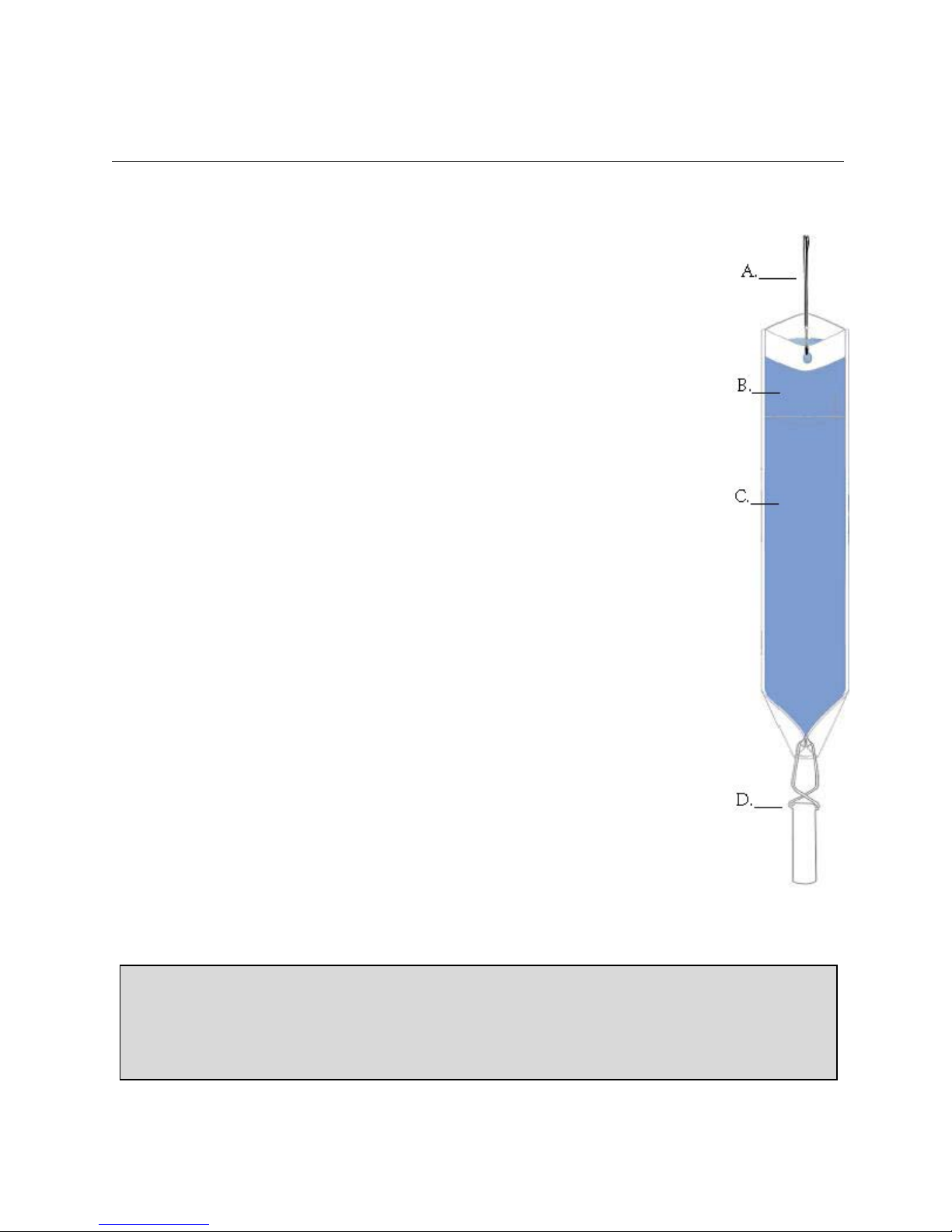
because it has a very thin cross section and it displaces very little water (<100 ml) during
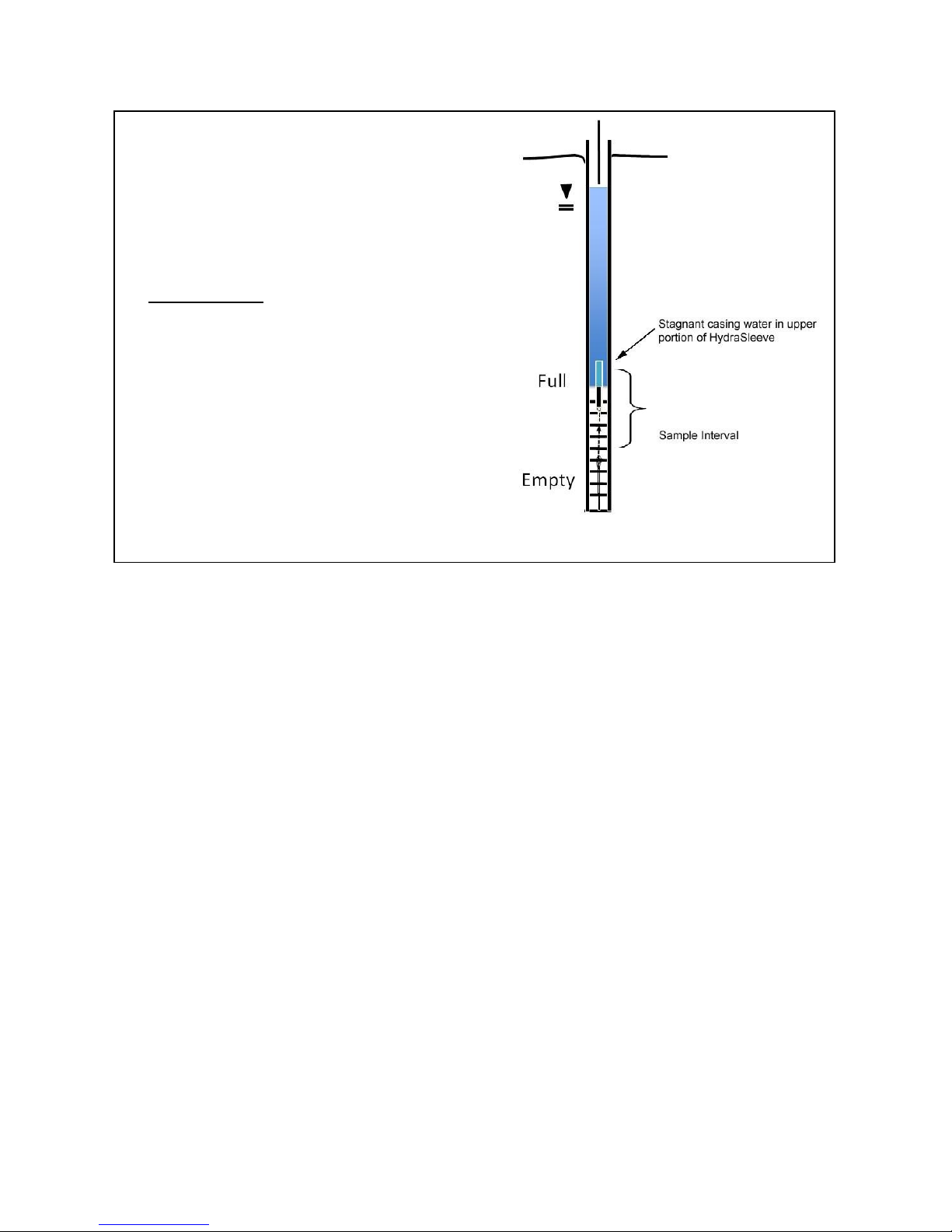
deployment in the well. The HydraSleeve collects a sample from within the screen only. It
excludes water from any other part of the water column in the well through the use of a self-
sealing check valve at the top of the sampler. It is a single-use (disposable) sampler that is not
intended for reuse, so there are no decontamination requirements for the sampler itself.
The use of no-purge sampling as a means of collecting representative groundwater samples
depends on the natural movement of groundwater (under ambient hydraulic head) from the
formation adjacent to the well screen through the screen. Robin and Gillham (1987)
demonstrated the existence of a dynamic equilibrium between the water in a formation and the
water in a well screen installed in that formation, which results in formation-quality water
being available in the well screen for sampling at all times. No-purge sampling devices like
the HydraSleeve collect this formation-quality water as the sample, under undisturbed (non-
pumping) natural flow conditions. Samples collected in this manner generally provide more
conservative (i.e., higher concentration) values than samples collected using well-volume
purging, and values equivalent to samples collected using low-flow purging and sampling
(Parsons, 2005).
Applications of the HydraSleeve
The HydraSleeve can be used to collect representative samples of groundwater for all analytes
(volatile organic compounds [VOCs], semi-volatile organic compounds [SVOCs], common
metals, trace metals, major cations and anions, dissolved gases, total dissolved solids,
radionuclides, pesticides, PCBs, explosive compounds, and all other analytical parameters).
Designs are available to collect samples from wells from 1” inside diameter and larger. The
HydraSleeve can collect samples from wells of any yield, but it is especially well-suited to
collecting samples from low-yield wells, where other sampling methods can’t be used reliably
because their use results in dewatering of the well screen and alteration of sample chemistry
(McAlary and Barker, 1987).
The HydraSleeve can collect samples from wells of any depth, and it can be used for single-
event sampling or long-term groundwater monitoring programs. Because of its thin cross
section and flexible construction, it can be used in narrow, constricted or damaged wells where
rigid sampling devices may not fit. Using multiple HydraSleeves deployed in series along a
single suspension line or tether, it is also possible to conduct in-well vertical profiling in wells
in which contaminant concentrations are thought to be stratified.