GENERAL INFORMATION OA-3
installed equipment on the vehicle. The Payload Rating is
reduced if any accessories or other equipment is added to
the vehicle after final date of manufacture. The weight of
these items should be determined and deducted from the
Payload Rating.
The vehicle may also have a G WR (Gross ombina
tion Weight Rating). The G W (Gross ombination
Weight) is the total weight of the loaded tow vehicle (includ
ing passengers) and a loaded trailer.
The tires on the vehicle must be the proper size and
properly inflated for the load which you are carrying. The
vehicle ertification Label shows the originally equipped
tire size and recommended inflation pressures. For more
information on tires, refer to WHEELS AND TIRES (Sec.
3E). MODEL REFERENCE
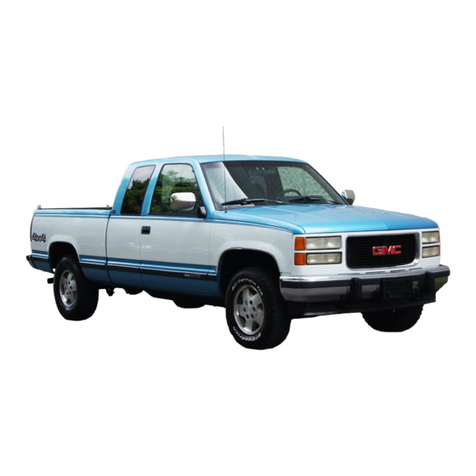
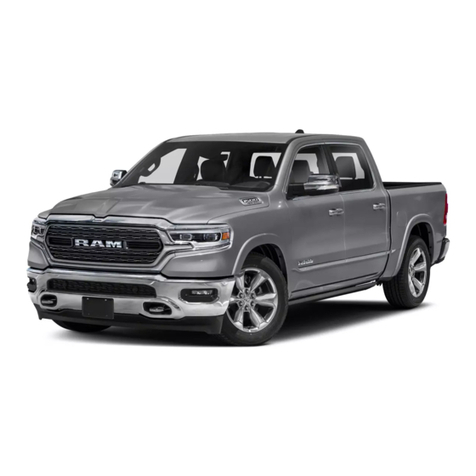
Refer to figures 5 and 6 to determine the vehicle model.
For R/V models, an “R” is a two-wheel drive vehicle and a
“V” is a four-wheel drive vehicle.
ENGINE IDENTIFICATION NUMBER
Refer to figure 7 to determine the location of the engine
I.D. number. Refer to figure 8 for engine, transmission, and
transfer case applications.
VEHICLE LIFTING PROCEDURES
CAUTION: To help avo d personal njury when a
veh cle s on a ho st,prov de add t onal support
for the veh cle at the oppos te end from wh ch
componets are be ng removed. Th s w ll reduce
the poss b l ty of the veh cle fall ng off the ho st.
For lifting a vehicle, various lift points are recommended.
Refer to figures 9 through 16.
When lifting the R vehicle with a hoist, the rear hoist
pads should be positioned under the rear spring front
hangers.
When lifting the V vehicle with a hoist, the front hoist
pads should be positioned under the frame, at the front
body mount. The rear hoist pads should be positioned
under the rear spring front hangers.
When lifting the front of the V vehicle with a floor jack,
position the jack pad at the center of the axle, not under the
front differential.
When lifting the P vehicle with a hoist, the rear hoist
pads should be positioned under the frame and inboard of
the rear spring front hangers.
When lifting the G vehicle with a hoist, the rear hoist
pads should be positioned under the rear spring forward
hangers.
Any time a vehicle is lifted with a vehicle jack or a floor
jack, the wheels at the opposite end of the lifted end should
be chocked. Also, jack stands should be used to provide
support. When supporting the vehicle with jack stands, the
jack stands should be placed under the frame, the front
suspension crossmember or the axle.
When removing major components of the vehicle while
the vehicle is on a hoist, the vehicle frame should be
chained to the hoist pads in order to prevent tip-off.
NOTICE: When jacking or lifting a vehicle, be
certain that the lift pads do not contact the cata
lytic converter, brake lines, brake cables, or fuel
lines. Such contact may result in damage or
unsatisfactory vehicle performance.
Pickup, Regular ab R-V MODELS hassis - ab, Bonus/ rew ab
Pickup, Bonus/ rew ab
hassis - ab, Regular ab
Surburban
L00301
Utility Vehicle
Jimmy (Blazer)
F gure 5 — R/V Models