English (GB)
9
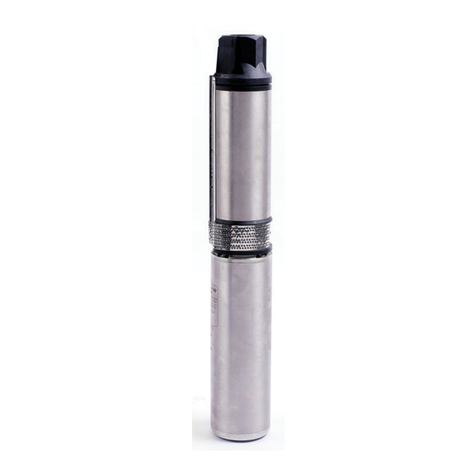
5.4 Submerged installation, portable
1. Fit the ring stand to the pump suction flange.
2. Fit a 90 ° elbow to the pump discharge port and connect the
discharge pipe/hose.
If a hose is used, make sure that the hose does not buckle
and that the inside diameter matches that of the discharge
port.
3. Lower the pump into the liquid by means of a chain secured to
the lifting bracket of the pump. It is recommended to place the
pump on a plane, solid foundation. Make sure that the pump is
hanging from the chain and not the cable.
4. Hang up the end of the chain on a suitable hook at the top of
the tank and in such a way that the chain cannot come into
contact with the pump housing.
5. Adjust the length of the motor cable by coiling it up on a relief
fitting to ensure that the cable is not damaged during
operation. Fasten the relief fitting to a suitable hook.
Make sure that the cables are not sharply bent or pinched.
6. Connect the motor cable and the control cable, if any.
5.5 Vertical installation in column pipe
1. Weld the ring supplied with the pump onto the lower opening
of the steel column pipe or concrete it into place at the lower
opening of the concrete column pipe.
2. Fasten a chain to the lifting bracket and uncoil the supply
cable.
3. Lower the pump into place in the column pipe. Make sure that
the O-ring seal is positioned correctly in the groove on the
outside of the pump housing. Three guide pins on the ring will
guide the pump into the right position and prevent it from
turning in the seat when running.
4. Hang up the end of the chain on a suitable hook at the top of
the tank and in such a way that the chain cannot come into
contact with the pump housing.
5. Adjust the length of the motor cable by coiling it up on a relief
fitting to ensure that the cable is not damaged during
operation. Fasten the relief fitting to a suitable hook.
Make sure that the cables are not sharply bent or pinched.
6. Connect the motor cable and the control cable, if any.
5.6 Pump controller
S pumps, range 50-70 can be connected to a separate Grundfos
pump controller for level control, which is available as an
accessory:
• type LC for one-pump installations
• type LCD for two-pump installations.
Depending on application, different types of level control
equipment can be used.
The LC controller is fitted with two or three level switches:
Two for start and stop of pump. The third level switch, which is
optional, is for high-level alarm.
The LCD controller is fitted with three or four level switches:
One for common stop and two for start of the pumps. The fourth
level switch, which is optional, is for high-level alarm.
When installing the level switches, the following points should be
observed:
1. To prevent air intake and vibrations in submerged pumps, the
stop level switch must be fitted in such a way that the pump is
stopped before the liquid level is lowered below the top of the
pump housing.
As a principal rule for pumps in dry installation, the lowest
stop level must be at least 20 cm above the opening of the
suction pipe. See fig. 10.
2. The start level switch should be installed in such a way that
the pump is started at the required level; however, the pump
must always be started before the liquid level reaches the
bottom inlet pipe to the tank.
3. The high-level alarm switch, if installed, should always be
installed about 10 cm above the start level switch; however,
alarm must always be given before the liquid level reaches the
inlet pipe to the tank.
5.7 Galvanic separation
Double-insulated sensors for all measurements of high voltages
ensure the electrical safety. Furthermore, there is a galvanic
separation inside the IO 113.
5.8 IO 113
The IO 113 forms interface between a Grundfos sewage and
wastewater pump with analogue and digital sensors and the
pump controller. The most important sensor data are indicated on
the front panel.
One pump can be connected to an IO 113 module.
Together with the sensors, the IO 113 forms a galvanic separation
between the motor voltage in the pump and the controller
connected.
5.8.1 Measurement of insulation resistance
The IO 113 measures the insulation resistance between a stator
winding and earth:
• Resistance above 10 MΩ= ok.
• Resistance between 10 MΩand 1 MΩ= warning.
• Resistance below 1 MΩ= alarm.
Warning
The pump controller must not be installed in
potentially explosive atmospheres.
Warning
Pumps installed in potentially explosive
atmosphere must always be filled with the
pumped liquid.
An additional level switch must be installed to
ensure that the pump is stopped in case the stop
level switch is not operating.