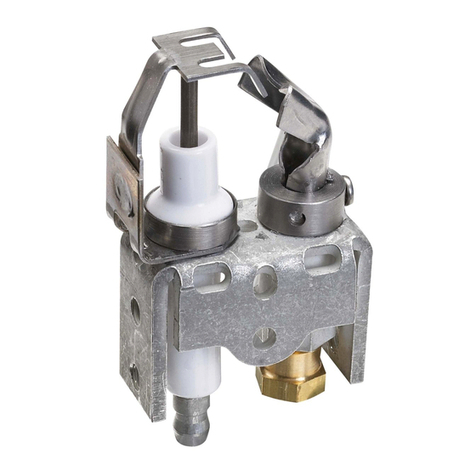
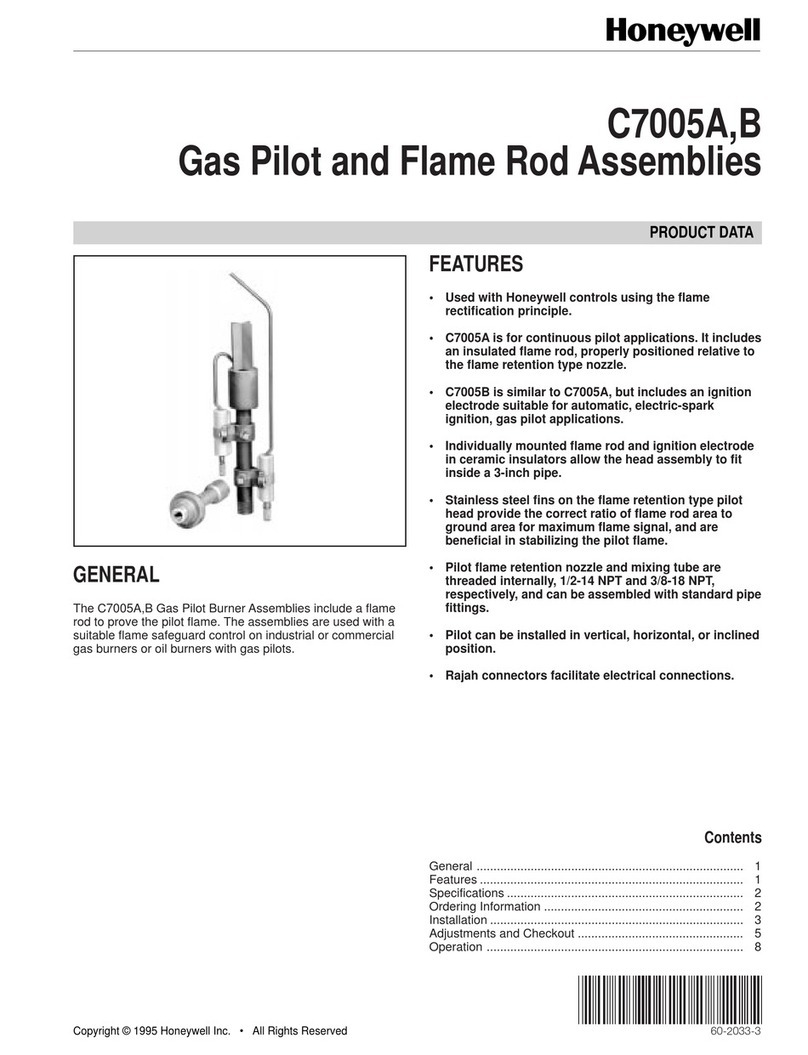
Q3450A,B,C,D,E,F,G AND Q3480B,C, SmartValve
™
SYSTEM PILOT BURNERS
68-0125—2 6
INSTALLATION
When Installing this Product…
쐃Read these instructions carefully. Failure to follow
instructions can damage product or cause a hazardous
condition.
쐇Check ratings given in instructions and on product to
make sure product is suitable for your application.
쐋Make sure installer is a trained, experienced service
technician.
쐏After completing installation, use these instructions to
check out product operation.
WARNING
FIRE OR EXPLOSION HAZARD CAN CAUSE
PROPERTY DAMAGE, SEVERE INJURY,
OR DEATH.
Follow these warnings exactly:
1. Disconnect power supply before wiring to prevent
electrical shock or equipment damage.
2. To avoid dangerous accumulation of fuel gas,
turn off gas supply at appliance service valve
before starting installation and perform Gas Leak
Test after completion of installation.
3. Do not bend pilot tubing at the control or pilot
after compression nut is tightened. Gas leakage
at the connection may result.
Follow appliance manufacturer instructions if available;
otherwise, use instructions provided below.
Location
쐃Position the pilot burner for easy access and
observation. In replacement applications, replace the
pilot burner with an identical unit and position the new
pilot burner in the same location and orientation as the
original pilot burner.
쐇Mount the pilot burner on the main burner. Mounting
surfaces other than the main burner can shift, bend, or
warp as the furnace expands and contracts while
operating. See Fig. 5.
PILOT BURNER MUST
BE RIGIDLY POSITIONED
RELATIVE TO MAIN BURNER M2688A
Fig. 5. Mount pilot burner on main burner.
쐋Mount the pilot burner so the pilot flame remains
properly positioned with respect to the main burner
flame. See Fig. 6.
쐏Supply pilot flame with ample air which is free of
combustion products.
쐄Do not impinge pilot flame on adjacent parts. Do not
impinge main burner flame on pilot burner.
쐂Do not expose the pilot flame to falling scale that could
impair the main burner ignition.
PILOT BURNER
JUST RIGHT
PILOT BURNER
TOO LOW
PILOT BURNER
TOO HIGH
MAIN BURNER
FLAME WILL
IMPINGE ON
IGNITION-
SENSOR
IGNITION
FLAME WILL
IMPINGE ON
MAIN BURNER
IGNITION FLAME
JUST MISSES
MAIN BURNER
M9537
Fig. 6. Location of pilot burner.
쐆Do not expose the pilot burner to main burner rollout
while igniting or extinguishing.
쐊Do not expose the pilot flame to drafts that push or pull
the pilot flame away from the igniter-flame rod.
Connect Pilot Gas Tubing
쐃Cut tubing to the desired length and bend as necessary
for routing to the pilot burner. Do not make sharp bends
or deform tubing. Do not bend tubing at control after
compression nut is tightened because this can result in
gas leakage at connection.
쐇Square off and remove burrs from the end of the tubing.
쐋Push tubing into compression nut clearance hole until
tubing bottoms.
NOTE: When replacing SmartValve™ System control,
cut off the old compression fitting and replace
it with a new compression fitting provided with
the new pilot burner. Never use the old
compression fitting because it might not
provide a gas-tight seal. See Fig. 7.
쐏While holding the tubing all the way in, engage threads
and turn until finger tight.
쐄Using a wrench, turn compression nut one turn beyond
finger tight.
Do not overtighten.
쐂Connect the other end of the tubing to the ignition
system control according to the ignition system control
manufacturer instructions.
Wire Pilot Burner to Ignition System Control
쐃Mount the igniter-flame rod assembly on the pilot
burner.
쐇Connect the igniter-flame rod assembly keyed plug
connector to its mating terminal block labeled IGNITER
on the SV9500/SV9600.
쐋Use ceramic or plastic standoff insulators as necessary
to prevent cable from contacting metal surfaces.