9EN
Consult local laws and ordinances before choosing a location
to fly your aircraft.
Select a large, open area away from people and objects. Your first flights should
be outdoors in low-wind conditions. Always stay at least 30 feet (10 meters) away
from the helicopter when it is flying.
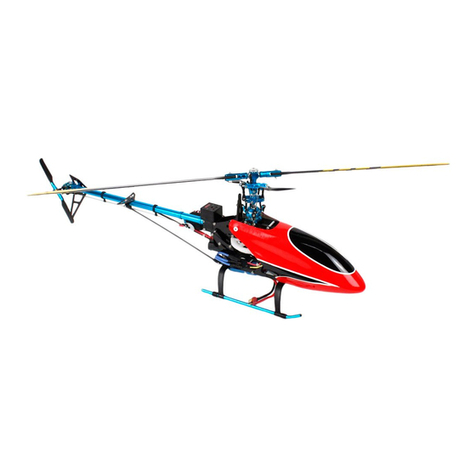
The Blade 450 X is intended to be flown outdoors.
CAUTION: The Blade 450 X is intended for pilots with experience
flying aerobatic, collective pitch helicopters. The Blade 450 X is more
responsive than other Blade helicopters. If you are not an experienced 3D or
collective pitch helicopter pilot, do not attempt to fly this product.
Takeoff
Deliberately increase throttle and establish a hover at least 24” (0.6 meter) high,
outside of ground effect.
CAUTION: Do not give any aileron, elevator or rudder commands before
takeoff or the helicopter may crash during takeoff.
Flying
The helicopter lifts off the ground when the rotor head reaches a suitable speed.
Establish a low-level hover to verify proper operation of your helicopter. You must
not set any trim; the flybarless design of the Blade 450 X renders trim unneces-
sary. Setting trim or sub-trim can cause an unwanted drift or rotation of the
helicopter.
First flights should be performed in normal mode and low cyclic and rudder dual
rates until you are familiar with the flying manner of the Blade 450 X. Discover
the rates that fit your flying style.
CAUTION: Always fly the helicopter with your back to the sun and the
wind to prevent loss of flight control.
Landing
Establish a low level hover. Deliberately lower the throttle until the helicopter
lands. Do not give any aileron, elevator or rudder commands when the helicopter
is landing.
When the helicopter is in stunt mode:
• The rotor head speed is constant.
• The main rotor will increase negative pitch as the throttle/collective stick is
moved from the middle stick position to the low stick position. Negative pitch
allows the helicopter to fly upside down and perform aerobatics.
Change between stunt and idle up modes in a hover with the throttle near the
hovering stick position.
The helicopter may go up or down when you change between modes due to the
difference in the throttle and pitch curves.
WARNING: Do not use wooden main blades with the Blade 450 X or in-
jury and/or property damage could occur. Only use Blade 450 X approved
carbon fiber main blades.
Gyro Gain Adjustment
• If the tail wags or oscillates, lower the gain on the gyro.
On your transmitter’s gyro menu, decrease the gyro gain values a small amount
at a time until the helicopter is stable within a particular flight mode.
• If the tail is drifting while hovering, increase the gain on the gyro.
On your transmitter, increase the gyro gain values a small amount at a time until
the tail starts to wag/oscillate. Afterwards, reduce the gain until the tail stops
wagging/oscillating within a particular flight mode.
Post-Flight Inspections and Maintenance
Ball Links Make sure the plastic ball link holds the control ball, but is not tight (binding) on the ball. When a link is too loose on the ball, it can separate from the ball
during flight and cause a crash. Replace worn ball links before they fail.
Cleaning Make sure the battery is not connected before cleaning. Remove dust and debris with a soft brush or a dry lint free cloth.
Bearings Replace bearings when they become notchy (sticky in places when turning) or draggy.
Wiring Make sure wiring does not block moving parts. Replace damaged wiring and loose connectors.
Fasteners Make sure there are no loose screws, other fasteners or connectors. Do not over tighten metal screws in plastic parts. Tighten screw so parts are mated
together, then turn screw only 1/8th of a turn more.
Rotors Make sure there is no damage to rotor blades and other parts which move at high speed. Damage to these parts includes cracks, burrs, chips or scratches.
Replace damaged parts before flying.
Gyro Make sure the AR7200BX is securely attached to the frame. Replace the double-sided tape when necessary. The helicopter will crash if the AR7200BX
separates from the helicopter frame.
Blade Helicopter Belt Tension
Belt tension that is too tight results in loss of power and causes the belt to wear more quickly. Tension that is too loose can cause belt damage and loss of tail rotor
control in flight.
To check for proper belt tension:
1. View the tail rotor drive belt through the opening at the back of the main
frame.
2. Use a hex wrench or standard screwdriver to compress the belt through the
opening.
3. Apply light pressure on the belt, compressing the belt toward the left side of
the tail boom.
4. The belt tension is correct if the compressed side of the belt reaches approxi-
mately halfway to the opposite side of the belt.
a. If the compressed side of the belt reaches farther than halfway to the
other side of the belt, the tension is too loose.
b. If the compressed side of the belt does not reach halfway to the other
side of the belt, the tension is too tight.
To adjust belt tension:
1. Loosen the two horizontal stabilizer screws.
2. Loosen the four screws at the back of the main frame.
3. Slide the boom forward or aft to adjust the belt tension.
4. When the belt tension is properly adjusted, tighten the four screws at the back
of the frame.
5. Tighten the horizontal stabilizer screws.