EN
Flying Tips and Repairs
WARNING:
Always decrease
throttle at propeller
strike.
Post Flight
1Disconnect the flight battery from the ESC (Required for Safety
and battery life).
2 Power OFF the transmitter.
3 Remove the flight battery from the aircraft.
4 Recharge the flight battery.
5 Repair or replace all damaged parts.
6Store the flight battery apart from the aircraft and monitor the
battery charge.
7Make note of the flight conditions and flight plan results, planning for
future flights.
Consult local laws and ordinances before choosing a flying location.
Flying Field
Always choose a wide-open space for flying your aircraft. It is recommended
that you fly at a designated RC flying field. Always avoid flying near houses,
trees, wires and buildings. Avoid flying in areas where there are many people,
such as parks, schoolyards, or soccer fields.
Range Check your Radio System
Before you fly, range check the radio system. Refer to your specific transmitter
instruction manual for range test information.
Takeoff
For your first flights, set your transmitter timer or a stopwatch to 7 minutes.
Adjust your timer for longer or shorter flights once you have flown the model.
Place the aircraft in position for takeoff (facing into the wind). Select low rates
for first takeoff and gradually increase the throttle to 3/4 to full and steer with
the rudder. Pull back gently on the elevator and climb to a comfortable altitude.
Flying
Fly the airplane and trim it for level flight at 3/4 throttle. After landing, adjust
the linkages mechanically to account for trim changes and then reset the trims
to neutral. Ensure the aircraft will fly straight and level with no trim or sub-trim.
Landing
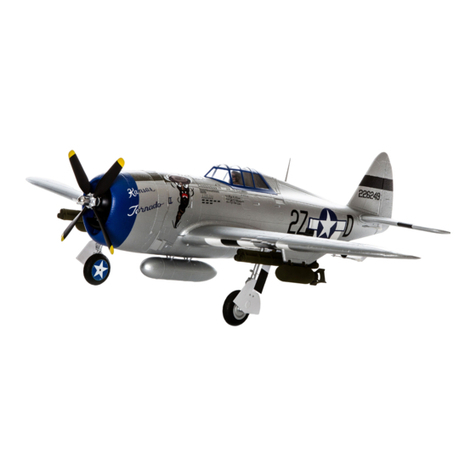
To land the aircaft, fly the airplane down to about a foot above the ground.
Reduce power and add back pressure on the elevator to flare the airplane.
Touch down with the main wheels first by holding the nosewheel off the
ground. Avoid holding too much elevator after touchdown to prevent the plane
from becoming airborne again. Gently steer with the rudder until the plane has
slowed. Avoid sharp turns on the ground until the plane has slowed enough to
prevent scraping the wing tips.
NOTICE: If a crash is imminent, reduce the throttle and
trim fully. Failure to do so could result in extra dam-
age to the airframe, as well as damage to the ESC and
motor.
NOTICE: After any impact, always ensure the receiver
is secure in the fuselage. If you replace the receiver,
install the new receiver in the same orientation as the
original receiver or damage may result.
NOTICE: Crash damage is not covered under warranty.
NOTICE: When you are finished flying, never leave the
aircraft in direct sunlight or in a hot, enclosed area
such as a car. Doing so can damage the aircraft.
Low Voltage Cutoff (LVC)
When a Li-Po battery is discharged below 3V per cell, it will not hold a charge.
The ESC protects the flight battery from over-discharge using Low Voltage
Cutoff (LVC). Before the battery charge decreases too much, LVC removes
power supplied to the motor. Power to the motor pulses, showing that some
battery power is reserved for flight control and safe landing.
Disconnect and remove the Li-Po battery from the aircraft after use to prevent
trickle discharge. Charge your Li-Po battery to about half capacity before stor-
age. During storage, make sure the battery charge does not fall below 3V
per cell. LVC does not prevent the battery from over-discharge during storage.
NOTICE: Repeated flying to LVC will damage the battery.
Tip: Monitor your aircraft battery’s voltage before and after flying by using a
Li-Po Cell Voltage Checker (EFLA111, sold separately).
Repairs
Thanks to the Z-Foam™material in this aircraft, repairs to the foam can be
made using virtually any adhesive (hot glue, regular CA, epoxy, etc). The hori-
zontal tail is not made of the same material, so use only foam-compatible
CA on the horizontal tail.
When parts are not repairable, see the Replacement Parts List for ordering by
item number. For a listing of all replacement and optional parts, refer to the list
at the end of this manual.
NOTICE: Use of CA accelerant on your aircraft can damage paint. DO NOT
handle the aircraft until accelerant fully dries.
10