Page 5 12
Installation
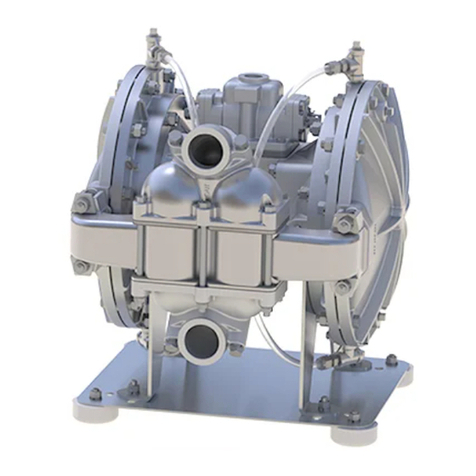
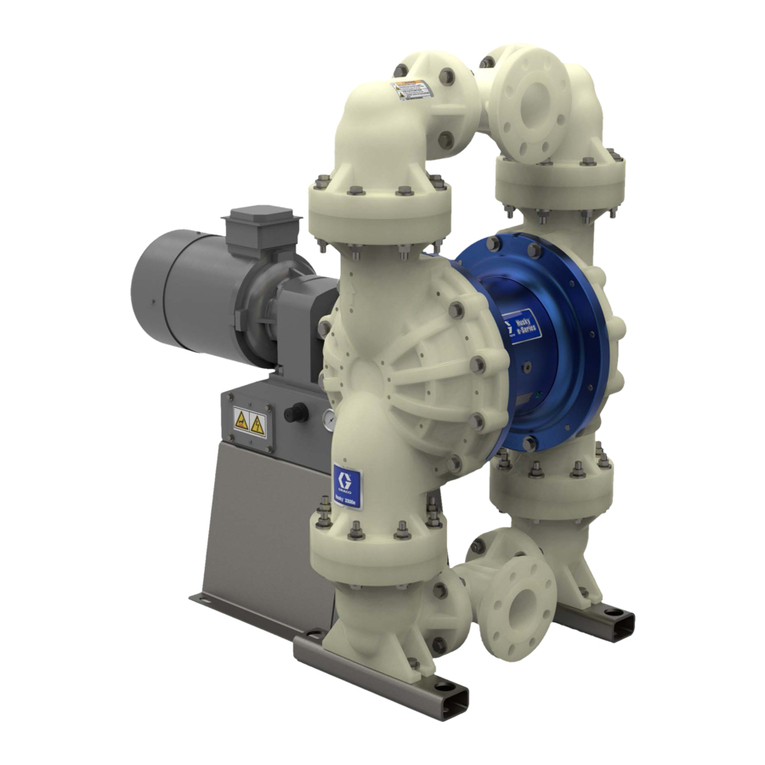
This pump comes with a footed base for easy mounting in permanent installations. The pump should be
mounted in a vertical position. In permanent installations, the pump should be attached to plant piping using a
flexible coupling on both the intake and discharge connections to reduce vibration to the pump and piping. To
further reduce vibration, a surge suppressor next to the pump may be used.
Suction pipe size should be at least 1 inch in diameter or even larger if highly viscous fluid is to be pumped. If
suction hose is used, it must be of a non collapsible reinforced type. Discharge piping should be at least 1 inch
in diameter. It is critical, especially on the suction side of the pump, that all fittings and connections are airtight
or pumping efficiency will be reduced and priming will be difficult.
The air supply line should be at least 3/8 inch in diameter. Make certain the supply line and compressor are
capable of supplying the required pressure and volume of air needed to operate the pump at the desired flow
rate. The quality of the compressed air source should be considered. Air that is contaminated with moisture
and dirt may result in erratic pump performance and increased maintenance cost as well as frequent process
down time when the pump fails to operate properly.
Pump Operation
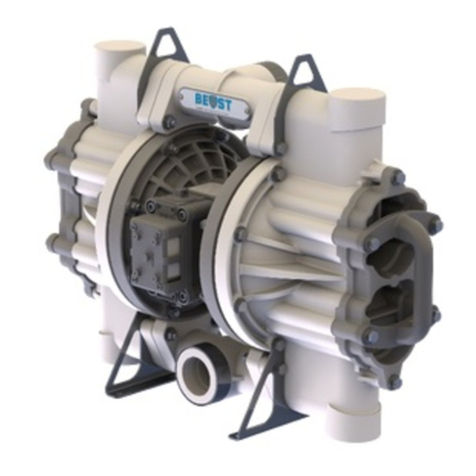
The pump is powered by compressed air. Compressed air is directed to the pump air chamber by the main air
valve. The compressed air is separated from the fluid by a membrane called a diaphragm. The diaphragm in
turn applies pressure on the fluid and forces it out of the pump discharge. While this is occurring, the opposite
air chamber is depressurized and exhausted to atmosphere and fluid is drawn into the pump suction. The
cycle again repeats, thus creating a constant reciprocating action, which maintains flow through the pump.
The flow is always in through the bottom suction connection and out through the top discharge connection.
Since the air pressure acts directly on the diaphragms, the pressure applied to the fluid roughly approximates
the air supply pressure supplied to the main valve.
Troubleshooting
The pump will not run, or runs slowly:
1. Examine the air inlet screen for debris.
2. Check for a sticking air valve. Remove the air valve from the pump and flush with solvent to
remove dirt and/or debris. Check the spool and sleeve for nicks and scratches. If the spool is shiny instead
of dull black, the spool and sleeve may be worn out and may need to be replaced. Clean all ports and
airways and replace worn out gaskets and o rings.
3. Check pilot shaft and main shaft for scoring and scratches; replace if needed. Replace the pilot shaft and
main shaft o rings if they are worn, flat or torn.
The pump runs, but little or no material flows:
1. Check for pump cavitation, slow the pump speed down to match the thickness of the material being
pumped.
2. Look for sticking ball checks. If the material being pumped is not compatible with the ball material, the
elastomer may swell. Replace the balls and seats with a compatible elastomer type.
3. Make sure all the suction line fittings and connections are tight.
Air bubbles in pump discharge:
1. Look for a ruptured diaphragm.
2. Check for suction leaks in pump manifolds and piping.
Material comes out of the pump air exhaust:
1. Inspect the diaphragm for rupture.
2. Check the tightness of the diaphragm plates to the pump shaft.