►This product is not intended or approved for
medical applications, food and/or application in
gas appliances.
►Solenoid valves can only be used with clean
liquids or gases. It is recommended to install a
filter before the solenoid valve.
►Check the compatibility of the medium used,
temperature and other operating conditions with
the materials and specifications of the product.
►Never exceed the limits for pressure, temperature
or voltage as indicated on the product and/or in
the technical documentation.
►The temperature of a solenoid valve coil can rise
during operation; this is normal. Overheating will
cause smoke and a burning smell. In this case, the
power supply must immediately be disconnected.
►Warning: a valve opens and closes quickly.
Improper use can cause pressure transients (fluid
hammer) in the pipes with possible damage as a
consequence.
►It is not allowed to change the construction of the
valve.
►Beware of electric shock when working with
electrical equipment.
3. INSTALLATION AND MAINTENANCE
1.1. Safety instructions before starting
►It is recommended to install the product in a dry
environment. In moist environments, make sure
that no moisture can penetrate the coil,
actuator or connector. Install the solenoid valve
in a safe way to avoid electric shock, burning or
other injuries. Ensure that the solenoid valve is
installed in an area with adequate ventilation to
facilitate heat dissipation. Make sure the
solenoid valve is not in contact with or in the
vicinity of flammable materials. Ensure that the
product is protected from frost. Frost may
damage the product and/or block the moving
parts, causing the product to malfunction.
►Operations may only be performed when the
system is not pressurized, electrically
disconnected and cooled down.
►Turn off the power supply before performing
any work on the solenoid valve to prevent the
risk of electrical shock and to prevent activation
of the solenoid valve.
►The product is only safe when properly installed
and operated by qualified persons. Please read
the safety instructions and technical
documentation carefully before installation, use
or maintenance.
►Always make sure to start the installation safely
after installation or maintenance.
►Water hammer is a typical consequence of a
high flow rate and pressure in pipes with small
diameters. There are several solutions to this
problem:
►Reduce the pressure with a pressure
reducing valve before the solenoid
valve.
►Increase the pipe diameter if possible.
►Dampen the water hammer by using a
flexible hose or buffer before the
solenoid valve.
1.2. Installation
Clean fluids and gases
The solenoid valve can be used in combination with clean liquids or
gases. Check if there is any dirt in the piping or valve before installing.
It is recommended to install a filter (500 µm) before the solenoid valve.
Mounting the valve
Be aware of the direction of flow of the medium when installing the
valve. Solenoid valves with an arrow on the housing must be connected
in the indicated direction. The pipes on both sides of the valve must be
securely fastened. Use a wrench for both valve and pipe while
tightening to prevent unnecessary stresses in the system. The solenoid
valve must be fixed via the provided connection points. Only exert force
at the designated areas on the body such as the hexagon; never to the
coil or armature. Avoid vibration in the pipes. Use a suitable sealant for
threaded connections of the solenoid valve. Avoid the entry of thread
sealing material in the valve, this can lead to malfunctioning of the
valve.
Position
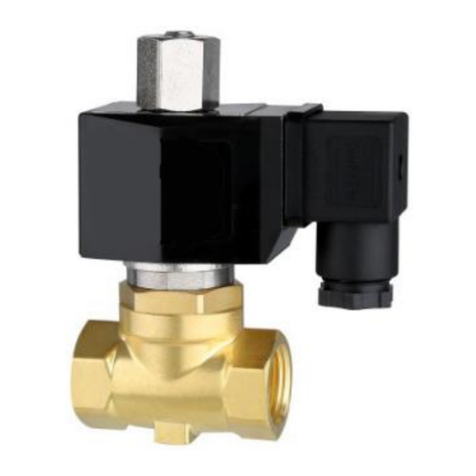
It is recommended to install the solenoid in vertical position with the
coil facing upwards. This reduces the probability of the collection of
debris in the solenoid valve. When the solenoid valve is mounted at an
angle, it is recommended to deviate maximally 90° from the vertical
position.