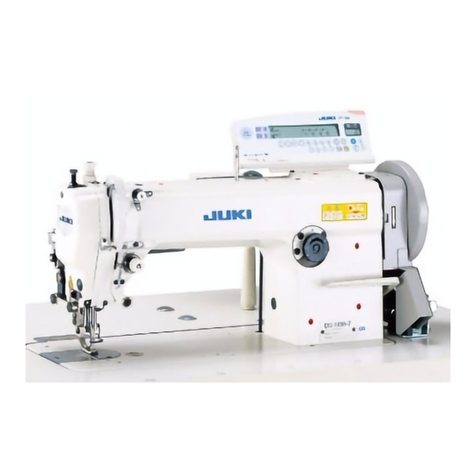
JUKI DDL-8700-7 Quick start guide

®
40094273
No.E395-00
ENGINEER’S MANUAL
1-Needle, Lockstitch Machine
with Automatic Thread Trimmer
DDL-8700-7

PREFACE
This Engineer’s Manual is written for the technical personnel who are responsible for the service and
maintenance of the machine.
The Instruction Manual for these machines intended for the maintenance personnel and operators at an
apparel factory contains operating instructions in detail.
It is advisable to use the Instruction Manual and Parts List for SC-920 together with this Engineer's Manual
when carrying out the maintenance of these machines.
This manual gives the "Standard Adjustment" on the former section under which the most basic adjustment
value is described and on the latter section the "Results of Improper Adjustment" under which stitching errors
and troubles arising from mechanical failures and "How To Adjust" are described.

CONTENTS
1. GENERAL ......................................................................................................1
(1) Features .................................................................................................................................. 1
(2) Applications ............................................................................................................................ 1
2. SPECIFICATIONS ........................................................................................ 2
3. NAME OF EACH COMPONENT .................................................................. 4
4. ADJUSTMENT .............................................................................................. 6
(1) Adjustment of the belt tension .................................................................................................. 6
(2) Adjustment of the needle stop position .................................................................................... 8
1) How to sdjust the upper stop position (after thread trimming) .................................................. 8
2) How to sdjust the lower stop position........................................................................................ 8
(3) Adjustment of the wiper (WB type) ........................................................................................ 10
(4) Theory of thread trimming ...................................................................................................... 12
(5) Thread trimming sequence .................................................................................................... 13
(6) Adjustment of the timing of the thread trimmer cam .............................................................. 14
1) How to adjust the timing ........................................................................................................ 14
2) How to adjust the timing of the thread trimmer cam .............................................................. 14
(7) Adjustment of the position of the moving knife........................................................................ 16
1) Proper position of the moving knife ........................................................................................ 16
2) How to position the moving knife .......................................................................................... 16
3) When the moving knife can not be properly positioned merely by adjusting
the position of the link driving magnet pin .............................................................................. 16
(8) Adjustment of the counter knife .............................................................................................. 18
1) Properly installing the knife thread guide .............................................................................. 18
2) Adjusting the counter knife .................................................................................................... 18
(9) Adjustment of the floating amount of the tension disc No. 2 .................................................. 20
1) How to check the floating amount of the tension disc No. 2 .................................................. 20
2) How to adjust the floating amount of the tension disc No. 2 .................................................. 20
(10) Sharpening the counter knife ................................................................................................ 22
(11) Replacing the moving knife .................................................................................................... 24
(12) Replacing the knife thread guide ............................................................................................ 26
(13) Adjustment of the thread take-up picker ................................................................................ 28
1) Positioning the thread take-up picker...................................................................................... 28
2) How to adjust the position of the thread take-up picker .......................................................... 28
(14) Adjustment of the clutch disc and thread trimmer solenoid .................................................... 30
(15) Adjustment of driving arm stopper .......................................................................................... 32
(16) Adjustment of the knife mounting base .................................................................................. 34
(17) Adjustment of the one-touch type reverse feed switch lever .................................................. 36
(18) How to replace the synchronizer ............................................................................................ 38
(19) Adjustment of normal/reverse stitching .................................................................................. 40
(20) Setting and Ajusting for SC-920.............................................................................................. 42
1) Setting procedure of the machine head .................................................................................. 42
2) Machine head list .................................................................................................................... 43

5. TROUBLES AND CORRECTIVE MEASURES .......................................... 44
(1) Mechanical components ........................................................................................................ 44
(2) Sewing performance .............................................................................................................. 50
6. BOBBIN CASE WITH AN IDLING PREVENTION SPRING ...................... 61
(1) How to adjust the tension of the an idling prevention spring .................................................. 61
(2) When using a bobbin case...................................................................................................... 61
(3) How to correct irregular stitches produced at high/low speed ................................................ 61
7. BRIEFLY CHECKING THE ADJUSTMENT
OF THE THREAD TRIMMER OF DDL-8700-7 SERIES ............................ 62
8. DRAWING OF THE TABLE ...................................................................... 64

Needle
DB ×1
DB ×1 KN
DA ×1
Size Thread Materials Application
#9
#11
#14
#16
#18
#9
#10
#12
#8 ~ #9
#11
#14
#80
#80 ~ #60
#60 ~ #50
#50 ~ #30
#30 ~ #20
#80
#60
#50
#80
#60
#50
Georgette, nylon, T/C broadcloth
General broadcloth, light-weight knit
Wool, cotton gaberdine, drill
Overcoats
Denim
Georgette, nylon, T/C broadcloth
General broadcloth, Iight-weight knit
Wool cotton gaberdine, drill
Georgette, nylon, T/C broadcloth
General velvet, Iight-weight knit
Wool, cotton gaberdine, drill
Extremely light-weight materials
Light-weight materials
General fabrics
Medium-weight materials
Heavy-weight materials
Extremely light-weight materials
Light-weight materials
General fabrics
Extremely light-weight materials
Light-weight materials
General fabrics
1. GENERAL
(1) Features
(2) Applications
1.
The sewing speed can be changed continuously from low to high by adjusting the level of depression
of the pedal, contributing to higher efficiency.
2. Performs automatic reverse feed stitching at the start and end of sewing.
When the front part of the pedal is depressed, the machine carries out reverse feed stitching at
constant speed, assuring consistent quality.
3. The pressure required for depressing the front and back parts of the pedal can be adjusted to suit
each operator.
4.
A operation panel mounted on the machine head enables the operator to easily check ON/OFF of
the main switch and automatic reverse stitch at start/end, and stitching patterns selected. This
feature virtually eliminates chances for operational mistakes.
5. A synchronizer is included in the handwheel to ensure easy operation.
1. Standard models
Extensively used for light- to medium-weight general fabrics in men’s suits, Iadies’wear, working wear,
student’s uniforms, etc. Cotton or synthetic thread of #80 to #30 is generally used.
2. NA-type machines for light-weight materials
Suited for relatively light-weight materials from tetoron broadcloth to silky materials and georgette in
men’s shirts, blouses, etc. Cotton or synthetic thread of #80 to #50 is mainly used for these models.
− 1 −

1
2
3

4
5
6
7
8
9
10
11
12
13
14
15
16
17
18
19
20
21
22
23
24
25
Model
Max. sewing speed
Max. stitch length
Needle bar stroke
Needle (standard)
Presser foot pressure
lift of presser foot
Presser foot
Feed dog
Height of feed dog
Feed system
Thread take-up
Thread take-up stroke
Lubrication
Oil return
Lubricant
Wiper
Automatic reverse
stitching device
Motor
Motor output
Control box
Power supply
Frequency
Power consumption
Solenoid drive power supply
Max. speed adjustment range
Needle up/down
stop selector switch
Auto-lifter
Machine head weight
DDL-8700-7
Standard DDL-8700A-7
Light-weight
DDL-8700H-7
Heavy-weight
Cotton thread
5,000 sti/m
Synthetic thread
4,000 sti/m 4,000 sti/m 4,000 sti/m
4 mm 5 mm
30.7 mm 29 mm 35 mm
DB ×1 #14
DB ×1
#9 to #18
DB ×1 KN
#9 to #18
DA ×1 #9 DA ×1
#9 to #11
DB ×1
#19 to #23
DB ×1 #21
4 to 5 kg 4 to 5 kg 5 to 7 kg
By hand : 5.5 mm
By knee
: 13 mm
By hand : 4 mm
By knee
: 9 mm
By hand : 5.5 mm
By knee
: 13 mm
Exclusive hinging presser foot
4-row teeth or 3-row teeth
(feed dog tilt adjustable)
0.75 to 0.85 mm 0.7 to 0.8 mm 1.0 mm
4-row teeth
(feed dog tilt adjustable)
4-row teeth
(feed dog tilt adjustable)
Swing type
Link-type
Standard 107 mm
(Max.112 mm to Min.105 mm)
Max.115 mm to Min.108 mm
Fully automatic
By plunger pump
JUKI NEW DEFRIX OIL No.1 or
JUKI MACHINE OIL 7 (equivalent to ISO VG7)
Equipped (WB) Not equippedEquipped (WB)
Equipped as standard device
Compact-size servo motor M92 (450W)
Related output 400 W, Max. output 550 W
SC-920
Single-phase 100 to 120 V, 3-phase 200 to 240 V, Single-phase 220 to 240 V
50 Hz / 60 Hz
320 VA
DC24 V
400 sti/min, to max. speed
The machine normally stops with its needle down.
By setting this switch, the machine can be stopped with its needle up.
Option (AK85)
30 kg
2. SPECIFICATIONS
− 2 −

MEMO
− 3 −

3. NAME OF EACH COMPONENT
/Power switch
4Operation panel (CP-18, CP-180)
)Synchronizer
0L-shaped thread stand
1PSC box (SC-920)
6Motor (M 92)
2Pedal
*One-touch type reverse feed switch
-Wiper
Adjusting screw for levelling the stand or caster
❿
❶
❾
❹
❸
❼
❽
❺
❻
❷
− 4 −

Power switch
Power switch of the motor, PSC and operation panel.
Operation panel (CP-18, CP-180)
Automatic reverse feed stitching, the stitch number of pattern sewing, etc. are set through this operation
panel.
Synchronizer
Built inside the sewing machine pulley and used to detect the upper and lower positions of the needle
and transmit input signal to the PSC box.
L-shaped thread stand
PSC box (SC-920)
Comprises a circuit to control the sewing machine and motor, an output circuit to operate the elements
(thread trimming solenoid, reverse feed solenoid, etc.), a pedal sensor to sense pedal operation, and a
power circuit to actuate the elements.
Motor (M92)
Operates the machine at high speed medium speed low speed in response to the signals received from
the PSC box.
Pedal
The front and back parts of the pedal are depressed to control the sewing speed and to actuate the
thread trimmer, presser foot lifter (AK85 type only), etc.
One-touch type reverse feed switch
Used by hand to perform reverse feed stitching.
Wiper
Wipes out the needle thread after thread trimming in response to the wiper signal received from the PSC
box.
Adjusting screw for levelling the stand or caster
Used to perform adjustment so that the table stands on the floor flatly to minimize variable during
operation.
❶
❷
❸
❹
❺
❻
❼
❽
❾
❿
− 5 −

(1) Adjustment of the belt tension
Standard adjustment
4. ADJUSTMENT
❶
belt
− 6 −
Other manuals for DDL-8700-7
3
Table of contents
Other JUKI Sewing Machine manuals

JUKI
JUKI IT-10 User manual

JUKI
JUKI AMS-210DHL-6100 User manual

JUKI
JUKI TL-2010Q User manual

JUKI
JUKI HZL35Z-UL5 User manual

JUKI
JUKI DDL-8700-7 User manual

JUKI
JUKI LU-1508N User manual

JUKI
JUKI LU-1560 User manual

JUKI
JUKI PLC-2710N-7 User manual

JUKI
JUKI SC-921 User manual

JUKI
JUKI DDL-5550-7 User manual

JUKI
JUKI PLC-1710 User manual

JUKI
JUKI LH-3528A User manual

JUKI
JUKI LBH-1700 Quick start guide

JUKI
JUKI PS-800SB-2850 Series User manual

JUKI
JUKI MF-7900-E22 User manual

JUKI
JUKI MEB-3810N Series User manual

JUKI
JUKI DNU-1541 User manual

JUKI
JUKI HZL-27Z User manual

JUKI
JUKI HZL-E70 User manual

JUKI
JUKI LZ-2290A Series User manual