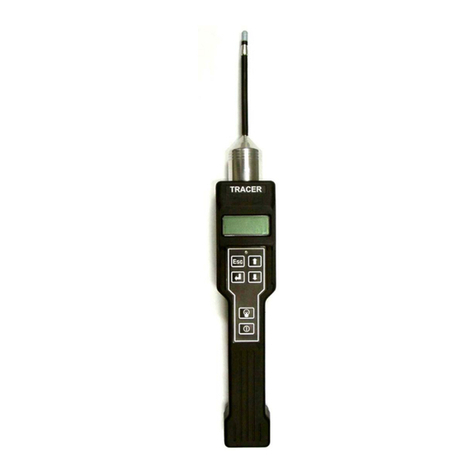
König SAS-GD100U User manual

SAS-GD100 /
SAS-GD100U
MANUAL (p. 2)
ANLEITUNG (S. 5)
MODE D’EMPLOI (p. 8)
GEBRUIKSAANWIJZING (p. 11)
MANUALE (p. 14)
MANUAL DE USO (p. 17)
MANUAL (p. 20)
HASZNÁLATI ÚTMUTATÓ (o. 23)
KÄYTTÖOHJE (s. 26)
BRUKSANVISNING (s. 29)
NÁVOD K POUŽITÍ (s. 32)
MANUAL DE UTILIZARE (p. 35)
ΕΓΧΕΙΡΙΔΙΟ XPHΣHΣ (σελ. 38)
BRUGERVEJLEDNING (s. 41)
VEILEDNING (s. 44)
ИНСТРУКЦИЯ (47 стр.)
KILAVUZ (s. 50)
KASUTUSJUHEND (lk. 53)
NÁVOD (s. 56)
ROKASGRĀMATA (lpp. 59)
NAUDOJIMO VADOVAS (62 p.)
PRIRUČNIK (str. 65)
РЪКОВОДСТВО (p. 68)
INSTRUKCJA OBSŁUGI (str. 71)
PRIROČNIK (str. 74)
Gas detector

ENGLISH
2
Introduction
Guarantee your own safety in the house with this useful free standing
ammable gas alarm, household type made for indoor use only. When the gas
concentration reaches a certain level the detector provides a visual and audible
signal.
Warning
The service life of the gas detector is for 3 years guaranteed. For optimal
protection we recommend replacing the gas detector every 3 years.
Specications
• Detectable gases: Natural gas: methane, ethane, propane, and butane.
Liqueed petroleum gas (LPG): propane, butane, propylene and butylene
• Power: 100-240 V AC~ 50/60 Hz
• Rated load: < 2 W
• Alarm level: 3% LEL~20% LEL
• Alarm volume: > 85 dB
• Temperature range: -10°C ~ 50°C
• Relative humidity: < 97% RH
• Storage temperature: -10°C~+40°C
• Dimensions: 67 x 67 x 112 mm
• Weight: 122 g
Where to install the gas detector
Before installing the gas detector we recommend checking, which type of gas
is relevant for the room(s) you are placing a gas detector in.
Natural gas and town gas
It should be installed in the room(s) where a gas leak is most likely to occur;
installed above the level of a possible gas leak and near the ceiling; typically
0.3m from the ceiling, in a place where air movement is not impeded by
furniture and furnishings.
LPG
It should be installed in the room(s) where the most frequently used appliance
is accommodated and where a leak is most likely to occur. Install as low as
possible; typically 0.1 m above the oor and in a place where air movement is
not impeded by furniture.

ENGLISH
3
Where not to install the gas detector
• In a small enclosed space
• Directly above a sink
• Next to a door or window
• Next to an extractor fan
• In an area where the temperature may drop below -10°C or exceed 40°C
• Where dirt and dust may block the sensor
• In a damp or humid location
Operation
Display gas level
indicator
Gas sensor
Alarm buzzer
Alarm indicator
State indicator
Power indicator
1. Connect the gas detector to a power outlet. The green power indicator is
constantly on, and it alarms with beep sound (red alarm indicator ashes
twice). The display gas level indicator displays “-” for about 4 minutes. Then
the gas detector starts the alarm detection mode.
2. When the concentration is 0, 1 or 2 the status indicator is o.
3. When the concentration is 3, the status indicator is red and the alarm
indicator ashes. When the concentration is 3, 4 or 5, it alarms with a slow
beep tone.
4. When the concentration is 6, 7, 8 or 9 it alarms with a fast beep tone.
5. When the display gas level indicator concentration is A, it alarms with the
status indicator in red, alarm indicator constantly on in red.

ENGLISH
4
6. When the concentration falls below the dened value, the alarm recovers
to the normal state.
What to do in the event of an alarm sounding or the smell of gas even
without an alarm
Keep calm and carry out the following actions (not necessarily in the given
order):
• Extinguish all open ames, including all smoking materials
• Turn o all gas appliances
• Do not switch on or o any electrical equipment, including the gas
detection apparatus
• Open doors and windows to increase ventilation
• Do not use a telephone in the building where the presence of gas is
suspected
Maintenance
Your gas detector will alert you to potentially hazardous gas concentrations in
your home, if maintained properly. To maintain your alarm in proper working
order, we recommend that you:
• Test your gas detector at least once per week (e.g. you can gently press a
lighter to produce gas in front of the gas sensor)
• Keep the gas detector free of dust by gently vacuuming the case with a soft
brush attachment once per month
• Never use cleaning solutions on your gas detector, simply wipe with a
slightly damp cloth
• Do not paint the gas detector
• Do not spray aerosols on or near the gas detector

DEUTSCH
6
Einleitung
Mit diesem nützlichen, frei stehenden Gasmelder für brennbare Gase sorgen
Sie für Ihre Sicherheit im eigenen Haus (nur für den Innenbereich). Sobald der
Gaspegel ein bestimmtes Level erreicht, gibt der Gasmelder ein sichtbares und
hörbares Signal.
Warnung
Die Lebensdauer des Gasmelders wird für 3Jahre garantiert. Für einen
optimalen Schutz empfehlen wir, den Gasmelder alle 3Jahre zu wechseln.
Spezikationen
• Erkennbare Gase: Erdgas: Methan, Ethan, Propan und Butan. Flüssiges
Propangas (LPG): Propan, Butan, Propylen und Butylen
• Betrieb: 100-240 V Wechselstrom (AC)~50/60 Hz
• Traglast: < 2 W
• Alarmstufe: 3% LEL~20% LEL
• Lautstärke des Alarms: > 85 dB
• Temperaturbereich: -10°C~50°C
• Relative Luftfeuchtigkeit: < 97% RH
• Lagertemperatur: -10°C bis+40°C
• Abmessungen: 67 x 67 x 112 mm
• Gewicht: 122 g
Wo der Gasmelder installiert werden sollte
Vor der Installation der Gasmelders sollten Sie überprüfen, welche Art von Gas
für das/die Zimmer, in dem/denen Sie einen Gasmelder nutzen wollen, relevant
sind.
Erdgas und Stadtgas
Er sollte in dem Raum bzw. den Räumen installiert werden, in dem/denen ein
Gasleck am wahrscheinlichsten ist. Er sollte oberhalb eines möglichen Gaslecks
und nahe der Decke installiert sein (in der Regel mit einem Abstand von 0,3m
von der Decke). Außerdem sollte er an einem Ort installiert sein, an dem die
Luftströme nicht durch Möbel oder andere Einrichtungsgegenstände behindert
werden.

DEUTSCH
7
Flüssiges Propangas
Er sollte in dem Raum bzw. den Räumen installiert werden, in dem das/die am
häugsten verwendete(n) Gerät(e) untergebracht ist/sind und wo ein Leck am
wahrscheinlichsten ist. Installieren Sie ihn so tief wie möglich (in der Regel 0,1m
über dem Boden) und an einem Ort, an dem die Luftströme nicht durch Möbel
behindert werden.
Wo der Gasmelder nicht installiert werden sollte
• In einem kleinen, geschlossenen Raum
• Direkt über einem Waschbecken
• Neben einer Tür oder einem Fenster
• Neben einer Dunstabzugshaube
• In einem Bereich, in dem die Temperatur unter -10°C fallen oder über 40°C
steigen könnte
• Wo Schmutz und Staub den Sensor blockieren könnten
• An einem feuchten Ort oder Ort mit hoher Luftfeuchtigkeit
Betrieb
Zeigt den
Gaspegel
Gassensor
Alarmsummer
Alarm-Anzeige
Zustandsanzeige
Betriebsanzeige
1. Schließen Sie den Gasmelder an eine Steckdose an. Die grüne Stromanzeige
leuchtet durchgehend und ein hörbarer Signalton ertönt (die rote
Alarmanzeige blinkt zweimal). In der Anzeige für den Gaspegel erscheint

DEUTSCH
8
„-“ für ca. 4 Minuten. Danach bendet sich der Gasmelder im Alarm-
Erkennungsmodus.
2. Wenn der Pegel bei 0, 1 oder 2 liegt, ist die Statusanzeige aus.
3. Wenn die Konzentration bei 3 liegt, ist die Statusanzeige rot und die
Alarmanzeige blinkt. Wenn der Pegel bei 3, 4 oder 5 liegt, ertönt ein Alarm
mit einem langsamen Signalton.
4. Wenn der Pegel bei 6, 7 , 8 oder 9 liegt, ertönt ein Alarm mit einem
schnellen Signalton.
5. Wenn der Gaspegel-Anzeiger bei einem Pegel von A ist, dann erfolgt der
Alarm mit einer roten Statusanzeige (Alarmanzeige ist durchgehend rot).
6. Wenn der Pegel unter den festgelegten Wert fällt, dann kehrt der Alarm
wieder in den normalen Zustand zurück.
Was tun im Falle eines Alarms oder beim Geruch von Gas, selbst ohne
Alarm
Bewahren Sie Ruhe und tun Sie Folgendes (nicht unbedingt in dieser
Reihenfolge):
• Löschen Sie alle oenen Flammen, einschließlich aller Rauchwaren
• Schalten Sie alle Gasgeräte ab
• Schalten Sie keine anderen Elektrogeräte ein oder aus, einschließlich des
Gasmelders
• Önen Sie Fenster und Türen, um frische Luft hineinzulassen
• Benutzen Sie in dem Gebäude, in dem das Gasleck vermutet wird, kein
Telefon
Wartung
Ihr Gasmelder alarmiert Sie über möglicherweise gefährliche Gaspegel in
Ihrem Haus, wenn er richtig gepegt wird. Um Ihren Melder in einwandfreiem
Zustand zu halten, empfehlen wir Ihnen Folgendes:
• Testen Sie Ihren Gasmelder mindestens einmal pro Woche (z.B. können Sie
mit einem Feuerzeug vorsichtig Gas vor dem Gassensor ausströmen lassen)
• Halten Sie den Gasmelder durch vorsichtiges Staubsaugen im Gehäuse mit
einem weichen Bürstenaufsatz (einmal pro Monat) frei von Staub
• Verwenden Sie keine Reinigungslösungen für Ihren Gasmelder, sondern
wischen Sie ihn einfach mit einem leicht feuchten Tuch ab
• Bemalen oder lackieren Sie den Gasmelder nicht
• Verwenden Sie keine Sprühaschen am oder in der Nähe des Gasmelders

FRANÇAIS
10
Introduction
Garantissez votre propre sécurité chez vous avec ce détecteur de gaz
inammable autonome, de type ménager conçu pour un usage intérieur
uniquement. Lorsque la concentration de gaz atteint un certain niveau, le
détecteur déclenche un signal visuel et sonore.
Attention
Ce détecteur de gaz est garanti d’avoir une durée de vie de 3ans. Pour une
protection optimale, nous vous recommandons de remplacer le détecteur de
gaz tous les 3ans.
Spécications
• Gaz détectés: Gaz naturels: méthane, éthane, propane et butane. Gaz de
pétrole liquéé (GPL): propane, butane, propylène et butylène
• Alimentation: 100-240 V CA 50/60 Hz
• Charge nominale: < 2 W
• Niveau d'alarme: 3% LIE~20% LIE
• Niveau sonore: > 85 dB
• Plage de température: -10°C~50°C
• Humidité relative: < 97% RH
• Température de stockage: -10°C~+40°C
• Dimensions: 67 x 67 x 112 mm
• Poids: 122 g
Où installer le détecteur de gaz
Avant d'installer le détecteur de gaz, nous vous recommandons de vérier le
type de gaz susceptible d’être présent dans la ou les pièces où vous en placerez
un.
Gaz naturel et gaz de ville
Il doit être installé dans la ou les pièces où une fuite de gaz est plus susceptible
de se produire, au-dessus du niveau d'une fuite de gaz possible et à proximité
du plafond, généralement à 0,3m du plafond, dans un endroit où la circulation
de l'air n’est pas entravée par des meubles et les articles d’ameublement.
GPL
Il doit être installé dans la ou les pièces où l'appareil le plus fréquemment utilisé
est situé et où une fuite est plus susceptible de se produire. Il doit être installé

FRANÇAIS
11
aussi bas que possible; typiquement à 0,1m au-dessus du sol et dans un
endroit où la circulation de l'air n’est pas entravée par des meubles.
Où ne pas installer de détecteur de gaz
• Dans de petits espaces clos
• Directement au-dessus d'un évier
• À côté d'une porte ou d'une fenêtre
• À côté d'une hotte aspirante
• Dans une zone où la température peut être inférieure à -10°C ou supérieure
à 40°C
• Dans des endroits où la saleté et la poussière peuvent bloquer le capteur
• Dans un endroit humide
Fonctionnement
Témoin de
l’achage du
niveau de gaz
Capteur de gaz
Avertisseur d'alarme
Témoin d'alarme
Témoin d’état
Témoin
d'alimentation
1. Branchez le détecteur de gaz à une prise de courant. Le témoin
d'alimentation vert est allumé en continu, et il signale une alarme avec
un signal sonore (le témoin d’alarme rouge clignote deux fois). Le témoin
d’achage du niveau de gaz indique «-» pendant environ 4 minutes.
Ensuite, le détecteur de gaz entre dans le mode de détection d'alarme.
2. Lorsque la concentration est de 0, 1 ou 2, le témoin d'état de l’alarme est
éteint.

FRANÇAIS
12
3. Lorsque la concentration est de 3, le témoin d'état est rouge et témoin
d'alarme clignote. Lorsque la concentration est 3, 4 ou 5, il signale l’alarme
avec un bip lent.
4. Lorsque la concentration est de 6, 7, 8 ou 9, il signale l’alarme avec un bip
rapide.
5. Lorsque la concentration du témoin de l’achage du niveau de gaz est A,
il signale l’alarme avec un témoin d'état rouge, le témoin d'alarme reste
rougeen continu.
6. Lorsque la concentration redevient inférieure à la valeur dénie, l'alarme
retourne à son état normal.
Que faire lorsque l'alarme sonore se déclenche ou qu’il y a une odeur de
gaz, même sans alarme
Restez calme et exécutez les actions suivantes (pas nécessairement dans l'ordre
indiqué):
• Éteignez toutes les ammes, en incluant tout ce qui est en train de brûler
• Éteignez tous les appareils à gaz
• N’allumez ou n’éteignez aucun appareil électrique, y compris l'appareil de
détection de gaz
• Ouvrez portes et fenêtres pour augmenter la ventilation
• N’utilisez pas de téléphone dans l’édice où la présence de gaz est
suspectée
Entretien
Votre détecteur de gaz vous alertera des concentrations de gaz potentiellement
dangereuses à l’intérieur de votre maison, à condition d’être correctement
entretenu. Pour maintenir votre alarme en bon état de fonctionnement, nous
vous recommandons de:
• Tester votre détecteur de gaz au moins une fois par semaine (par exemple,
vous pouvez doucement actionner un briquet de façon à relacher du gaz
en face du capteur de gaz)
• Maintenir le détecteur de gaz sans poussière en nettoyant le boîtier à l’aide
d’un aspirateur muni d’une brosse douce une fois par mois
• Ne jamais utiliser de détergents sur votre détecteur de gaz, il sut de
l'essuyer avec un chion légèrement humide
• Ne pas peindre le détecteur de gaz
• Ne pas pulvériser des aérosols sur ou près du détecteur de gaz
This manual suits for next models
1
Table of contents
Languages:
Other König Gas Detector manuals
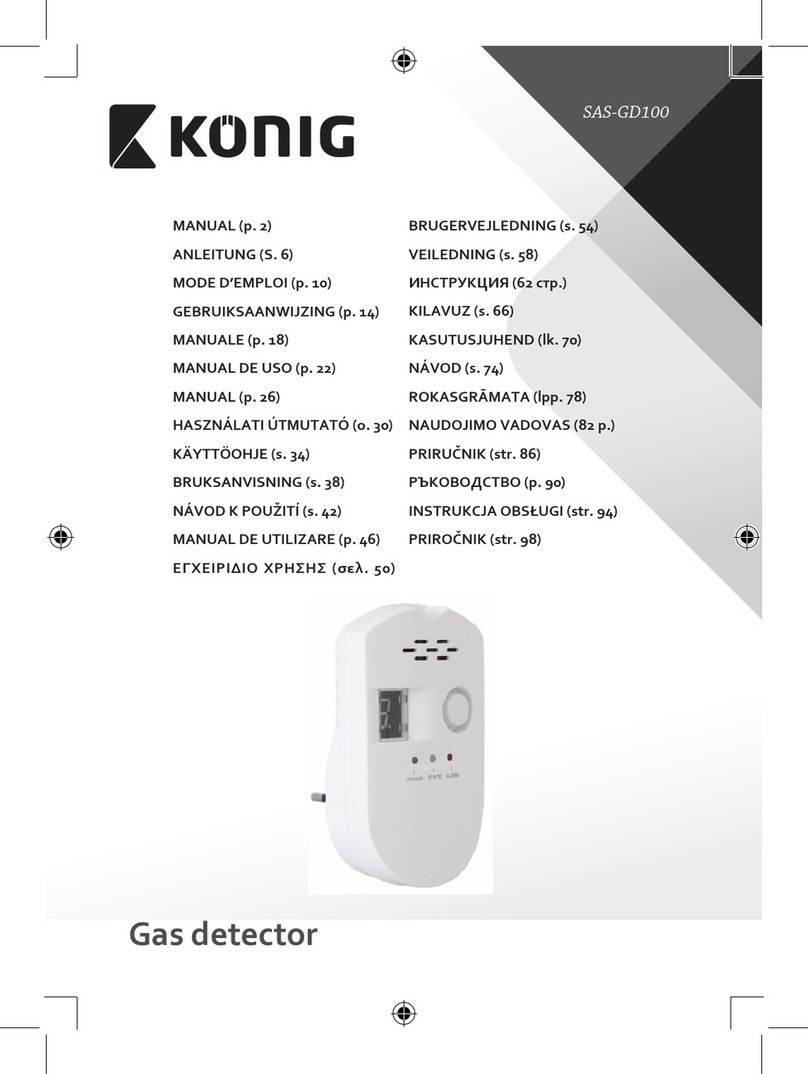
Popular Gas Detector manuals by other brands

RKI Instruments
RKI Instruments 35-3001A-08-01 Operator's manual
isweek
isweek AS8900 manual
Beacon
Beacon MEGA Installation, operation and maintenance instructions

MSA
MSA ULTIMA X5000 operating manual

Critical Environment Technologies
Critical Environment Technologies CGAS-A Series Installation & operation manual
Sensidyne
Sensidyne SensAlert Plus instruction sheet