11
Amplifier to speaker connections
All connections should be made
with the amplifier switched
OFF. Ensure the integrity of all
connections prior to switching
the amplifier ON.
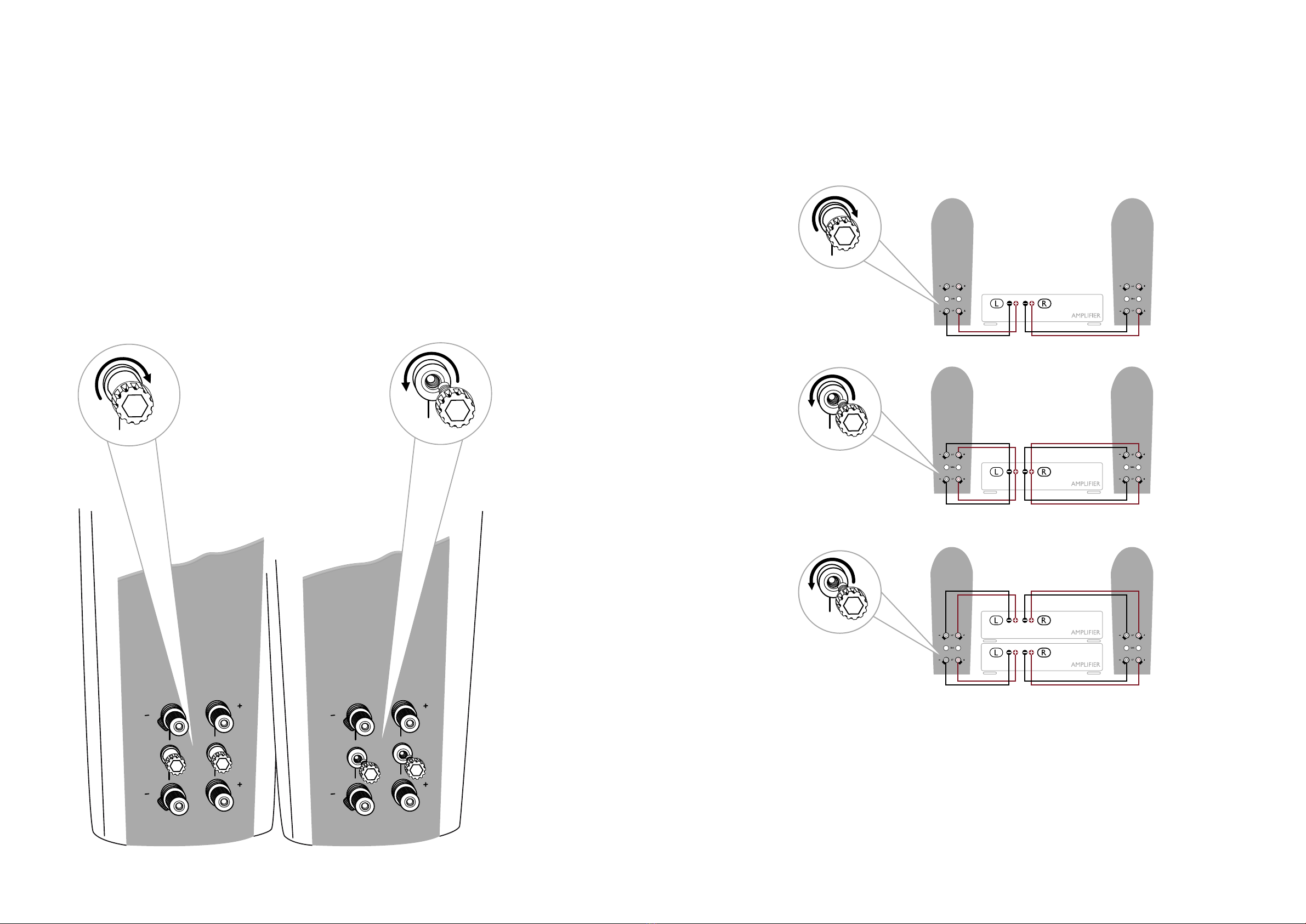
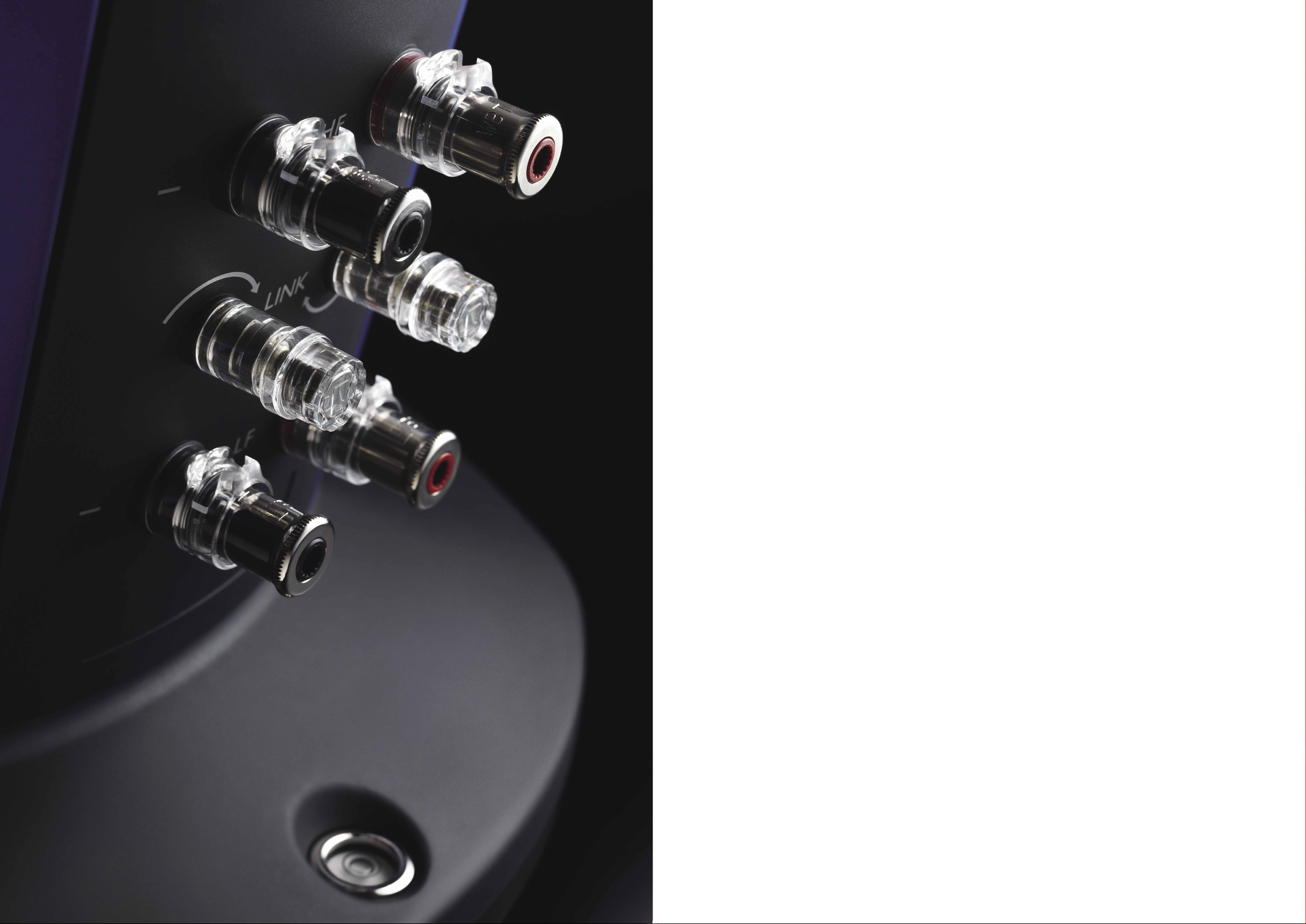
KEF Blade Meta speakers are
fitted with purpose designed
silver-plated Bi-wire/Bi-amp
terminals which will accept bare
wire, spade or 4mm connectors.
Most good quality speaker
cables have some indication,
such as colour coding or
‘ribbing’ on the insulating
l-|;ub-Ѵķbm7b1-ঞm]_b1_
conductor is ‘+’ or positive.
Connection to the speakers can
then be made as follows:
Bare wire connections are the
simplest to achieve and involve
stripping 12.5mm (0.5in.) of
insulation to expose the
speaker wire core. (You should
twist together, using clean
fingers, the ends of each
multi-stranded core prior to
the next stage to ensure
a good signal contact). Having
unscrewed the lower terminal
cap, push the wire through the
exposed hole in the terminal
body and screw the cap
down tightly.
Make sure that no stray strands
come into contact with the
opposite terminal; this could
cause a short circuit between
the terminals and may damage
your amplifier.
Be aware that a higher quality
run of cable will always give a
more rewarding presentation
than multiple runs of an
inferior cable.
Installation and operation
The left channel amplifier
output terminal marked ‘+’ or
coloured RED connects to the
left speaker terminal marked ‘+’.
The left channel amplifier
output terminal marked ‘-’ or
coloured BLACK connects to
the left speaker terminal
marked ‘-’. Similarly, these
instructions should be followed
=oul-hbm]1omm;1ঞomv
between the right channel
amplifier output and the right
speaker. Correct polarity, or
phase, is vital to the proper
operation of the system.
If the connections are not
made correctly the sound will
deteriorate giving poor
bass output and a diffuse
presentation of the soundstage.
Amplifier requirements
and power handling
In KEF literature and in the
specification table within these
instructions are listed a range
of amplifier power outputs to
match your Blade Meta
vr;-h;uvĺom7bঞomvo=v;
(room size, type of programme,
preferred listening level) and
the nature of the speaker/
amplifier interface vary so
widely that it is not possible to
lay down hard and fast rules
about amplifiers and the
speakers they drive.
KEF speakers are built to
rigorous standards of quality
and consistency and the upper
Ѵblb|vo=|_;-lrѴbC;u
requirements shown are those
which the speaker in question
should handle without distress
or damage when used under
moul-Ѵ7ol;vঞ11om7b|bomvĺ
Remember it is easier to
damage the speaker by using a
small amplifier driven into
distortion by too much volume,
possibly with bass and treble
boost, than by using a larger
amplifier which has power in
reserve. If in doubt,
ask the advice of your retailer
or consultant.
Installation and operation
If higher than specified
amplifier powers are used, great
care should be taken to avoid
abnormal conditions such as
switch-on surges or gross
distortion, either of the
amplifier or the speaker,
resulting in power peaks greatly
in excess of the ratings
specified. Care should be taken
as the possibility still exists
under certain conditions (such
as excessive bass or treble
boost caused by tone and/or
loudness controls, graphic
equalisers, etc.) that the
speakers can be overloaded and
damaged. The lower limits of
amplifier power are those
necessary to give a reasonable
sound pressure level under
domestic conditions.