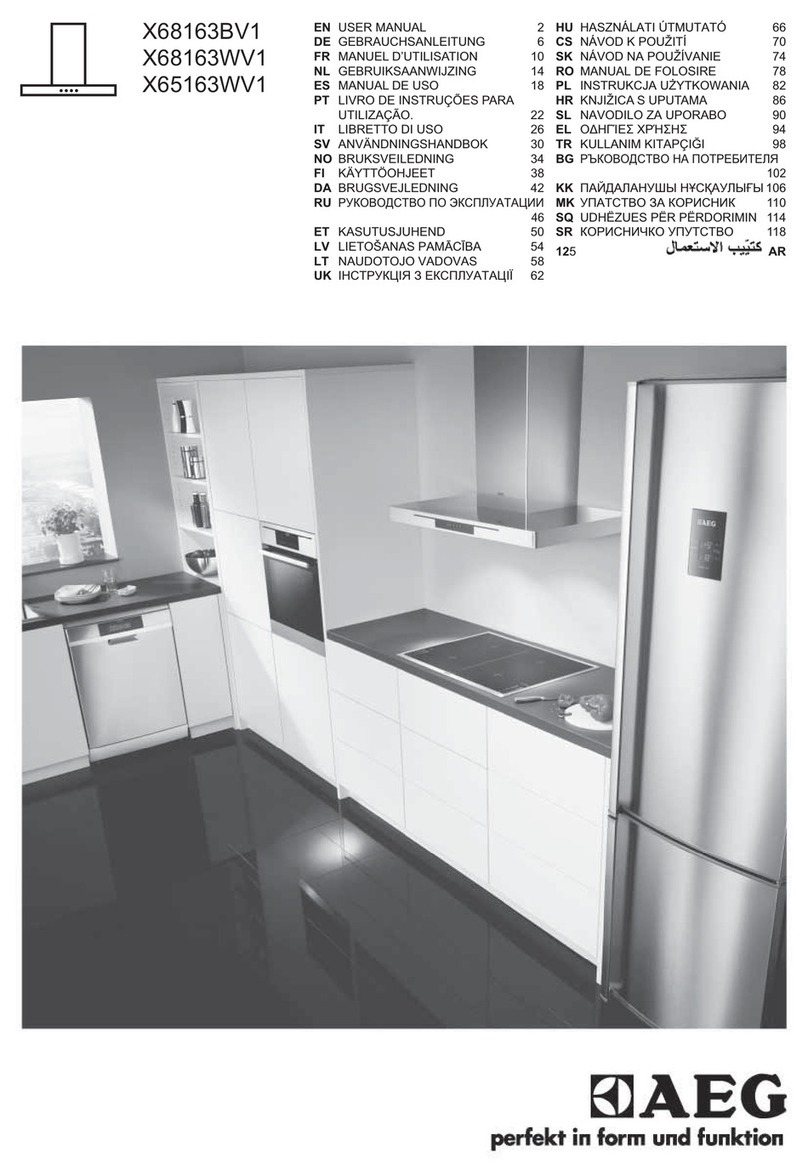
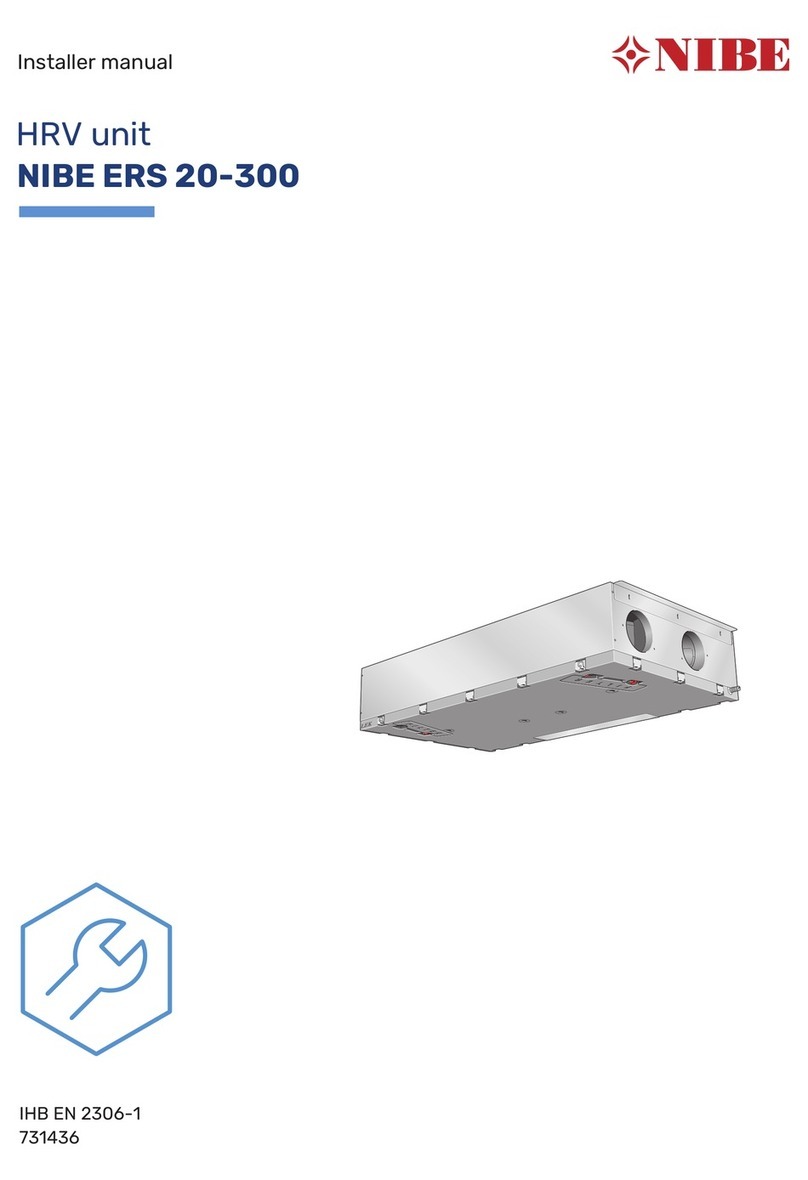
Installation - Fig. 5-6-7
The Rangehood must be placed at a minimum distance of
650mm* above electric, gas or mixed cooktops. The
recommended distance is 750mm*.
The hood is equipped with a top air outlet Fig5B for
discharge of fumes to the outside (Ducting version
– exhaust pipe and pipe fixing clamps not provided).
Should it not be possible to discharge cooking fumes and
vapour to the outside, the hood can be used in the filter
version, fitting an activated carbon filter and the deflector F
on the support (bracket) G, fumes and vapours are recycled
through the top grille Hby means of an exhaust pipe
connected to the top air outlet Band the connection ring
mounted on the deflector F(exhaust pipe and pipe fixing
clamps not provided).
Preliminary information for installing the hood:
Expansion plugs are provided to secure the hood to most
types of ceilings. However, a qualified technician must
verify suitability of the materials in accordance with the type
of ceiling. The ceiling must be strong enough to take the
weight of the hood.
During electrical connection ensure the power supply is
disconnected at the domestic main switch.
1. Adjust extension of the hood support structure, as the
final height of the hood depends on this, and remember
that with installation completed the hood must be at least
650mm* above electric, gas or mixed cooktops. The
recommended distance for canopy or island is 750mm.*
*Please confirm these measurements with your
Local Building Authority.
2.
a.
Fix the two sections of the structure using 8 screws.
b.
If the hood is provided with extensions longer than the
minimum, fit the reinforcement bracket
S
to the frame,
using 4 screws.
3.Place the ceiling hole diagram directly above the cook-
top (the center of the diagram must match the center of
the cook-top and the edges must be parallel to the sides
of the cook-top – the side of the diagram with the wording
FRONT corresponds to the control panel side). Prepare
the electrical connection.
4.Drill as shown (6 holes for 6 wall plugs – 4 plugs for
fixture), screw the outer screws leaving a space of about
1 cm. between the screw head and the ceiling.
5.Fit an exhaust pipe inside the truss and connect it to the
motor compartment connection ring Fig 5B (exhaust
pipe and fixing brackets are not supplied).
6.Hook the frame onto the 4 screws (see step 4).
CAUTION! The side of the truss with connection box
corresponds to the side of the control panel with hood
assembled.
7.Tighten the 4 screws.
8.Insert and tighten another 2 screws in the remaining free
holes for secure fixing.
9.Carry out the electrical connection to the mains power
supply, only turn on the power supply upon completion
of assembly.
10.Hook the hood onto the truss, ensuring it fits properly –
to hook the hood onto the truss partially tighten 4 screws
(see also step 12).
11.Secure the hood to the truss using two screws; this will
also help center the two sections.
12.Tighten the 4 screws securing the truss to the hood.
13.For extractor versions (13A), connect the other end of
the exhaust pipe to the flue.
For filter versions (13F), fit deflector F to the truss and
secure it to the bracket supplied using 4 screws, then
connect the exhaust pipe to the connection ring located
on the deflector.
14.Fit the nuts with fixing hooks supplied inside the top and
bottom sections of the flues at the rectangular slots. A total
of 10 nuts must be fitted.
15.Join the two top sections of the flue to cover the truss so
that one of the slots on the sections is situated on the same
side of the control panel and the other on the opposite side.
Screw the two sections together with 4 screws (2 each
side- see the plan diagram for joining the two sections).
16.Fix the top flue assembly to the truss, near the ceiling,
with two screws (one each side).
17.Carry out electrical connection of control panel and
bulbs.
18.Join the two bottom sections of the flue covering the truss
using 6 screws (3 each side, see the plan diagram for
joining the two sections).
19.Insert the bottom section of the flue in its seat so that it
completely covers the motor compartment and electrical
connection box, then ensure it from inside the hood using
two screws.
20.Apply the 2 tabs (supplied) to cover the fixing points of
the bottom flue (CAUTION! THE BOTTOM FLUE TABS
ARE THE NARROWER AND SHALLOWER ONES).
The wider and deeper tabs are those used for the top flue,
and must be cut to size.
21.Turn the mains power on again at the central electrical
panel and check for correct hood operation.
Electrical connection
The electrical tension must correspond to the tension noted
on the label placed inside the rangehood. Connect the
electrical plug, where provided, to the an easily accessible
outlet in conformity with local standards in force.
Where an electrical plug is not provided (for direct connection
to electrical network) place a standards approved bipolar
switch with an aperture distance of not less than 3mm
(accessible) from the contacts.
INSTRUCTIONONMOUNTINGANDUSE
Consult the designs in the front pages referenced in the text by alphabet letters. Closely follow the instructions set out in this
manual. All responsibility, for any eventual inconveniences, damages or fires caused by not complying with the instructions in
this manual, is declined.
GB