3
10.01.2019 flame cutting table SCT-2100
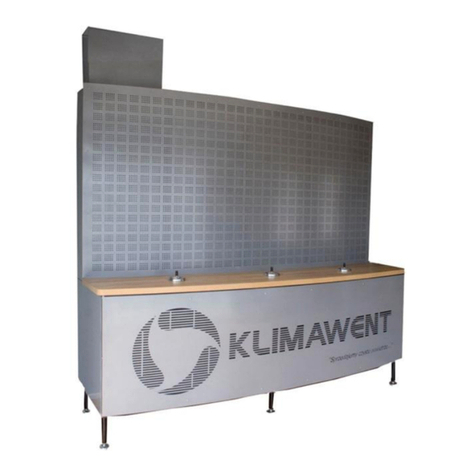
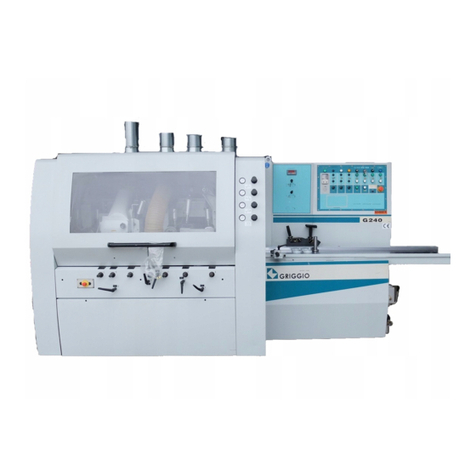
Fig. No.1 –SCT –flame cutting table
5. Structure and Function
SCT consists of subsequent assemblies:
–table body
–replaceable grate
–waste container
–cut-off damper assembly
–elements of the pneumatic control for the cut-off damper
Tables are constructed of single modules, while single modules are divided into two sections.
Depending on the size of the (meant for cutting) elements, the tables can be suited together in
a way providing adequate length.
The material for cutting ought to be placed on the grate of the tables. The grate is constructed
of specifically shaped steel sheets, therefore it will not get burnt through. During the cutting,
the spatters and impurities of the processed material fall into the subsequent waste containers
that are easy to empty.
The mounting eye grips, provided at the waste containers, are for lifting the elements and sig-
nificantly simplify the cleaning process. Additionally, the waste containers are protected with
an extra grill, so the small processed elements would not fall onto the waste container bottom.
As the shut-off dampers are opened pneumatically (by means of micro-switches), the extrac-
tion proceeds exclusively from one section, right where the cutting process takes place, resul-
ting in significant pollution extraction efficiency and it is also energy saving.
6. Assembly and Start-up
Assembly and start-up are carried out by a maintenance team of manufacturer or a maintenan-
ce team monitored by manufacturer.
7. Operational Use
In the course of operational use, empty and clean the waste containers and clean the grate of
the deposited metal particles (mechanical cleaning).
CAUTION: In application with a filtering unit (e.g. UFO-4), to provide extraction from one table,
its real volume flow will be by twice reduced, as compared to its nominal volume flow. This has
to be considered upon the selection of the device size. For example, for UFO-4-M/N-2 of nomi-
nal volume flow 10000 m3/h, its efficiency for plasma cutting or gas cutting will be 5000 m3/h.