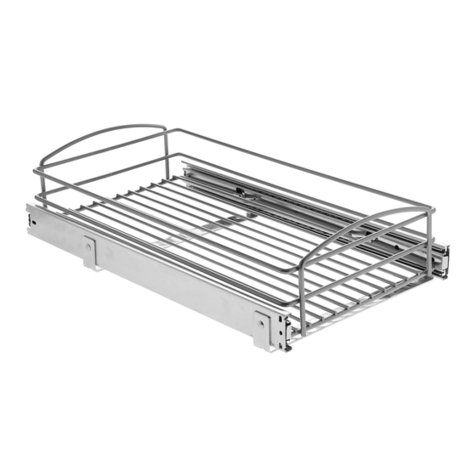
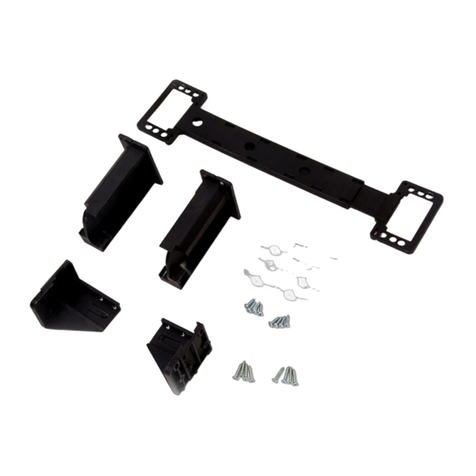
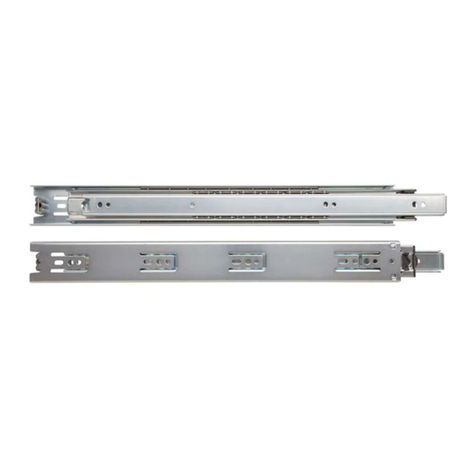
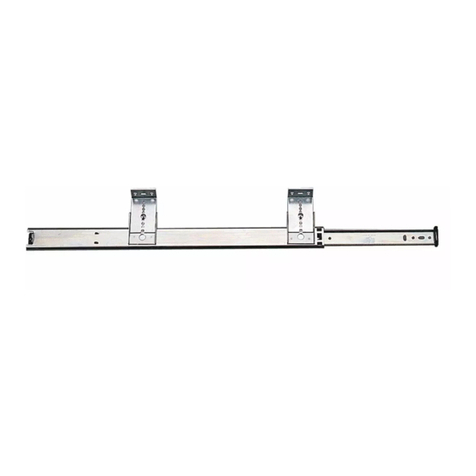
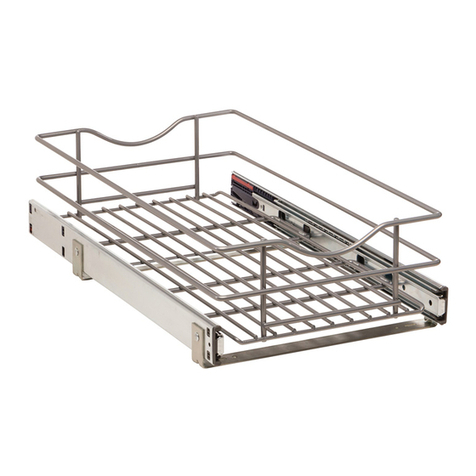
Carton should contain the Keyboard Tray Subassembly and a Hardware Kit consisting of:
4 – #8 x 1/4" self tapping screws 4 – Adjustable mounting brackets with
7-position slots.
8 – #8 x 5/8" mounting screws
Keyboard Tray Assembly, Mounting and
Installation Instructions
Step 1. Keyboard Preparation (Optional).
It is recommended, but is not req u ir e d,
to disassemble the slides from the tray
for easier installation. This is easily done
by first depressing the plastic lever as
shown in Fig ure 1 and then pulling the
slide members apart. Repeat for other
sl i de .
Step 2. Determine Mounting Direction.
Me a s u r e mounting location to deter-
mine if the mounting brackets should
face inwards or outwards. If width is
less than 24 inches the brackets mu s t
face inward. If the mounting location is
24 inches or great e r, the brackets may
face either dire c ti o n .
Step 3. Determine Drop Height.
A. Measure the maximum height of
the keyboard that you will be
using. Compare keyboard height
with the adjustment heights in
Chart A to determine at which
height position the mounting
brackets need to be installed.
B. Alternatively, you may use Chart B
and Figure2to determine what
height is desired to allow a knee
clearance or chair clearance,
underneath the keyboard after
installation.
Step 4. Assemble Brackets.
Attach mounting brackets to the slide
cabinet member, in the direction (step
1) and position (step 2 a or b), using
the #8 x 1/4" self tapping screws pro-
vided in hardware kit.
Step 5. Surface Preparation.
Depending on whether the bracket
direction is inward or outward…
A. …Use the dimensions provided
on this sheet to layout the hole
locations on the surface before
drilling…
B. …Or tape this sheet in the desired
position and use it as a template,
drilling holes through the target
locations.
Drill 4 pilot holes, for #8 x 5/8" scre w s ,
into the underside of the surf a c e .
Step 6. Mounting.
Attach the slide cabinet members to
the underside of the surface, using
#8 x 5/8" screws provided in the hard-
w a re kit. For now, only put screws in
the front side-to-side slotted holes.
Step 7. Installation.
With the slides mounted, first pull the
ball bearings to the front end. Then
insert the keyboard tray subassembly
into the slides and push tray com-
pletely to closed position as shown in
Figure 4. (It is normal to encounter
some resistant force when inserting
the tray and closing it for the first
time, as the ball bearings must skid
into place the last 25% of the travel.)
Step 8. Adjustment.
Open and close the keyboard slowly.
Check that nothing is binding and that
the tray latches in the open position.
(The latch is to hold the tray station-
a r y during typing. To close the tray,
just push.)
Ca r efully loosen screws in surface
and adjust slides as needed. Ti g h t e n
s c rew s securely and add additional
s c rew s through the center fro n t - t o -
rear slotted holes to lock the tray in
its final position.
Step 9. Operation.
The keyboard tray is now ready for
use. Place your keyboard on the tray
and adjust the palm rest to your
de si red position, as shown in F i g u re5.
Figure 2.
Figure 1.
Chart AMax. Keyboard Height (inches)
Position 1 3.60
Position 2 3.38
Position 3 3.15
Position 4 2.93
Position 5 2.70
Position 6 2.48
Position 7 2.25
Chart B Height Loss Under Surface (inches)
Position 1 3.78
Position 2 3.56
Position 3 3.33
Position 4 3.11
Position 5 2.88
Position 6 2.66
Position 7 2.43