DF-SEN 6
FM Rev. 12/13
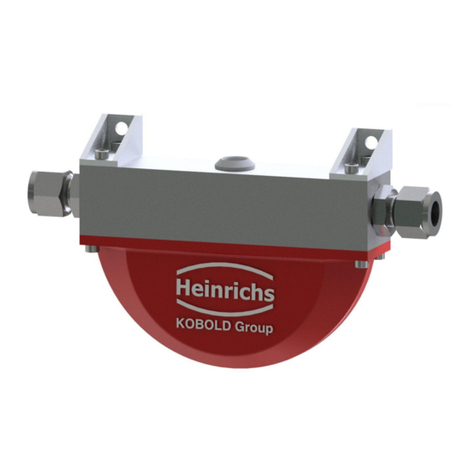
If you have an OEM version (supplied without terminal box), a connector with three wires
will be visible. Depending on the color combination of wires your sensor has, attach
these as follows:
Blue - (-) Ground Blue - (+) VDC
Yellow - Open Collector or Yellow - Open Collector
Red - (+) VDC Green - (-) Ground
You are now ready to mechanically connect the unit.
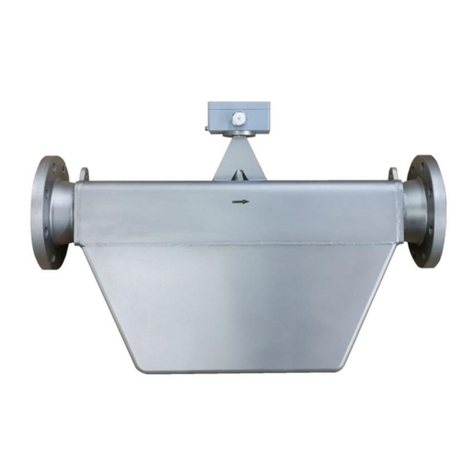
1. The flow direction is indicated by an arrow on the housing. Install the
instrument with the arrows aligned with the flow direction in your pipes. To
achieve the operational design accuracy, output consistency over the entire
measuring range and longest service life, orient the unit so that the axle
always remains in a horizontal plane.
2. Connect with appropriately sized fittings. Take care not to place stresses on
the housing - use a wrench to hold the instrument fittings static while you
tighten the fittings on your pipe. As with any flowmeter, this device must not be
used as a structural member of the piping system to avoid damage.
3. Should there be small amounts of ferrite contaminants in the medium, we
recommend the installation of our magnetic filter (type MFR or equivalent).
4. Medium should always be introduced to the system slowly to avoid pressure
surges which could damage the instrument.
4.0 Operation
The device is delivered with a calibration diagram describing its frequency versus flow
rate behavior. You must use this to calculate rate of flow in your system. Modification of
the sensor (by physically modifying or replacing sensor components) requires
recalibration of the unit.
4.1 - Turning the Unit On
The sensor is operational as soon as it is wired into a power supply.
4.2 - Flow Measurement
A frequency counting device must be used to read the sensor output and convert that
measurement to rate of flow (output frequency is directly proportional to flow rate). The
nature of this relationship is described by the sensor’s “k-factor” which is the number of
pulses the sensor generates per gallon of water flow through the sensor. The device’s
nominal k-factor can be easily calculated with the use of the provided output frequency
(in Hz) and knowing the maximum flow rate of the particular sensor.