manuals.online logo
Brands
  1. Home
  2. •
  3. Brands
  4. •
  5. Lamona
  6. •
  7. Oven
  8. •
  9. Lamona LAM3208 User manual

Lamona LAM3208 User manual

Other Lamona Oven manuals

Lamona LAM3802 Guide

Lamona

Lamona LAM3802 Guide

Lamona LAM3214 Guide

Lamona

Lamona LAM3214 Guide

Lamona LAM3401 Troubleshooting guide

Lamona

Lamona LAM3401 Troubleshooting guide

Lamona LAM3676 Guide

Lamona

Lamona LAM3676 Guide

Lamona LAM4602 User manual

Lamona

Lamona LAM4602 User manual

Lamona LAM4403-1 User manual

Lamona

Lamona LAM4403-1 User manual

Lamona LAM4408 Guide

Lamona

Lamona LAM4408 Guide

Lamona LAM3601 Guide

Lamona

Lamona LAM3601 Guide

Lamona LAM3452 User manual

Lamona

Lamona LAM3452 User manual

Lamona LAM4603 Guide

Lamona

Lamona LAM4603 Guide

Lamona LAM3675 Guide

Lamona

Lamona LAM3675 Guide

Lamona LAM4601 Troubleshooting guide

Lamona

Lamona LAM4601 Troubleshooting guide

Lamona HJA7030 User manual

Lamona

Lamona HJA7030 User manual

Lamona LAM3304 Guide

Lamona

Lamona LAM3304 Guide

Lamona LAM4609 Guide

Lamona

Lamona LAM4609 Guide

Lamona LAM7000 User manual

Lamona

Lamona LAM7000 User manual

Lamona LAM7150 User manual

Lamona

Lamona LAM7150 User manual

Lamona LAM3803 Guide

Lamona

Lamona LAM3803 Guide

Lamona LAM3405 User manual

Lamona

Lamona LAM3405 User manual

Lamona LAM3209 Guide

Lamona

Lamona LAM3209 Guide

Lamona LAM3404 Troubleshooting guide

Lamona

Lamona LAM3404 Troubleshooting guide

Lamona LAM3801 Guide

Lamona

Lamona LAM3801 Guide

Lamona LAM4675 Guide

Lamona

Lamona LAM4675 Guide

Lamona LAM3303 Guide

Lamona

Lamona LAM3303 Guide

Popular Oven manuals by other brands

Brandt FC 222 user manual

Brandt

Brandt FC 222 user manual

aumate TOA20M04N-1E instruction manual

aumate

aumate TOA20M04N-1E instruction manual

Maytag CWE4100AC - 24" Single Electric Wall Oven Dimension Guide

Maytag

Maytag CWE4100AC - 24" Single Electric Wall Oven Dimension Guide

Kernau KBO 1076 S PT B instruction manual

Kernau

Kernau KBO 1076 S PT B instruction manual

Bosch HB 37 N Series User manual and installation instructions

Bosch

Bosch HB 37 N Series User manual and installation instructions

Electrolux EOD5420AA user manual

Electrolux

Electrolux EOD5420AA user manual

Mx Onda MX-HC2183 instruction manual

Mx Onda

Mx Onda MX-HC2183 instruction manual

Daewoo F6EV19SM2 Service manual

Daewoo

Daewoo F6EV19SM2 Service manual

Blodgett MT3870 Specifications

Blodgett

Blodgett MT3870 Specifications

GE ZET2F owner's manual

GE

GE ZET2F owner's manual

GE JK3000DF3WW owner's manual

GE

GE JK3000DF3WW owner's manual

eka EKF 523 NT Operating and instruction manual

eka

eka EKF 523 NT Operating and instruction manual

AEG Electrolux E3191-5 user manual

AEG Electrolux

AEG Electrolux E3191-5 user manual

Pratica Rocket Express quick start guide

Pratica

Pratica Rocket Express quick start guide

Viking Professional VGSO260T user guide

Viking

Viking Professional VGSO260T user guide

FM RX203 instruction manual

FM

FM RX203 instruction manual

Bosch HBN331 9B Series instruction manual

Bosch

Bosch HBN331 9B Series instruction manual

NEFF B95M42N0MK Instructions for use

NEFF

NEFF B95M42N0MK Instructions for use

manuals.online logo
manuals.online logoBrands
  • About & Mission
  • Contact us
  • Privacy Policy
  • Terms and Conditions

Copyright 2025 Manuals.Online. All Rights Reserved.

User Manual
Built-in
Conventional oven
LAM3208
CONTENTS
2noitamrofniytefaS
3snoitcurtsniytefaS
Product description 5
6esutsriferofeB
6esuyliaD
Using the accessories 7
Additional functions 8
8spitdnastniH
Care and cleaning 12
51gnitoohselbuorT
61noitallatsnI
71ycneiciffeygrenE
71eetnaraugruoY
Subject to change without notice.
SAFETY INFORMATION
Before the installation and use of the appliance, carefully read
the supplied instructions. The manufacturer is not responsible
if an incorrect installation and use causes injuries and
damages. Always keep the instructions with the appliance for
future reference.
Children and vulnerable people safety
tThis appliance can be used by children aged from 8 years
and above and persons with reduced physical, sensory or
mental capabilities or lack of experience and knowledge if
they have been given supervision or instruction concerning
use of the appliance in a safe way and understand the
hazards involved.
tDo not let children play with the appliance.
tKeep all packaging away from children.
tKeep children and pets away from the appliance when it
operates or when it cools down. Accessible parts are hot.
tIf the appliance has a child safety device, we recommend
you activate it.
tCleaning and user maintenance shall not be made by
children without supervision.
tChildren of less than 3 years should be kept away unless
continuously supervised.
2
General Safety
tOnly a qualied person must install this appliance and
replace the cable.
tInternally the appliance becomes hot when in operation. Do
not touch the heating elements that are in the appliance.
Always use oven gloves to remove or put in accessories or
ovenware.
tBefore maintenance cut the power supply.
tEnsure that the appliance is switched o before replacing
the lamp to avoid the possibility of electric shock.
tDo not use a steam cleaner to clean the appliance.
tDo not use harsh abrasive cleaners or sharp metal scrapers
to clean the glass door since they can scratch the surface,
which may result in shattering of the glass.
tIf the supply cord is damaged, it must be replaced by the
manufacturer, its Authorised Service Centre or similarly
qualied persons in order to avoid a hazard.
tThe means for disconnection must be incorporated in the
xed wiring in accordance with the wiring rules.
SAFETY INSTRUCTIONS
Installation
WARNING! Only a qualied
person must install this
appliance.
tRemove all the packaging.
tDo not install or use a damaged
appliance.
tObey the installation instruction supplied
with the appliance.
tAlways be careful when you move the
appliance because it is heavy. Always
wear safety gloves.
tDo not pull the appliance by the handle.
tKeep the minimum distance from the
other appliances and units.
tMake sure that the appliance is installed
below and adjacent safe structures.
tThe sides of the appliance must stay
adjacent to appliances or to units with
the same height.
Electrical connection
WARNING! Risk of re and
electrical shock.
tAll electrical connections should be
made by a qualied electrician.
tThe appliance must be earthed.
tMake sure that the electrical information
on the rating plate agrees with the
power supply. If not, contact an
electrician.
tAlways use a correctly installed
shockproof socket.
tDo not use multi-plug adapters and
extension cables.
tMake sure not to cause damage to the
mains plug and to the mains cable.
Should the mains cable need to be
replaced, this must be carried out by our
Authorised Service Centre.
3
tDo not let mains cables touch or come
near the appliance door, especially when
the door is hot.
tThe shock protection of live and
insulated parts must be fastened in such
a way that it cannot be removed without
tools.
tConnect the mains plug to the mains
socket only at the end of the installation.
Make sure that there is access to the
mains plug after the installation.
tIf the mains socket is loose, do not
connect the mains plug.
tDo not pull the mains cable to
disconnect the appliance. Always pull
the mains plug.
tUse only correct isolation devices: line
protecting cut-outs, fuses (screw type
fuses removed from the holder), earth
leakage trips and contactors.
tThe electrical installation must have an
isolation device which lets you
disconnect the appliance from the mains
at all poles. The isolation device must
have a contact opening width of
minimum 3 mm.
tThis appliance complies with the E.E.C.
Directives.
Use
WARNING! Risk of injury,
burns and electrical shock
or explosion.
tUse this appliance in a household only.
tDo not change the specication of this
appliance.
tMake sure that the ventilation openings
are not blocked.
tDo not let the appliance stay unattended
during operation.
tDeactivate the appliance after each use.
tBe careful when you open the appliance
door while the appliance is in operation.
Hot air can release.
tDo not operate the appliance with wet
hands or when it has contact with water.
tDo not apply pressure on the open door.
tDo not use the appliance as a work
surface or as a storage surface.
tOpen the appliance door carefully. The
use of ingredients with alcohol can
cause a mixture of alcohol and air.
tDo not let sparks or open ames to
come in contact with the appliance
when you open the door.
tDo not put ammable products or items
that are wet with ammable products in,
near or on the appliance.
WARNING! Risk of damage to
the appliance.
tTo prevent damage or discoloration to
the enamel:
– do not put ovenware or other
objects in the appliance directly on
the bottom.
– do not put aluminium foil directly on
the bottom of the appliance.
– do not put water directly into the hot
appliance.
– do not keep moist dishes and food
in the appliance after you nish the
cooking.
– be careful when you remove or
install the accessories.
tDiscoloration of the enamel has no eect
on the performance of the appliance. It
is not a defect in the sense of the
warranty law.
tUse a deep pan for moist cakes. Fruit
juices cause stains that can be
permanent.
tThis appliance is for cooking purposes
only. It must not be used for other
purposes, for example room heating.
tAlways cook with the oven door closed.
Care and cleaning
WARNING! Risk of injury, re,
or damage to the appliance.
tBefore maintenance, deactivate the
appliance and disconnect the mains
plug from the mains socket.
tMake sure the appliance is cold. There is
the risk that the glass panels can break.
tReplace immediately the door glass
panels when they are damaged. Contact
the Service.
4

tBe careful when you remove the door
from the appliance. The door is heavy!
tClean regularly the appliance to prevent
the deterioration of the surface material.
tRemaining fat or food in the appliance
tClean the appliance with a moist soft
cloth. Only use neutral detergents. Do
not use abrasive products, abrasive
cleaning pads, solvents or metal objects.
tIf you use an oven spray, obey the safety
instructions on the packaging.
tDo not clean the catalytic enamel (if
applicable) with any kind of detergent.
Internal light
tThe type of light bulb or halogen lamp
used for this appliance is only for
household appliances. Do not use it for
house lighting.
WARNING! Risk of electrical
shock.
tBefore replacing the lamp, disconnect
the appliance from the power supply.
tOnly use lamps with the same
Disposal
WARNING! Risk of injury or
tDisconnect the appliance from the mains
supply.
t
tRemove the door catch to prevent
children and pets to get closed in the
appliance.
PRODUCT DESCRIPTION
General overview
5
4
3
2
1
3 421
6
5
7
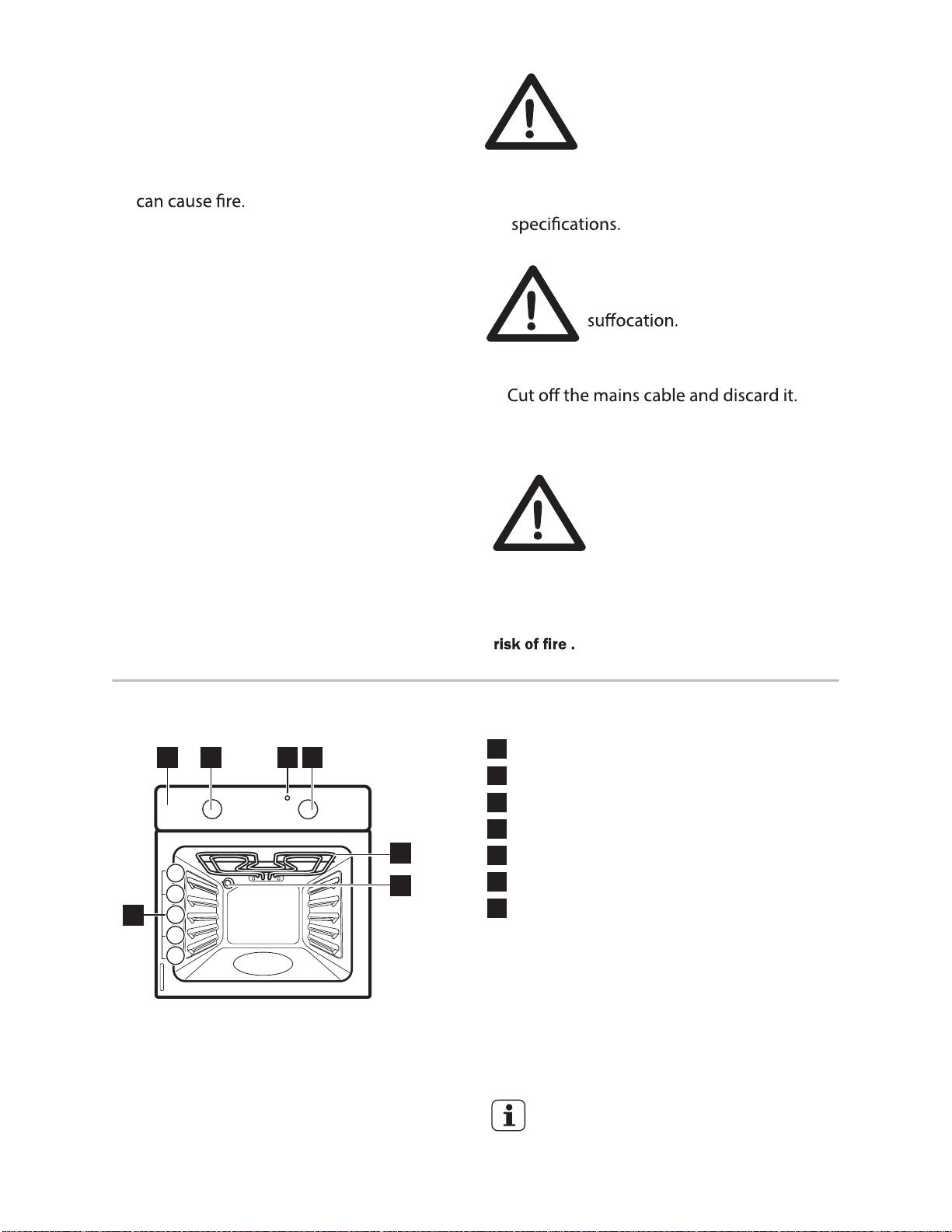
1Control panel
2Knob for the oven functions
3Temperature lamp / symbol / indicator
4Knob for the temperature
5Heating element
6Lamp
7Shelf positions
Accessories
tWire shelf
For cookware, cake tins, roasts.
tGrill- / Roasting pan
To bake and roast or as pan to collect
fat.
tTrivet
For roasting and grilling.
Use the trivet only with the
Grill- / roasting pan.
5
WARNING FIRE RISK -
Do not place aluminium foil, baking trays
or cook on the base of this oven, doing so
will cause permanent damage to your
appliance and cabinetry with the potential
BEFORE FIRST USE
WARNING! Refer to Safety
chapters.
Initial Cleaning
Remove all accessories from the appliance.
Refer to "Care and cleaning"
chapter.
Clean the appliance before rst use.
Put the accessories back to their initial
position.
Preheating
Preheat the empty appliance to burn o the
remaining grease.
1. Set the function and the maximum
temperature.
2. Let the appliance operate for 1 hour.
3. Set the function and the maximum
temperature.
4. Let the appliance operate for 15
minutes.
Accessories can become hotter than usual.
The appliance can emit an odour and
smoke. This is normal. Make sure that the
airow in the room is sucient.
DAILY USE
WARNING! Refer to Safety
chapters.
Activating and deactivating the
appliance
It depends on the model if
your appliance has knob
symbols, indicators or lamps:
tThe indicator comes on when
the oven heats up.
tThe lamp comes on when
the appliance operates.
tThe symbol shows whether
the knob controls the oven
functions or the temperature.
1. Turn the knob for the oven functions to
select an oven function.
2. Turn the knob for the temperature to
select a temperature.
3. To deactivate the appliance turn the
knobs for the oven functions and
temperature to the o position.
Oven functions
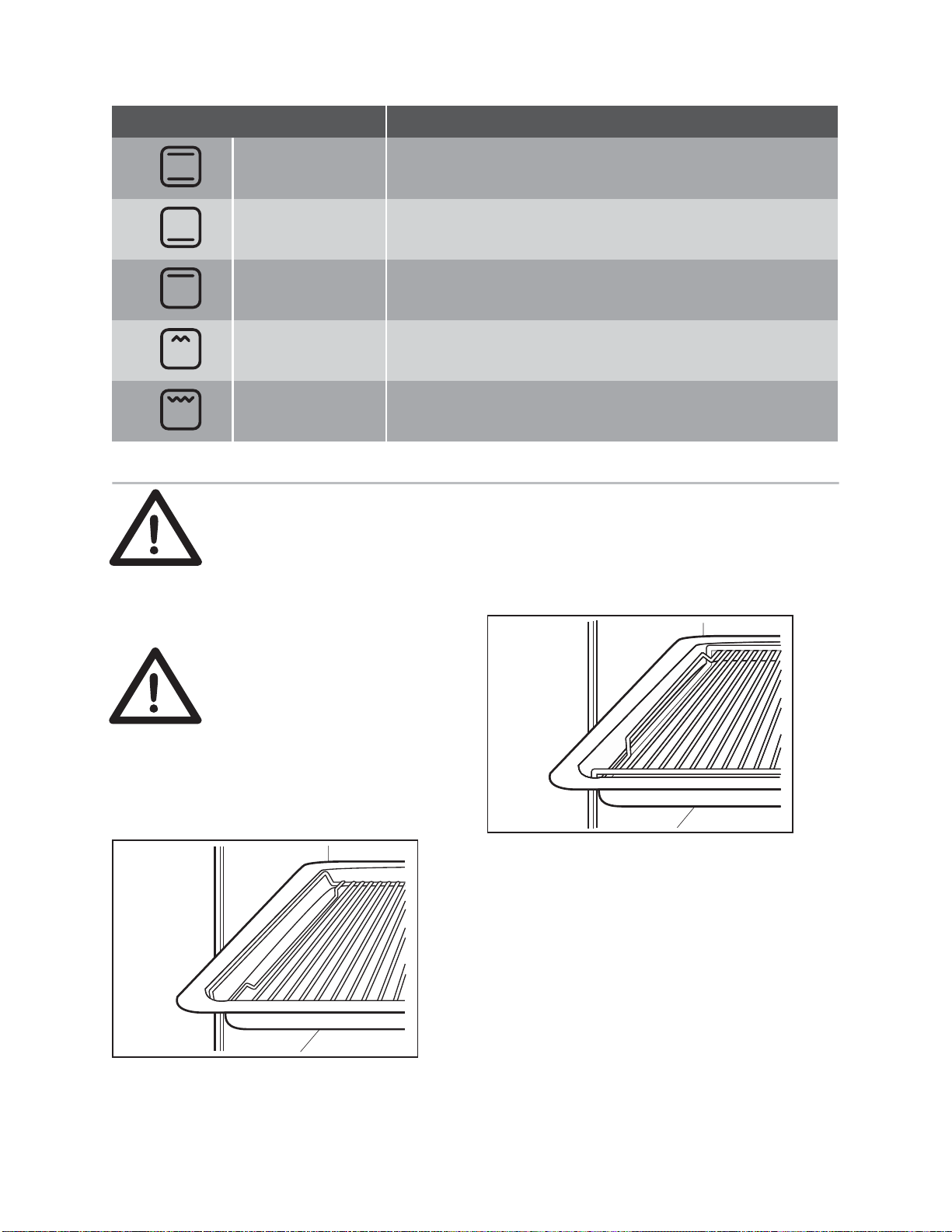
Oven function Application
O position The appliance is o.
6
Oven function Application
Conventional
Cooking
To bake and roast food on 1 shelf position.
Bottom Heat To bake cakes with crispy bottom and to preserve food.
Top Heat To brown bread, cakes and pastries. To nish cooked
dishes.
Grilling To grill at food and to toast bread.
Fast Grilling To grill at food in large quantities and to toast bread.
USING THE ACCESSORIES
WARNING! Refer to Safety
chapters.
Trivet and Grill- / Roasting pan
WARNING! Be careful when
you remove the accessories
from a hot appliance. There is a
risk of burns.
You can use the trivet to roast larger pieces
of meat or poultry on one shelf position.
1. Put the trivet into the deep pan so that
the supports of the wire shelf point up.
2. Put the deep pan into the oven on the
necessary shelf position.
You can use the trivet to grill at dishes in
large quantities and to toast.
1. Put the trivet into the deep pan so that
the supports of the wire shelf point
down.
2. Put the deep pan into the oven on the
necessary shelf position.
7
ADDITIONAL FUNCTIONS
Cooling fan
When the appliance operates, the cooling
fan activates automatically to keep the
surfaces of the appliance cool. If you
deactivate the appliance, the cooling fan
can continue to operate until the appliance
cools down.
Safety thermostat
Incorrect operation of the appliance or
defective components can cause
dangerous overheating. To prevent this, the
oven has a safety thermostat which
interrupts the power supply. The oven
activates again automatically when the
temperature drops.
HINTS AND TIPS
WARNING! Refer to Safety
chapters.
The temperature and baking
times in the tables are guidelines
only. They depend on the
recipes and the quality and
quantity of the ingredients used.
General information
tThe appliance has ve shelf positions.
Count the shelf positions from the
bottom of the appliance oor.
tMoisture can condense in the appliance
or on the door glass panels. This is
normal. Always stand back from the
appliance when you open the appliance
door while cooking. To decrease the
condensation, operate the appliance for
10 minutes before cooking.
tClean the moisture after each use of the
appliance.
tDo not put the objects directly on the
appliance oor and do not put aluminium
foil on the components when you cook.
This can change the baking results and
cause damage to the enamel.
Baking cakes
tDo not open the oven door before 3/4 of
the set cooking time is up.
tIf you use two baking trays at the same
time, keep one empty level between
them.
Cooking meat and sh
tUse a deep pan for very fatty food to
prevent the oven from stains that can be
permanent.
tLeave the meat for approximately 15
minutes before carving so that the juice
does not seep out.
tTo prevent too much smoke in the oven
during roasting, add some water into the
deep pan. To prevent the smoke
condensation, add water each time after
it dries up.
Cooking times
Cooking times depend on the type of food,
its consistency, and volume.
Initially, monitor the performance when you
cook. Find the best settings (heat setting,
cooking time, etc.) for your cookware,
recipes and quantities when you use this
appliance.
8
!@JHMF@MCQN@RSHMFS@AKD
"
"@JDR
%NNC "NMUDMSHNM@K"NNJHMF 3HLDLHM "NLLDMSR
3DLODQ@STQD
§"
2GDKEONRHSHNM
6GHRJDCQDB
HODR
   (M@B@JDLNTKC
2GNQSAQD@C
CNTFG
   (M@B@JDLNTKC
!TSSDQLHKJ
BGDDRDB@JD
   (M@BL
B@JDLNTKC
OOKDB@JD O
OKDOHD
   (MSVNBL
B@JDLNTKCRNM
@VHQDRGDKE
2SQTCDK    (M@A@JHMFSQ@X
)@LS@QS    (M@BL
B@JDLNTKC
2ONMFDB@JD    (M@BL
B@JDLNTKC
"GQHRSL@R
B@JD1HBGEQTHS
B@JD
   (M@BL
B@JDLNTKC
/KTLB@JD    (M@AQD@CSHM
2L@KKB@JDR
NMDKDUDK
   (M@A@JHMFSQ@X
2L@KKB@JDR
SVNKDUDKR
   (M@A@JHMFSQ@X
2L@KKB@JDR
SGQDDKDUDKR
   (M@A@JHMFSQ@X
!HRBTHSRO@RSQX
RSQHODRNMD
KDUDK
   (M@A@JHMFSQ@X
!HRBTHSRO@RSQX
RSQHODRSVN
KDUDKR
   (M@A@JHMFSQ@X
!HRBTHSRO@RSQX
RSQHODRSGQDD
KDUDKR
   (M@A@JHMFSQ@X

%NNC "NMUDMSHNM@K"NNJHMF 3HLDLHM "NLLDMSR
3DLODQ@STQD
§"
2GDKEONRHSHNM
,DQHMFTDR
NMDKDUDK
   (M@A@JHMFSQ@X
,DQHMFTDRSVN
KDUDKR
   (M@A@JHMFSQ@X
!TMR    (M@A@JHMFSQ@X
$BK@HQRNMD
KDUDK
   (M@A@JHMFSQ@X
$BK@HQRSVN
KDUDKR
   (M@A@JHMFSQ@X
/K@SDS@QSR    (M@BL
B@JDLNTKC
1HBGEQTHSB@JD    (M@BL
B@JDLNTKC
5HBSNQH@R@MC
VHBG
   (M@BL
B@JDLNTKC
/QDGD@SSGDNUDMENQLHMTSDR
!
!QD@C@MCOHYY@
%NNC "NMUDMSHNM@K"NNJHMF 3HLDLHM "NLLDMSR
3DLODQ@STQD
§"
2GDKEONRHSHNM
6GHSDAQD@C    OHDBDR
FQODQ
OHDBD
1XDAQD@C    (M@AQD@CSHM
!QD@CQNKKR    QNKKRHM@
A@JHMFSQ@X
/HYY@    (M@A@JHMFSQ@X
NQ@CDDOO@M
2BNMDR    (M@A@JHMFSQ@X
/QDGD@SSGDNUDMENQLHMTSDR
