LEROY-SOMER
INSTALLATION AND MAINTENANCE
Ref : 100080 Rev : 0
CPLS
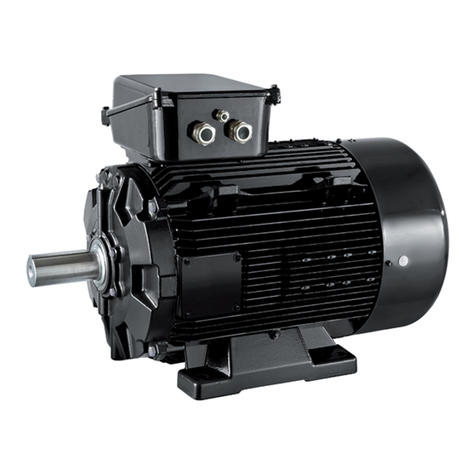
Drip-proof 3-phase induction motors
4
1.2 - Storage
Prior to commissioning, machines should be stored:
- Away from humidity: for relative humidity greater
than 90% the machine insulation can drop very
quickly and become virtually non-existent at around
100%; check the anti-rust protection on unpainted
parts.
For very long storage periods the motor can be
placed in a sealed package (for example heat-
shrunk plastic) containing sachets of desiccant.
- Protected from frequent significant temperature
variations to prevent any condensation during
storage.
- If the area is subject to vibration, try to reduce the
effect of this vibration by placing the motor on a
damping support (rubber plate or similar) and turn
the rotor a fraction of a turn once a fortnight to
prevent the bearing rings from becoming marked.
Even if the motor has been stored in the correct
conditions, some checks must be carried out before
it is started up
Greasing
Bearings that cannot be regreased
Maximum storage: 3 years. After this time, replace
the bearings (see section 6.1).
Bearings that can be regreased
Greases used by LEROY-SOMER
CPLS motors are lubricated with EXXON UNIREX
N3 grease used as standard. (Grade 3)
.
2 - ASSEMBLY
2.1 - Checking the insulation
Before starting the motor, it is advisable to
check the insulation between the phases and
earth, and between phases.
This check is essential if the motor has been stored
for longer than 6 months or if it has been kept in a
damp atmosphere.
This measurement must be carried out using a
megohmmeter at 500 V DC (do not use a magneto-
electric system). It is better to carry out an initial test
at 30 or 50 volts and if the insulation is greater than
1 megohm, carry out a second test at 500 volts for
60 seconds. The insulation value must be at least
10 megohms in cold state.
If this value cannot be achieved, or if the motor may
have been splashed with water or salt spray, or kept
for a long period in a very humid place or if it is
covered with condensation, it is advisable to dry the
stator for 24 hours in a drying oven at a temperature
of between 110°C and 120°C.
If it is not possible to place the motor in a drying
oven:
- Switch on the motor, with the rotor locked, at 3-
phase A.C. voltage reduced to approximately 10%
of the rated voltage, for 12 hours (use an induction
regulator or a reduction transformer with adjustable
outlets).
- Or supply the 3 phases in series with a D.C.
current, with the voltage at 1 to 2% of the rated
voltage (use a D.C. generator with independent
excitation or batteries for motors of less than 22kW).
- NB: The A.C. current must be monitored using a
clamp ammeter, and the D.C. current using a shunt
ammeter. This current must not exceed 60% of the
rated current. It is advisable to place a thermometer
on the motor housing: if the temperature exceeds
70°C, reduce the indicated voltage or current by 5%
of the original value for every 10°difference.
While it is drying, all the motor orifices must be open
(terminal box)
Warning: If the high voltage test, carried out
at the factory before despatch, needs to be repeated, it
should be performed at half the standard voltage.
ie: 1/2 (2U+1000V).
Prior to commissioning for all motors:
Rotate the motor at no load (no mechanical load) for 2
to 5 minutes, checking that there is no abnormal
noise. If there is any abnormal noise, see section 5.
Before testing at no load and without
coupling, secure the key!