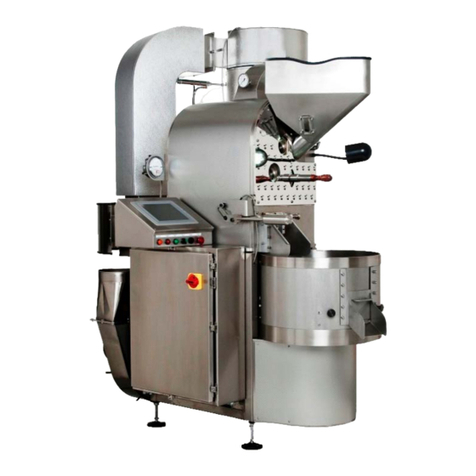
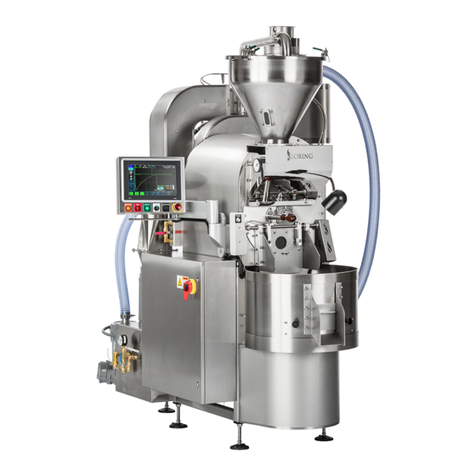
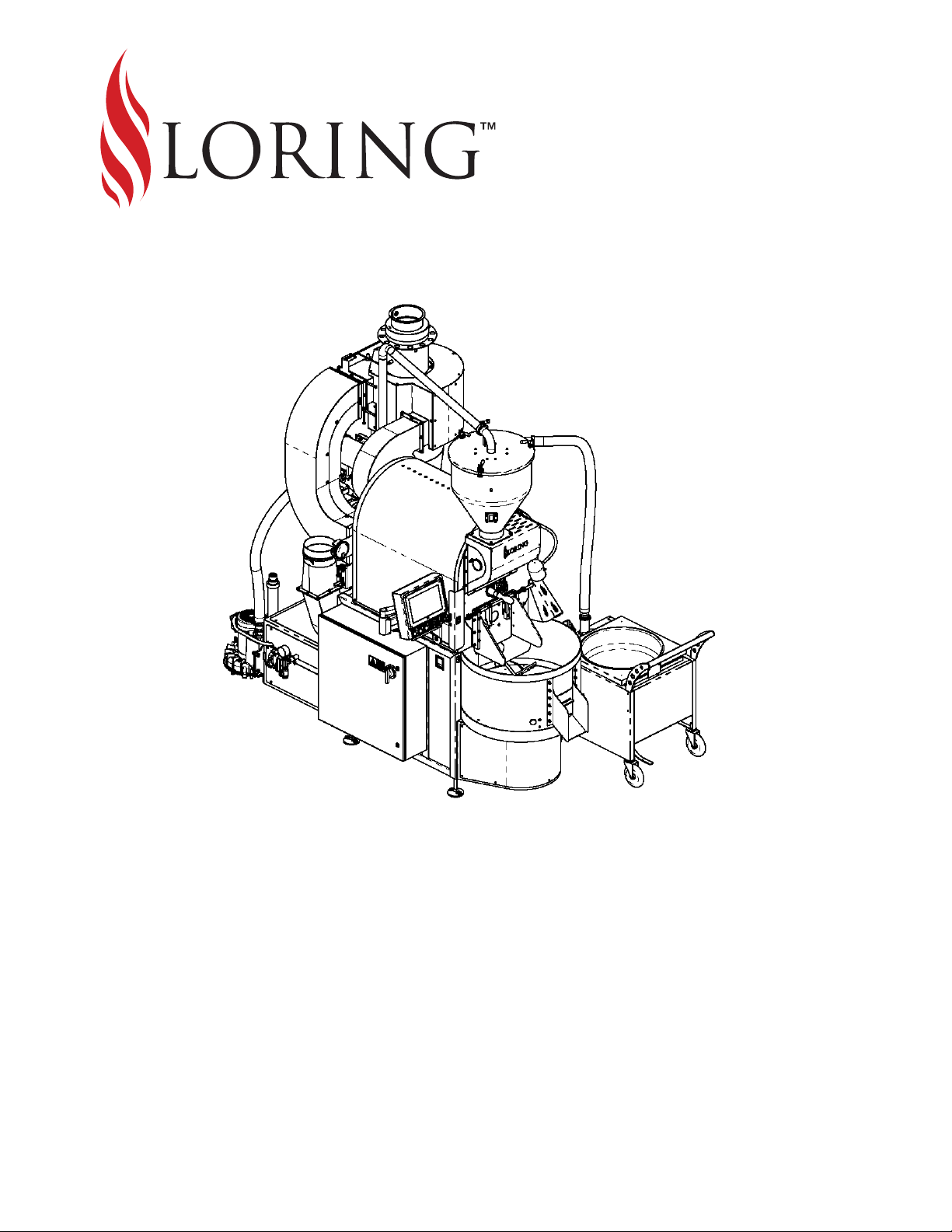
S35 Pre-Installation and Site Preparation Guide
Page 8 of 52 Loring Smart Roast Proprietary – This document is controlled by
Document Control. By printing this document, it will become a “Reference” copy.
Users are responsible for verifying that it is the latest revision available.
1006705 Rev B
Additional Documentation
The following additional documentation is available to aid with installation and setup. Contact your
Loring Account Representative for more information.
• Welcome Packet. The Welcome Packet contains detailed instructions and information sent
by Loring to each new customer upon purchase of a coffee roaster. One item, the Product
Specication Form, must be completed and returned to Loring in order for Loring to begin
building the roaster.
• Product Specication Form (PSF). The customer must provide information to Loring
regarding the site’s utility characteristics. This information is used to congure the roaster at the
factory, a process that requires several weeks’ lead time. Loring strongly recommends working
with a licensed professional contractor when providing this information. This form is included in
the Welcome Packet.
• Suggested Stack Manufacturers. One of the items in the Welcome Packet is a list of
recommended manufacturers of stack ventilation components. Loring recommends ordering
stacks 6 weeks prior to the arrival of the roaster.
• Installation and Assembly Guide. After receiving the coffee roaster, the customer must
engage with a licensed general contractor to assemble, position, and hook up the roaster to
various utilities and stack ventilation.
• Mechanical Interface Control Documents (MICDs). These technical drawings provide
detailed information on system dimensioning and components, as well as system weights. They
are intended for permit submittals and for use by general contractors, as well as by architects
and facilities planners. These drawings are available upon request from Loring.
• Special Reports for Permitting. Additional reports on various technical subjects are
available from Loring. Each customer may need to satisfy unique local or regional regulatory
requirements. For example, air quality reports are typically required, and some locations may
require both county and city permits.
The Product Specication Form (PSF) conveys extremely
important customer information regarding the customer
site’s power supply voltage and network conguration.
Loring requires this form to be completed by the customer
a minimum of 9 weeks prior to production completion.
Any delay in providing any portion of this information can
delay the roaster production by a corresponding number of
weeks.