SAFETY PRECAUTIONS
PREPERATION
PREPERATIONPREPERATION
PREPERATION
▶ Move t e w eels to t e tractor manufacturer's widest recommended settings to increase stability.
▶
▶ Add rear ballast or rear weig t to t e tractor to compensate for t e load and increase stability.
▶ Add recommended rear trie liquid weig t or rear w eel weig ts for increased stability.
▶
▶
▶
BEFORE OPERATION
BEFORE OPERATIONBEFORE OPERATION
BEFORE OPERATION
▶
▶
OPERATION
OPERATIONOPERATION
OPERATION
T e loader may s ift during s ipping and andling, making it unstable on t e pallet. Support loader wit
an over ead oist or ot er suitable means prior to removing bands or attac ing straps securing loader
to pallet. Failure do so could result in accidental tip-over of t e loader t at could cause serious injury to
Before starting t e engine of your tractor, make sure all operating controls are in park lock or neutral
For better stability, always use a tractor equipped wit a wide front axle, never use a tractor equipped
wit a tricycle type front axle.
Do not modify, alter, or permit anyone else to modify or alter t e loader, any of its components, or any
loader function wit out first consulting a LS Mtron dealer.
Assemble, remove, and reinstall t e loader only as directed in t is manual. Failure to do t is could
result in serious personal injury or deat .
Be certain lig ts and safety markings, as provided by t e tractor manufacturer, are clean and operating
w en transporting t e tractor/loader on public roads. Be certain t at t e Slow Moving Ve icle (SMV)
emblem is visible. C eck wit local law enforcement for specific requirements.
SAFETY PRECAUTIONS
SAFETY PRECAUTIONSSAFETY PRECAUTIONS
SAFETY PRECAUTIONS
5
OPERATION
OPERATIONOPERATION
OPERATION
▶
▶ Additional counterweig t requirements will vary wit loader attac ments and equipment application.
▶ Move and turn t e tractor at low speeds.
▶ Carry loader boom at a low position during normal operation.
▶ Never travel at ig speeds wit bucket loaded.
▶ Use caution w en operating t e loader wit a raised bucket or attac ment.
▶
▶ Allow for t e loader lengt w en making turns.
▶ Use caution w en anding loose or unstable loads.
▶ Gradually stop t e loader boom w en lowering or lifting loads.
▶
▶
▶
▶ Be careful during loading, transporting, and stacking to minimize rolling bales and tractor tip over.
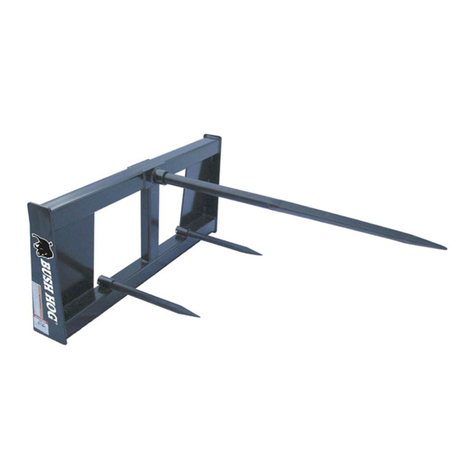
▶ Do not use buckets, forks, or ot er attac ments wit out bale retaining devices.
▶
▶
A loader attac ment s ould be transported in a low position at slow ground speeds. Make turns slowly
and use t e tractor brakes cautiously. A loaded attac ment in t e raised position alters t e center of
gravity location of t e mac ine and increases t e possibility of mis aps.
Operate t e tractor and loader suc t at complete control and mac ine stability is maintained at all
W en using a loader, be alert of bucket or attac ment position at all times. Loader in raised position
wit bucket or attac ment rolled back can dump material onto tractor causing damage or injury to
Add w eel ballast and/or rear weig t to counterbalance tractor/loader for stability at maximum loader
Avoid driving over loose fill, rocks, oles, or anyt ing t at may be dangerous for loader operation or
W en using remote ydraulic tractor valves on some tractors, t e loader lift and dump cylinders will
continue moving unless t e valve andle/ andles are manually returned to neutral, or until relief
pressure is reac ed at t e ends of piston strokes. Observe t e bucket movement and maintain control
Travel speed s ould be suc t at complete control and mac ine stability is maintained at all times.
W ere possible, avoid operating near ditc es, embankments, and oles. Reduce speed w en turning,
crossing slopes, and on roug , slick or muddy surfaces.
All manuals and user guides at all-guides.com