- 4 -
SAFETY INFORMATION
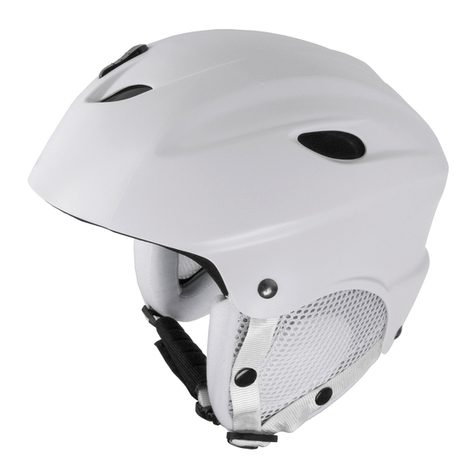
Before purchasing a helmet, Please follow Step A all the way through Step D below carefully.
WARNING
No helmet can protect the wearer against all possible impacts.
For maximum protection, the helmet must fit firmly on the head, and all retention straps must be securely fastened.
With the chinstrap comfortably but firmly adjusted, it should not be possible, in most cases, for the helmet to be
removed from the head when pulled at the rear in an upward direction.
The helmet is designed to be retained by a strap under the chin.
No attachments should be made to the helmet except those recommended by the helmet manufacturer. Do
not drill or cut the shell.
The helmet is designed to absorb shock by partial destruction of the shell and liner. This damage may not
be visible. Therefore if it subjected to a severe blow, the helmet should be replaced even if it is apparently
undamaged.
The liner is essential to the intended performance of the helmet.
The helmet may be damaged and rendered ineffective by petroleum products, cleaning agents, paints,
adhesives, etc., without the damage being visible to the user. Use only warm soapy water to clean the helmet
surface. Do not apply paint, stickers, petrol or other solvents to this helmet.
A. TO DETERMINE PROPER FIT
1. Measure your head size. Pass a tape measure horizontally around your head at a height of about one
inch (2.5 cm) above your eyebrows that results in the largest measurement.
2. Select the helmet that is closest to your head size with the above measurement. As the helmet may not
always exactly meet your head size and if your head measurement falls between two helmet size, first try
on the smaller size.
B. TRY THE HELMET ON
Expand the helmet opening with your hands, and slide your head into the helmet. Pull the chin straps only,
not the chin strap covers. Pulling on the covers may rip them. If the helmet is not tight, it is too big for you.
If you are unfamiliar with helmets you may be reluctant to pull down the helmet, which should feel tight.
Even if you feel it is difficult to put it on, please use the smallest helmet possible. You should feel a snug fit.
- 5 -
C. CHECK FOR A PROPER FIT. WITH THE HELMET ON,
GO THROUGH THE FOLLOWING CHECKLIST TO DETERMINE WHETHER THE HELMET IS THE CORRECT SIZE
1. Check whether the helmet inner lining fits snugly all around your head.
2. Check whether the top pad presses closely on the top of your head.
3. Check whether the cheek pads are in contact with your cheeks.
4. Check to make sure there is no space around your brow under the inner lining, where you can insert
your fingers.
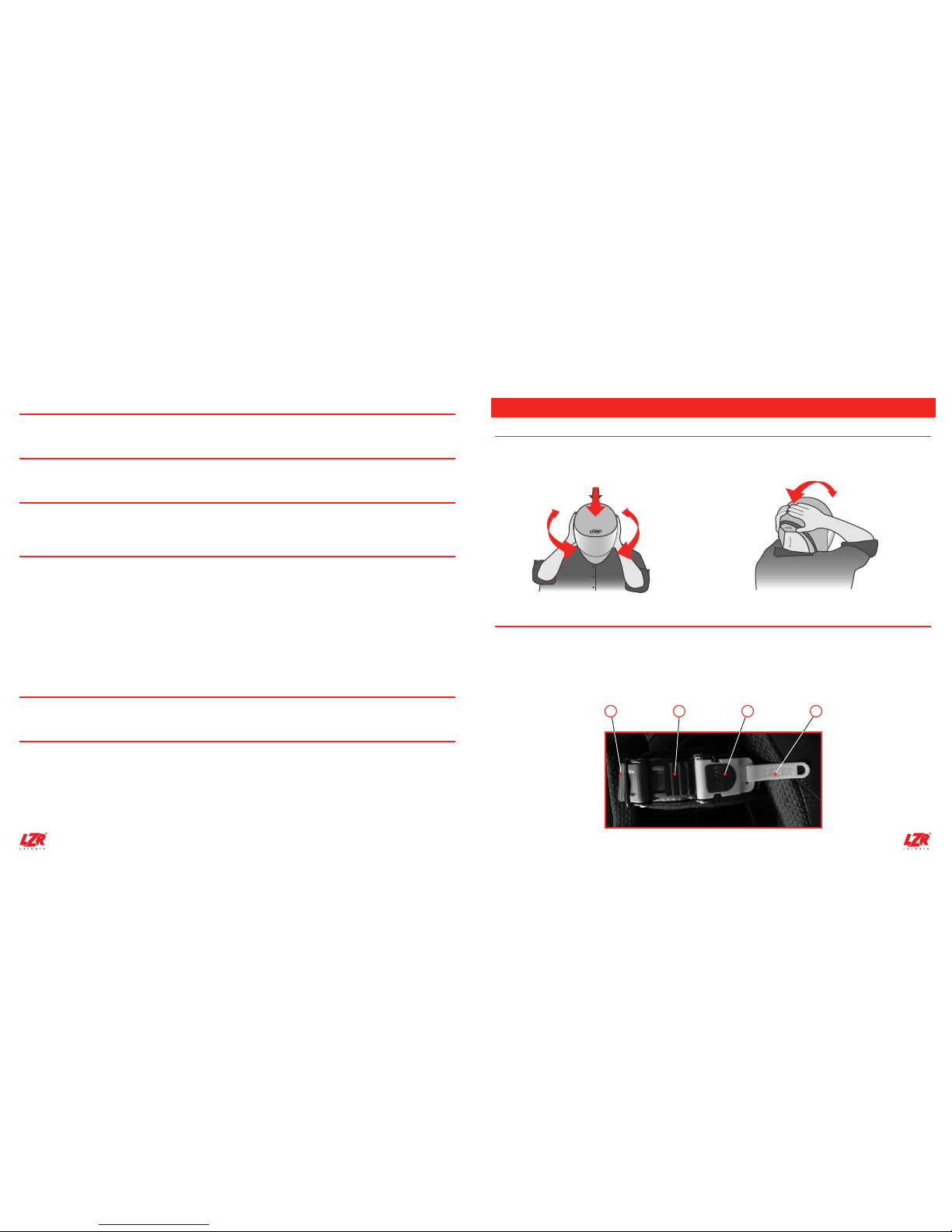
5. Now, take hold of the helmet with a hand on each side. Without moving your head, try to move the helmet
up and down, and side to side to side. You should feel the skin of your head and face being pulled as you
try move the helmet. If you can move the helmet around easily, it is too big. Try a smaller size.
D. CHECK THE RETENTION SYSTEM AND GO THROUGH THE FOLLOWING STEPS
1. Fasten the chinstrap as tight as possible without causing you pain. There must be no slack in the strap
and it must be tight up against your throat.
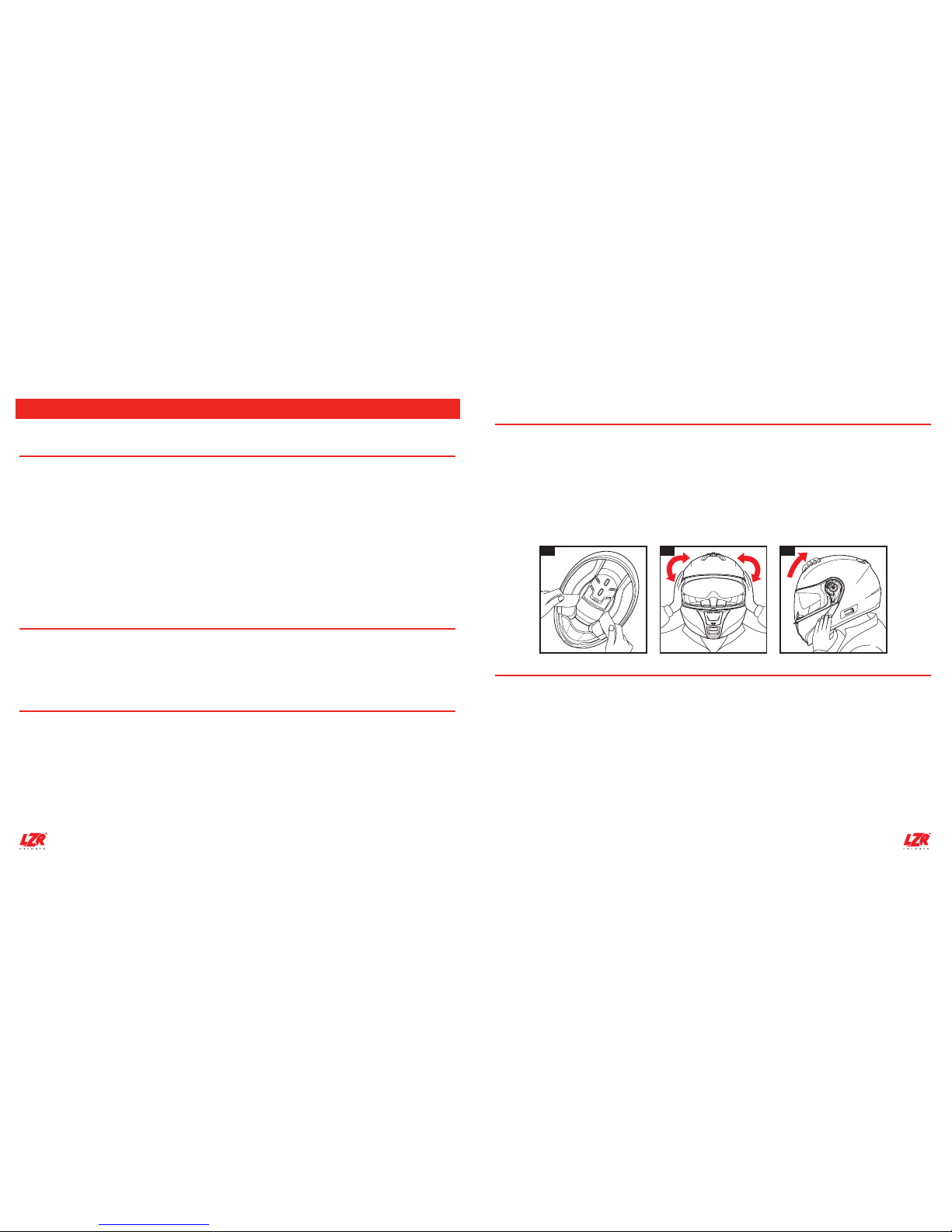
2. With the chinstrap secured, put your hands flat on the back of the helmet and try to push the helmet off
by rotating it forward.
3. Next, put your hands on the front of the helmet above your forehead (or on the chin guard) and try to
push the helmet off by rotating it toward the rear.
4 . If the helmet starts to come off in either direction, do not use the helmet. Either the helmet is too large for
you or the chinstrap is not tightened enough.
- 5 -