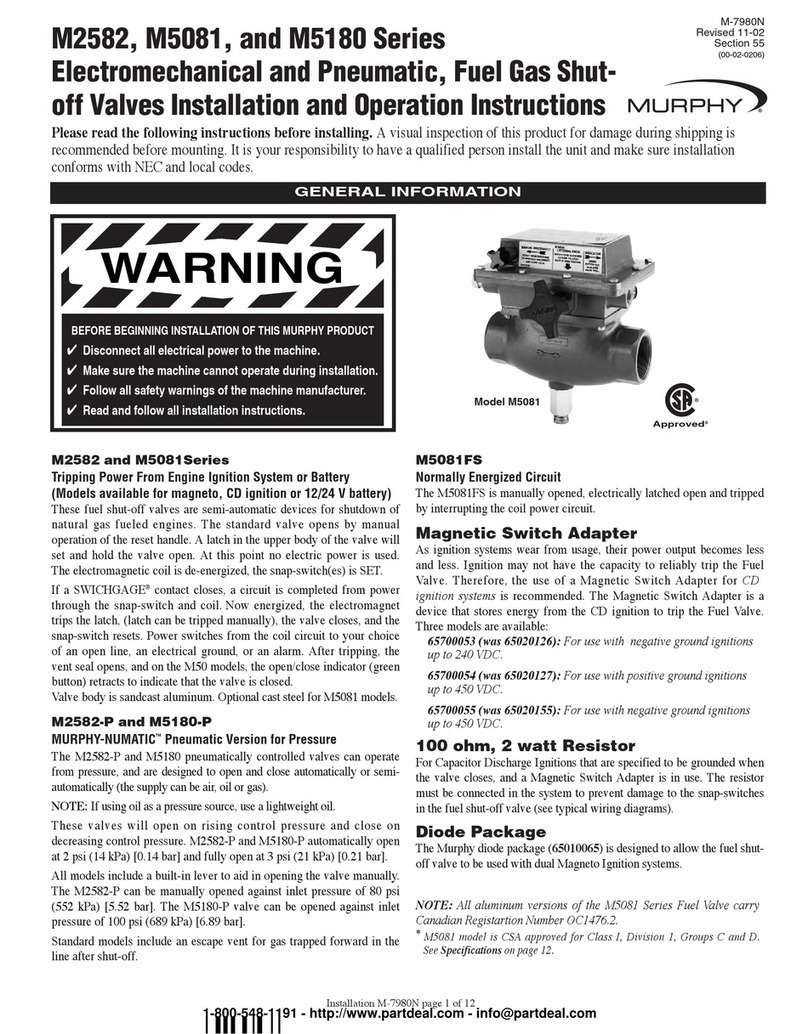
Installation 00-02-0483 page 3of 4
Suggested Tools
(Sizes listed are wrench openings.
Adjustable crescent wrenches, socket and/or end wrench, pipe
wrenches, flat edge screwdriver with 1/4” blade width, can also
be used .)
Replacing the Plug and Seat
1
. Close the pressure block valves (suction & discharge valves) on the inlet
and outlet of the skid. Lock them closed if possible.
2
. Open the blowdown valve to remove pressure from the unit. Lock the
blowdown valve open if possible.
3
. After taking all possible precautions to insure there is no pressure in the
vessel. (If the condensate line is pressurized, it must also be blocked and
locked.) Open the manual drain valve so it bleeds into the vessel so it
can also be bled down. Disconnect the pneumatic input signal connection
after insuring it also has been de-pressurized.
4
. Using a back-up wrench on the valve body, with a quick "breaking"
action loosen the union nut on the valve. There is a "weep" hole in the
nut. If at any time while loosening and taking off the nut pressure is
escaping through the "weep" hole, immediately stop loosening the nut.
Retighten the nut and check the preceding procedures to ensure the pres-
sure is bled off the vessel. Never remove the assembly if pressure is
coming through the weep hole. See Figure 4 on page 2.
5
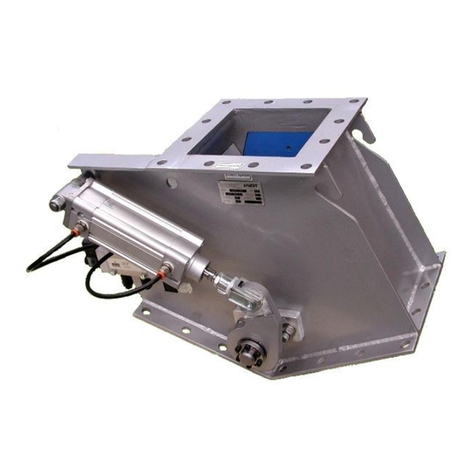
. With the upper assembly removed from the vessel the plug and/or seat can
be replaced. Loosen the 9/16” jam nut on the maintenance bolt on top of
the diaphragm cover. Spin the nut up against the head of the bolt. Tighten
the bolt to extend the shaft and plug. DO NOT OVERTIGHTEN.
6
. Using a back-up wrench on the plug, remove the stem nut on the shaft
under the plug. Once the stem nut is broken loose, the 9/16” head main-
tenance bolt and top assembly will keep the stem from turning. The
plug turns freely on the stem once loose. The plug and seat can now be
removed. All soft seals should be replaced. Refer to kit part numbers
under service parts on page 4.
7
. Install the seat and plug. Place the O-ring on the stem, followed by the
washer and stem nut.
8
. Tighten the stem nut. Loosen the 9/16” head maintenance bolt by at least one
turn past the point where it is no longer in contact with the stem. Tighten the
9/16" jam nut holding the 9/16” head maintenance bolt.
9
. Replace the crush washer and the O-ring hidden by the union nut.
NOTE: If pressure or fluid comes out the weep hole of the union nut,
either the O-ring under the union nut is leaking, or the packing could be
leaking through the internal weep hole above that O-ring.
10
. The assembly is ready to be re-installed. Check for relative position of
the pneumatic input signal connections before tightening the union nut.
Washer(s)*
*Number of washers varies depending on the model from 1 to 3.
Stem
Nut O-Ring
Plug
Crush Washer SealSeat butts into here
O-Ring Seals
Against Outlet
Stem
Seat
Stem
Packing
Diaphragm
Assembly
Pressure Inlet
Seal Washer Maintenance
Bolt
1-1/8" or
1" round nut
Backup
Plate
Stem Spring
Diaphragm
Diaphragm
Housing
1/2" Nut
REPAIR PROCEDURE
CAUTION:
THE INSTALLATION AND REPAIR PROCEDURES SHOULD
ONLY BE PERFORMED BY TRAINED, QUALIFIED, AND EXPERIENCED
PERSONNEL. THE TRAINING, QUALIFICATION AND EXPERIENCE
REQUIRED IS FOR WORK AROUND PRESSURE VESSELS, NATURAL GAS, POSSI-
BLY SOUR GAS, OR ANY SUBSTANCE TO BE FOUND IN THE VESSEL. EXTREME
CARE MUST BE TAKEN TO INSURE ANY RESIDUAL OR FULL PRESSURE IS
RELIEVED FROM ALL PARTS OF THE SYSTEM TO BE SERVICED.
Fig. 5
Fig. 6
Model
Valve Body Union Nut Plug Seal Hex Stem Nut
DVU150/DVU175 2-1/4” 2-1/4” 3/4” 3/8”
DVU2105 3” 3” 1-1/4” 1/2”
DVU2115 3” 3” 1” 1/2”
DVU2120 3” 3” 7/8” 1/2”
Replacing the Diaphragm
6A.If the diaphragm is to be replaced, all preceding steps have to be
done. Additionally, do the following:
6B. Loosen the 9/16” head maintenance bolt, allowing the
diaphragm spring to relax, and the stem to retract. Make align-
ment marks on the top and bottom halves of the diaphragm
assembly for alignment during re-assembly.
6C. Remove the 8, 7/16" bolts/nuts holding the diaphragm housing
together.
6D. Using a straight edge screwdriver, gently separate the 2 halves
of the diaphragm housing, and remove the top, or outside por-
tion.
6E. Lift the diaphragm and support plates far enough for the 1-1/8"
hex or 1” round nut on the bottom of the diaphragm assembly to
be accessible to a wrench and not have the spring interfere. If it
is desired to replace the packing, pull the stem all the way out.
The packing can be easily removed using a small screwdriver to
pry the packing out. The new packing can be simply pressed in,
making sure the orientation of the packing installed is the same
as the orientation of the packing removed. The packing is wider
toward the plug end. You will have to use the seat to hold the
packing in place when re-inserting the stem.
6F.With the 1-1/8" hex or 1” round nut held by a wrench, use a
wrench to loosen and remove the 1/2" nut on top of the
diaphragm. The diaphragm can now be removed and replaced.
6G. With the new diaphragm in place and the 1/2" nut tightened,
place the assembly, diaphragm down on a clean, smooth sturdy
surface.
6H.Have the seat, plug, washers and stem nut handy (if any of these
parts are to be replaced, use the old parts for this procedure).
Press down evenly and smoothly on the bottom of the
diaphragm assembly to cause stem to come up. Place the seat
and plug in place. Then push the bottom of the diaphragm
assembly down far enough to install the washers and stem nut
on the stem. Tighten the stem nut enough to hold against the
diaphragm spring.
6J.Align the diaphragm holes to the bolt holes (bottom half of the
housing). Install the upper diaphragm housing using the align-
ment marks from step 6B. Install the 8, 7/16" bolts and nuts.
Tighten the bolts evenly going from one bolt then 180° around
to the next bolt, then either 120°or 240°around to the next bolt
and so forth until all 8 bolts are evenly tight.
6K. Using the 9/16” head maintenance bolt, tighten, pushing the
stem out until the 9/16"bolt stops – DO NOT OVERTIGHTEN.
6L. Remove the stem nut holding the plug. (If old parts were used,
prepare to install the new parts now.)