67
ES
4.4 LIFE SPAN
The operational life span of the OCTAGON reserve parachute should
not exceed 10 years. If past that period, the product is deemed to be
B.E.R (beyond economical repair) and should be removed from service,
not to be used again (contact your local dealer or school on the correct
way to dispose of the reserve parachute).
4.5 REPAIRS
Repairs of the reserve parachute should be made by a professional
certied outt using genuine parts, materials, fabric and threads
matching the original strength and colours.
All threads stitching should have 6.5-11 stitches per inch, overlapping
stitch row at least 2-inches.
Zigzag stitching should extend at least 1/2-inch into the undamaged
stitching at each end. Re-stitching should be made directly over the ori-
ginal stitching, following the original stitch pattern as closely as possible.
All thread on the canopy should be V-T-295e, Type 2, Class A, Size E
and applied with a light or medium duty machine.
CAUTION!
Any repairs should only be carried out by the manufacturer or by an
approved agent. This will ensure that the correct materials and repair
techniques are used.
5. SAFETY AND RESPONSIBILITY
It is well known that paragliding is considered a high-risk sport, where
safety depends on the person who is practicing it.
Wrong use of this equipment may cause severe injuries to the pilot,
The materials used in the OCTAGON rescue have been carefully
selected for maximum durability. Nevertheless, maintaining your
rescue following the guidelines below will extend its lifetime.
4.2 STORAGE
Unnecessary exposure to UV rays, heat and humidity should always
be avoided. Keep your harness and reserve parachute in your rucksack
when not in use. Store all your paragliding equipment in a cool, dry
place, and away from solvents such as grease, acid, oil, paint and
abrasive materials.
Never stow your reserve parachute when damp or wet. If your reserve
parachute does ever get wet (i.e. water landings or snow), it must be
taken out of the harness, allowed to dry in a shaded area and properly
repacked before inserting it back into the reserve parachute container.
A dirty reserve parachute canopy or container can be cleaned with
lukewarm water. Mild soap may be used if necessary without rubbing
the fabric. Do not use caustic chemicals.
Rinse the canopy thoroughly and allow it to dry naturally. If the
canopy shows signs of mildew, it must be sent to the distributor or
manufacturer for repair, as its integrity could be compromised.
If the rescue parachute is to be stored for an extended period, the
canopy should be opened and loosely rolled.
Observe the following precautions: use care in handling packed
parachutes in case you cause any damage. Damage to the canopy
materials could result from watches, rings, bracelets, etc. Protect the
parachute from damaging elements, dust, oil, grease and caustic pro-
ducts. Place the unpacked reserve parachute in aviator kit bag/duffel
bag. When not in use, cover the canopy. Avoid prolonged exposure to
sunlight, inspection lights or orescent lights. Nylon material is sub-
ject to deterioration under ultraviolet light. If available, use a climate
controlled building to store parachutes. Store the parachute in a dry,
well-ventilated location, away from dampness, re, dirt, insects and
direct sunlight.
Use a climate controlled building to store parachutes when available.
Store parachute in a dry, well-ventilated location, dampness,re, dirt,
insects, and direct sunlight.
CAUTION!
Leaving the packed parachute system exposed to the sun will greatly
decrease its service life.
4.3 CHECKS AND CONTROLS
CANOPY
Canopy Assembly Fabric
Inspect for rips, tears, dampness, debris, broken or loose
stitching, marks and seams which are damaged or loose.
APEX
LINES
Inspect for holes, cuts, frays, tears, burns, loose or
broken bres.
APEX
WEBBING
LOOPS
Inspect for rips, tears, dampness, debris, broken or
loose stitching, marks and seams which are damaged
or loose.
GORES
SECTIONS
Inspect for loose or broken stitching, frays, tears, burns,
and cuts.
BRIDLE Inspect for damaged or loose seams, burns, stains, torn
fabric.
SUSPENSION
LINES
Inspect the symmetry of the length of the lines. Inspect
the zigzag stitching on the lines.
ENG
even death. Manufacturers and dealers are not responsible for any act
or accident that may be the result of practicing this sport.
You must not use this equipment if you have not been properly trained
to use it. Do not take advice or accept any informal training from
anyone who is not properly qualied as a ight instructor.
6. WARRANTY
The entire equipment and components are covered by a 2-year
warranty against manufacturing defects.
The warranty does not cover misuse or inappropriate use of the
product.
7. PACKING
The OCTAGON rescue parachute is initially inspected and packed
at the factory and it is recommend to have it serviced by a qualied
professional outt or parachute rigger prior to its installation inside the
harness. The reserve parachute’s efciency, and your life will depend
on it.
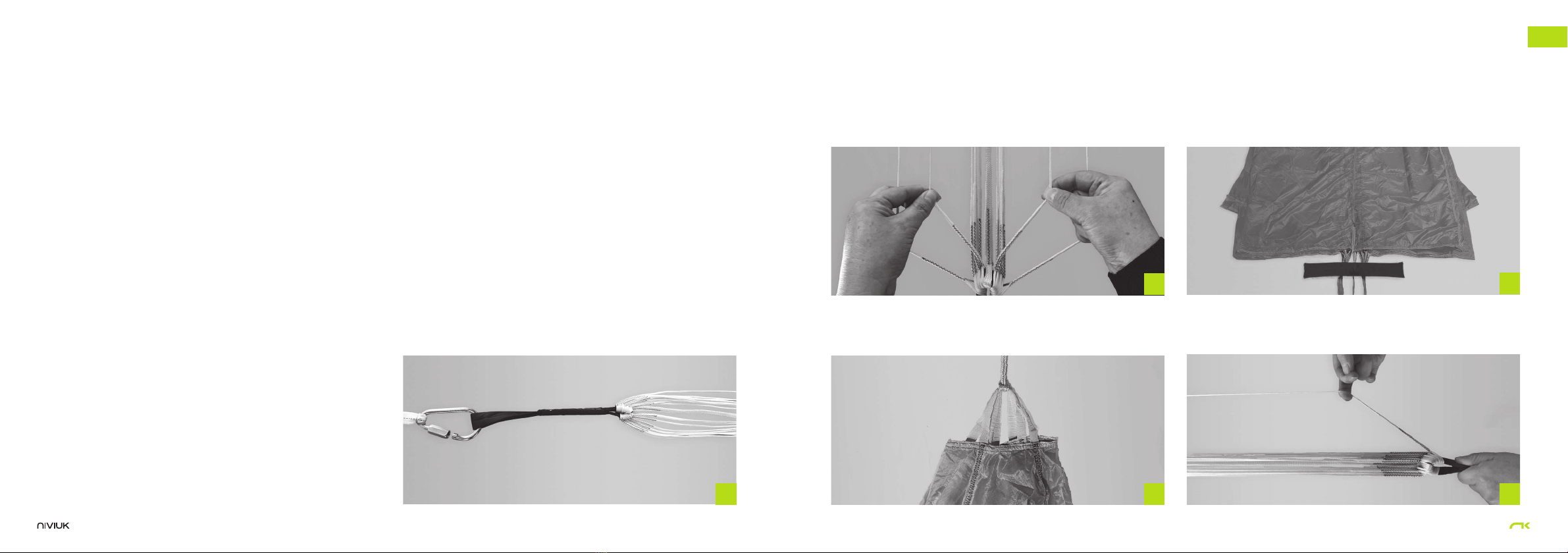
7.1 INSTALL THE RESERVE PARACHUTE AS FOLLOWS
• Check the reserve parachute and components have been assembled correctly.
• Place the packing tools in a convenient location on the packing table.• Lay out the canopy lengthwise on the packing table and attach the canopy’s packing loop to one end of the table.
• Fix the lines at the other end of the table and apply tension to extend the parachute fully.
• Check the apex line to determine if the canopy is inverted or