OPERATING INSTRUCTIONS
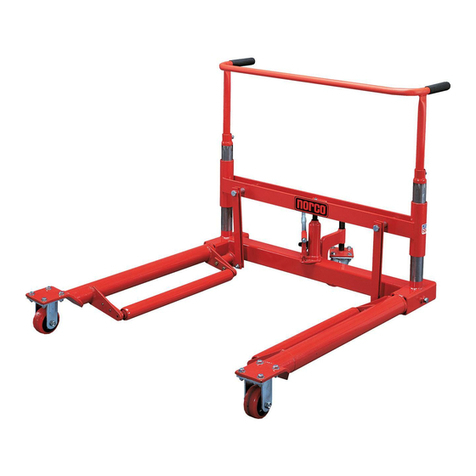
Hydraulic bottle jacks are used on every model wheel dolly.1.
Become familiar with the operation of the bottle jack. The jack’s
release valve knob must be turned in a clockwise direction until
tight before the jack can be pumped. Turning the release valve
knob very slowly in a counterclockwise direction lowers the load in
a safe controlled manner. There should never be a reason to turn
the release valve knob in a counterclockwise direction more than
two full turns. The bottle jack tilts the lift arms in order to match the
angle of the spindle.
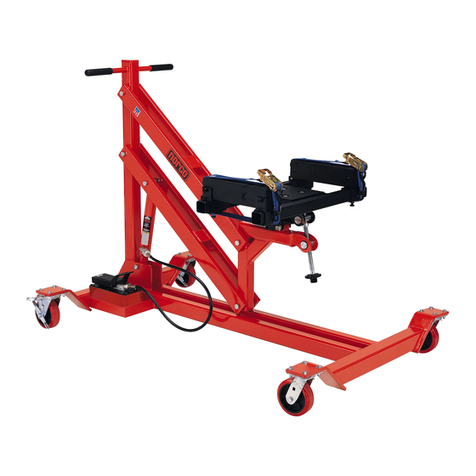
IMPORTANT:2. Become familiar with the pedal operation of the
air/hydraulic foot pump before using the wheel dolly under load.
Depressing the foot pedal end marked “Pump” raises the lift arms.
Toraisethearmsasmalldistanceitisnecessarytouseincremental
taps of your foot on the foot pedal until the arms reach the desired
height. Lowering the arms is accomplished by depressing the foot
pedal end marked “Release”. The pump is equipped with a two
speed release mechanism. Gently depressing the foot pedal end
marked “Release” lowers the arms slower than if you depress the
pedal all the way down. If you want to lower the load slower than
the slow speed release, use gentle incremental taps of your foot
on the “Release” pedal.
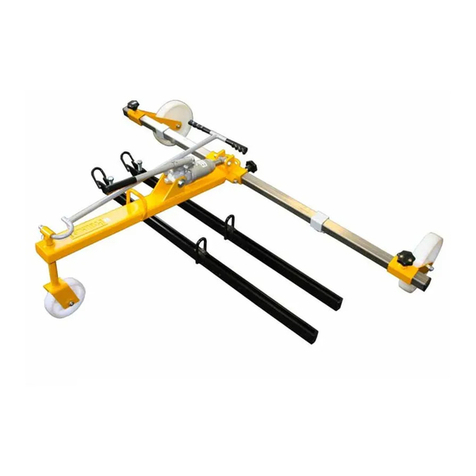
After the vehicle is raised and correctly blocked, push the3.
wheel dolly in towards the tire/wheel combination to be lifted. The
wheel dolly lift arms should straddle the tire and the side wall of
the tire should be as close as possible to the vertical portion of the
lift member. Raise the lift arms to meet the tire/s and adjust the lift
arm angles so the arms are in full contact with tire/s. If the lift arms
are not exactly centered on the tire/wheel, rotating the side shift
knob clockwise will adjust the lift arms right and counterclockwise
will shift them left.
Secure the tire/wheel combination to the dolly with the safety4.
restraint chain provided. Wrap the chain around the tire and secure
the chain hook or chain loop to the dolly.
Continue to lift the tire/wheel combination until the entire weight5.
is supported by the dolly lift arms. Back the dolly away to remove
the tire/wheel combination.
Slowly lower the load to the ground or desired work height.6.
Never raise, lower or transport a load without the safety restraint
chain securing the load.
REPAIR SERVICE
If your Norco product requires service or repair, contact the Norco
Customer Service Department for the location of the nearest Norco
Authorized Service Center.
Norco Industries, Inc.
365 West Victoria St.
Compton, CA 90220
(310) 639-4000 • Fax: (310) 639-7411
www.norcoindustries.com
It will be necessary to provide the NorcoAuthorized Service Center
with a copy of the bill of sale if requesting warranty repair. If the
authorized service center determines your product is eligible for
warranty repair, the repair will be made at no charge and returned
freight prepaid. The cost of non-warrantable service, repair, and
return freight is the customer’s responsibility.
Always store the wheel dolly in a well protected area where1.
it will not be exposed to inclement weather, corrosive vapors,
abrasive dust, or any other harmful elements. The wheel dolly
must be cleaned of water, snow, sand, or grit before using.
Lubricate moving parts once a month with a general purpose2.
grease.
It should not be necessary to rell or top off the reservoir with 3.
hydraulic uid unless there is an external leak. An external leak
requires immediate repair which must be performed in a dirt-
free environment by qualied hydraulic repair personnel who are
familiarwith this equipment.NorcoAuthorized ServiceCenters are
recommended. IMPORTANT: In order to prevent seal damage
and hydraulic failure, never use alcohol, hydraulic brake uid,
or transmission oil in the hydraulic system.
Every wheel dolly owner is responsible for keeping the dolly4.
labelcleanandreadable.Use a mild soap solution to washexternal
surfaces of the dolly but not any moving hydraulic components.
Contact Norco Industries for a replacement label if your dolly label
is unreadable.
Inspect the wheel dolly before each use. Do not use the dolly if5.
any component is cracked, broken, bent, shows signs of damage,
or leaks hydraulic uid. Do not use the dolly if it has loose or
missing hardware or components, or is modied in any way. Take
corrective action before using the dolly again.
Do not attempt to make any hydraulic repairs unless you6.
are a qualied hydraulic repair person that is familiar with this
equipment.
PREVENTATIVE MAINTENANCE
82304