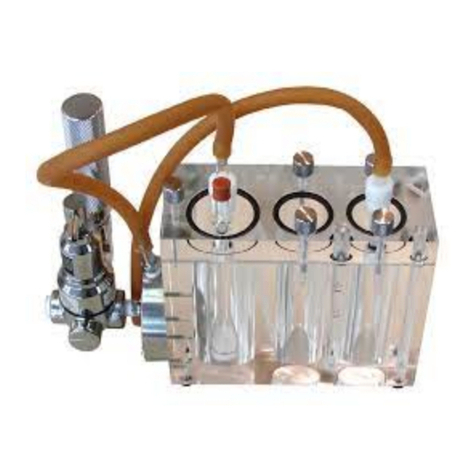
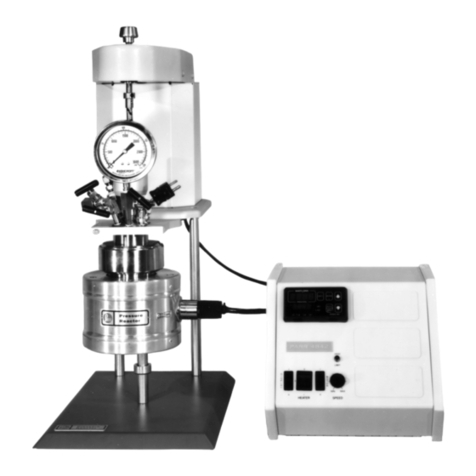
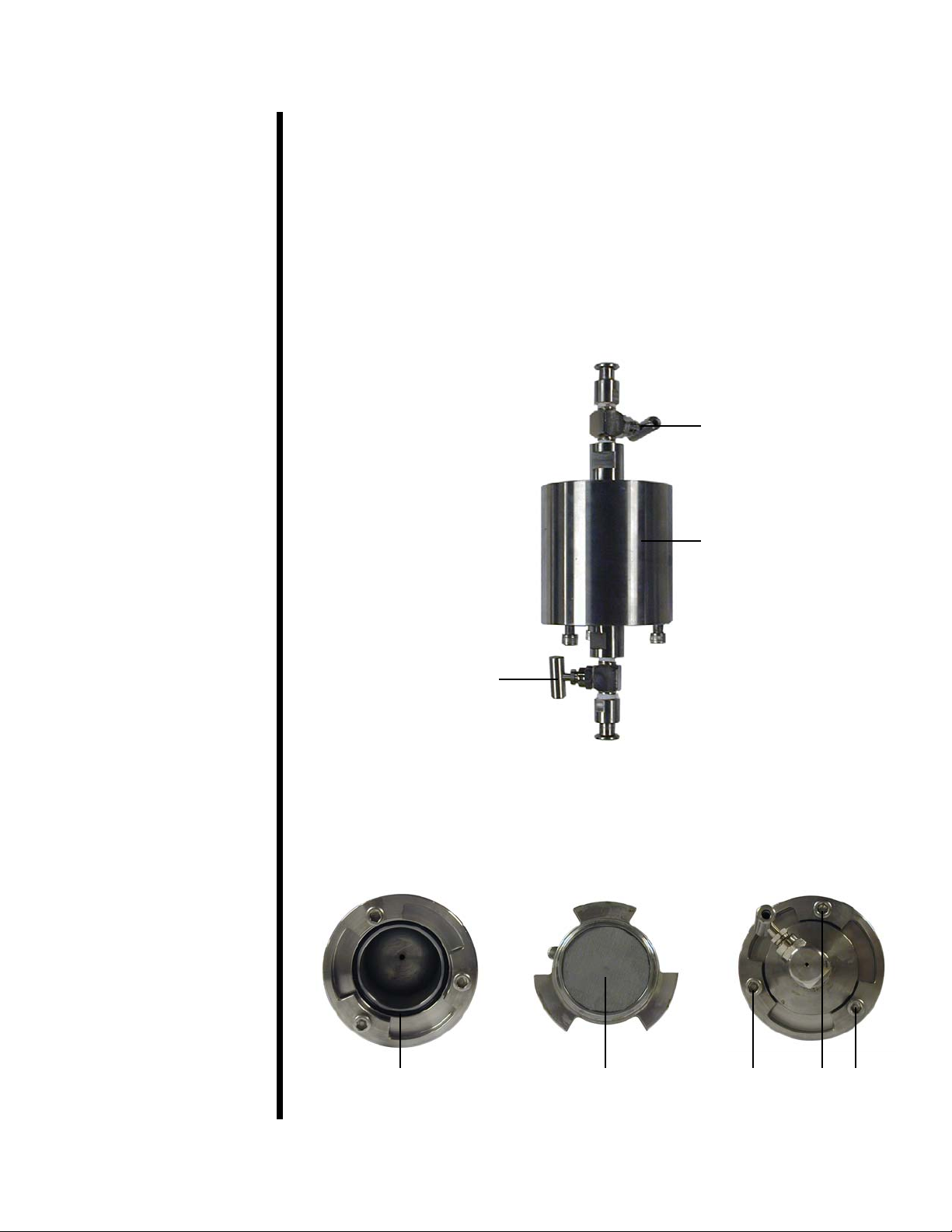
6. If you will be operating above 200°F (93.3°C), place the back pressure
receiver on the bottom valve assembly in the same manner.
7. Remove the CO2cartridge holder from both the top pressuring assem-
bly and the back pressure receiver. Make sure both regulator T-screws
are unscrewed completely and the needle valves are completely
closed. Place a CO2cartridge in each holder and screw the holder onto
the pressuring assemblies until the cartridges puncture. If the red relief
valve on the backpressure receiver is not already pulled out, pull it out
now.
8. Keeping the test cell valves closed, adjust the top and bottom regula-
tors to the recommended back pressure for your test. Open the top
valve one full turn to pressurize the sample. This pressure will mini-
mize boiling while the sample is heating. Maintain this pressure on the
fluid until the desired temperature is stabilized, as indicated by the ther-
mometer. The heating time of the sample should never exceed one
hour.
The upper and lower limits of the test pressure differential are deter-
mined by the test temperature. As this temperature exceeds 212°F
(100°C), the back pressure must be increased in order to prevent
vaporization of the filtrate. The 500 PSI differential pressure must be
maintained, so the top pressure will have to be increased accordingly.
The table below shows the pressures recommended for various test
temperatures.
9. When the fluid sample reaches the desired test temperature, increase
the pressure on the top pressure unit to 500 PSI (3,447.5 kPa) above
the back pressure. Open the bottom valve to initiate filtration and begin
timing.
OFITE, 11302 Steeplecrest Dr., Houston, TX 77065 USA / Tel: 832-320-7300 / Fax: 713-880-9886 / www.ofite.com 9
Note
Recommended Minimum Back Pressure
Test Temperature Vapor Pressure Minimum Back Pressure
°F °C PSI kPa PSI kPa
212 100 14.7 101 100 690
250 121 30 207 100 690
300 149 67 462 100 690
350 177 135 932 160 1,104
400* 204 247 1,704 275 1,898
450* 232 422 2,912 450 3,105
500* 260 680 4,692 700 4,830
*For tests above 400°F, use Teflon o-rings.