Unpacking
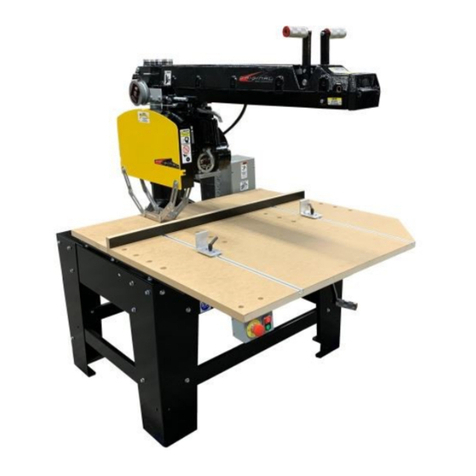
The box included in your shipment contains the legs, hardware and wrenches. Please use the following procedure to remove
the box: Remove the elevating handle from the hardware bag fastened to the carton top. Install handle on shaft located at
the lower right side of saw frame. Release the column clamp, elevate the arm and remove carton.
Attaching the Table Legs
The machine can be lifted with a fork lift under the steel saw frame. A sling or chain hoist may be used under the arm ONLY if
placed at the rear of the arm near the column.
Attach the legs using the 3/8” hexhead cap screws, lock washers and nuts provided in the hardware bag.
Tighten cap screws securely after the machine has been lowered onto its legs. When the saw has been placed in its perma-
nent location shim the legs where necessary to provide a solid foundation. This is important to maintaining an accurate cut.
In order to prevent the forward movement of the carriage when the operator releases his grip, it is recommended the front
legs be shimmed.
Important
Loosen the 2 cable clamps (1 inside of arm, 1 at right rear of arm) and adjust the cables so rollerhead is free to travel the
total length of the arm with the motor pivoted in the roller head so the blade is on the right hand side. Also, check to ensure
there is enough slack in the cables between the rear of the arm and the starter enclosure so the arm can be swung to the
right a full 900while the arm is elevated to its highest position.
Electrical Hookup
Recommended Copper Wire Sizes (A.W.G.)
To obtain maximum efficiency from your saw motor, the feeder wire from the power source to the machine should comply
with the table below.
1 Phase 3 Phase
Motor Horsepower 200-240 V 200-240 V 440-480 V 550-600 V
5 6 6 — —
7.5 — 4 6 8
NOTE: This table is based on 60-100’ distances from power supply. Less than 60’ may use one even size smaller (high num-
ber = smaller size); 100-160’ use one even size larger, over 160’ use two even sizes larger.
Connecting Electrical Current
The motor is properly connected to the magnetic switch at the factory for operation on the electrical voltage specified on the
tag attached to the starter enclosure. Make sure incoming voltage from your power supply conforms to the voltage specified
on the tag.
Remove the magnetic switch cover and insert power supply cable through the dust proof fitting. Connect wires to L1, L2 and
L3 for 3 phase; L1 and L2 for single phase. Attach the ground wire to the ground lug inside the switch enclosure. Wiring
must conform to the National Electrical Code and any applicable local codes.
Check Arbor Rotation (3 Phase Only)
Check arbor rotation with arbor nut and arbor collars removed. Open line disconnect to the saw to remove arbor nut and
collars, close the line disconnect and start saw. The rotation of the arbor must be clockwise as indicated on the arrow on the
nameplate. If the rotation is counterclockwise, the incoming wires are not properly connected to the switch box. To change
the direction reverse any two of the wire leading to the switch box from the power supply.
Changing Voltage (Dual Voltage Motors Only)
Dual voltage motors can be operated on either of the two voltages indicated on the motor nameplate. On the tag attached to
the guard stud, you will find the voltage that was set at the factory. To change the voltage:
1. Change the motor lead connections as shown on the diagram on the inside cover of the motor conduit box. This is also
found on pages 25-26 in this manual. Be sure to disconnect and lockout the power supply before attempting voltage
change.
2. Reconnect the transformer in the magnetic starter as shown in the diagram on the inside of the starter box cover. This
is also found on pages 26 of this manual.
3. Replace the thermal overload protectors with those rated at the desired voltage. See page 25 of this manual.
4. Contact your dealer for correct thermal overload protectors.