manuals.online logo
Brands
  1. Home
  2. •
  3. Brands
  4. •
  5. Panasonic
  6. •
  7. DVR
  8. •
  9. Panasonic DMR-EH50GN User manual

Panasonic DMR-EH50GN User manual

Other Panasonic DVR manuals
Panasonic AJ-YAD850G User manual

Panasonic

Panasonic AJ-YAD850G User manual

Panasonic DMRHS2 - DVD RECORD.W/HD DRIV User manual

Panasonic

Panasonic DMRHS2 - DVD RECORD.W/HD DRIV User manual

Panasonic AG-CPDIOCRUP User manual

Panasonic

Panasonic AG-CPDIOCRUP User manual

Panasonic DMR-E85HS User manual

Panasonic

Panasonic DMR-E85HS User manual

Panasonic LQ-MD800 User manual

Panasonic

Panasonic LQ-MD800 User manual

Panasonic WJ-ND400K/G User manual

Panasonic

Panasonic WJ-ND400K/G User manual

Panasonic AG-CPD15P User manual

Panasonic

Panasonic AG-CPD15P User manual

Panasonic DMR-E30S User manual

Panasonic

Panasonic DMR-E30S User manual

Panasonic WJ-NT104 User manual

Panasonic

Panasonic WJ-NT104 User manual

Panasonic DMR-ES30VGN User manual

Panasonic

Panasonic DMR-ES30VGN User manual

Panasonic DMR-E50K User manual

Panasonic

Panasonic DMR-E50K User manual

Panasonic WJHD220 - DIGITAL DISK RECORDER User manual

Panasonic

Panasonic WJHD220 - DIGITAL DISK RECORDER User manual

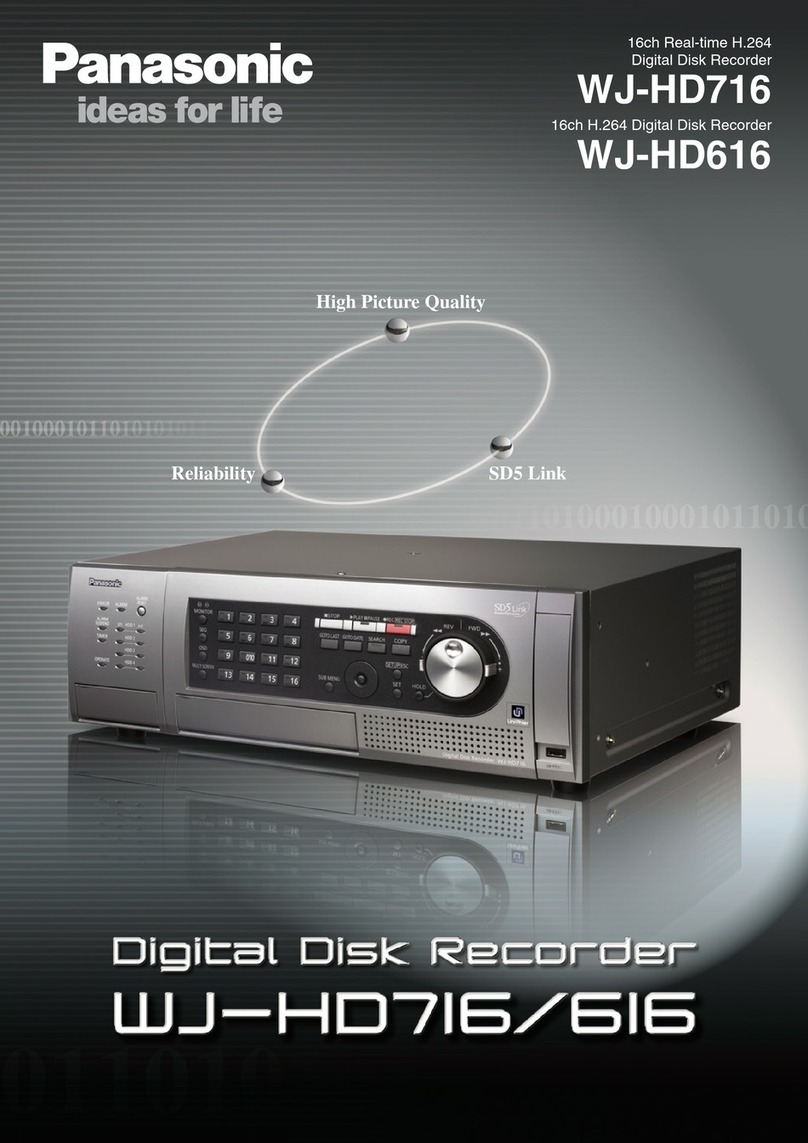
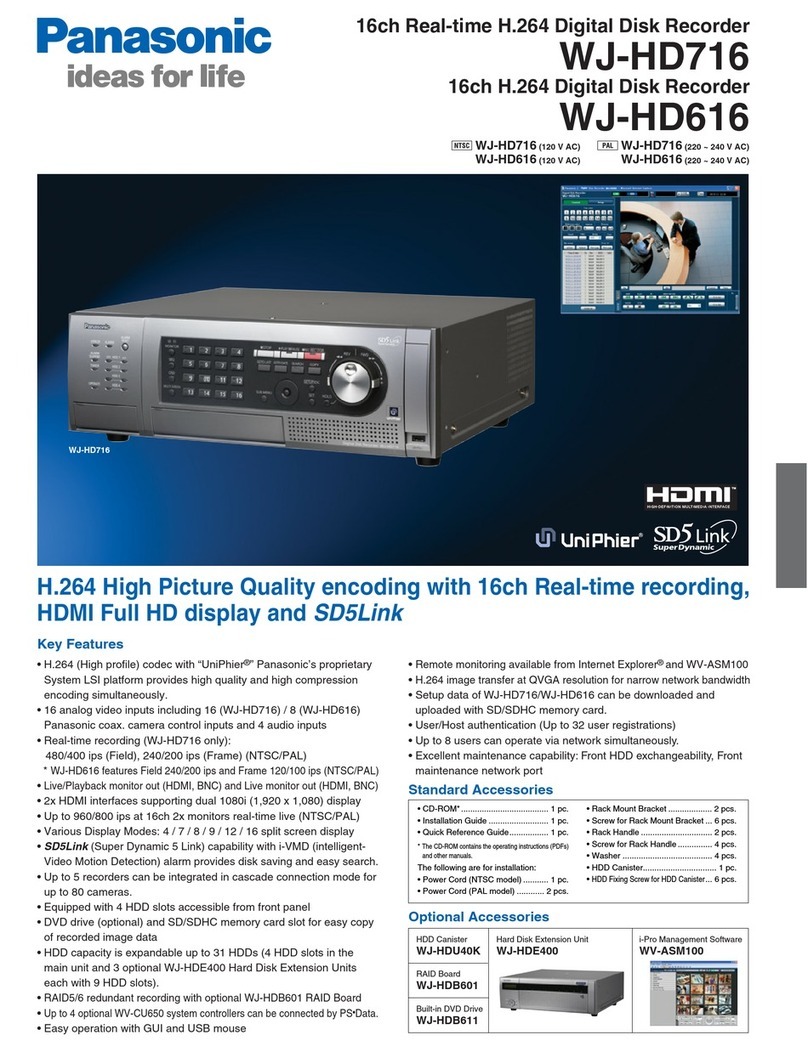
Panasonic WJ-HD716 User manual

Panasonic

Panasonic WJ-HD716 User manual

Panasonic Showstopper PV-HS2000 User manual
Panasonic

Panasonic Showstopper PV-HS2000 User manual
Panasonic WJRT416 - 16CH DIGITAL RECORDER User manual

Panasonic

Panasonic WJRT416 - 16CH DIGITAL RECORDER User manual

Panasonic X-Plus Series SP-DRH04 User manual

Panasonic

Panasonic X-Plus Series SP-DRH04 User manual

Panasonic WJ-GXD400 User manual

Panasonic

Panasonic WJ-GXD400 User manual

Panasonic WJHD309 - DIGITAL DISK RECORDER User manual

Panasonic

Panasonic WJHD309 - DIGITAL DISK RECORDER User manual

Panasonic DMR-HW220DMR-HW220 User manual

Panasonic

Panasonic DMR-HW220DMR-HW220 User manual

Panasonic TU-CTH100 User manual

Panasonic

Panasonic TU-CTH100 User manual

Panasonic DMR-E60S User manual

Panasonic

Panasonic DMR-E60S User manual

Panasonic WJHD316 - DIGITAL DISK RECORDER User manual

Panasonic

Panasonic WJHD316 - DIGITAL DISK RECORDER User manual

Panasonic AJ-D750E User manual

Panasonic

Panasonic AJ-D750E User manual

Panasonic DMR-E53 Diga Quick start guide

Panasonic

Panasonic DMR-E53 Diga Quick start guide

Popular DVR manuals by other brands

Pace TDC577X manual

Pace

Pace TDC577X manual

Zavio NQ2040 user manual

Zavio

Zavio NQ2040 user manual

KGuard Security KG-SHA104 user manual

KGuard Security

KGuard Security KG-SHA104 user manual

SanDisk V-Mate Quick manual

SanDisk

SanDisk V-Mate Quick manual

Hunt Electronic HVRM-T1600Q Install & user's guide

Hunt Electronic

Hunt Electronic HVRM-T1600Q Install & user's guide

Portwell PIVS-6104 user manual

Portwell

Portwell PIVS-6104 user manual

AVer EXR6004 Mini Quick user guide

AVer

AVer EXR6004 Mini Quick user guide

Security Labs SLD261 owner's manual

Security Labs

Security Labs SLD261 owner's manual

Swann DIGITAL VIDEO RECORDER instruction manual

Swann

Swann DIGITAL VIDEO RECORDER instruction manual

EverFocus ECOR 4 instruction manual

EverFocus

EverFocus ECOR 4 instruction manual

Xoro HRK 7550 user manual

Xoro

Xoro HRK 7550 user manual

FLIR M3100E Series instruction manual

FLIR

FLIR M3100E Series instruction manual

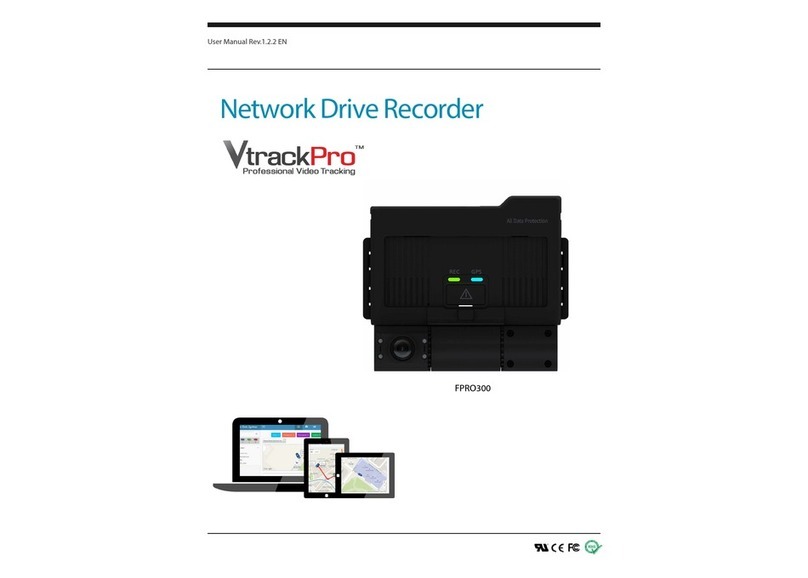
VTRACKPRO FPRO300 user manual

VTRACKPRO

VTRACKPRO FPRO300 user manual

Swann NVR-7085 models instruction manual

Swann

Swann NVR-7085 models instruction manual

RMRC FPV1000 manual

RMRC

RMRC FPV1000 manual

urmet domus 1093/004AHD instructions

urmet domus

urmet domus 1093/004AHD instructions

Toshiba D-VR3SU Service manual

Toshiba

Toshiba D-VR3SU Service manual

CMOS DOTCOM ANX-1670 manual

CMOS DOTCOM

CMOS DOTCOM ANX-1670 manual

manuals.online logo
manuals.online logoBrands
  • About & Mission
  • Contact us
  • Privacy Policy
  • Terms and Conditions

Copyright 2025 Manuals.Online. All Rights Reserved.

ORDER NO.DSD0503043C3
DVD Video Recorder
DMR-EH50GN
Vol.1
Colour
(S).......................Silver Type
© 2005 Matsushita Electric Industrial CO., Ltd. All rights reserved. Unauthorized copying and distribution is a violation
of law.
DSD0503043C3
DMR-EH50GN
z0 COVER
z1 Safety precautions
{1_1 General guidelines
1_1_1 Leakage current cold check
1_1_2 Leakage current hot check (See Figure 1
z2 Prevention of Electrostatic Discharge (ESD) to Electrostatic Sensitive (ES) Devices
z3 Precaution of Laser Diode
z4 Handling the Lead-free Solder
{4_1 About lead free solder (PbF)
z5 Each Button
z6 New Feature
{6_1 Quick start function(REC)
z7 Taking out the Disc from RAM-Drive Unit when the Disc cannot be ejected by OPEN/CLOSE
{7_1 Forcible Disc Eject
7_1_1 When the power can be turned off.
7_1_2 When the power can not be turned off.
{7_2 When the Forcible Disc Eject can not be done.
z8 Service Explorer
z9 Self-Diagnosis and Special Mode Setting
{9_1 Self-Diagnosis Functions
{9_2 Special Modes Setting
{9_3 Service Modes
z10 Assembling and Disassembling
{10_1 Disassembly Flow Chart
{10_2 P.C.B. Positions
{10_3 Top Case
{10_4 Front Panel
{10_5 SD Card P.C.B.
{10_6 Digital P.C.B.
{10_7 DVD-RAM Drive
{10_8 HDD
{10_9 LED P.C.B.
{10_10 Power P.C.B.
{10_11 Rear Panel
10_11_1 Fan Motor
{10_12 Front (L) P.C.B.
{10_13 Main P.C.B.
{10_14 Tuner P.C.B. and Nicam Decoder P.C.B.
z11 Service Fixture and Tools
z12 Service Positions
{12_1 Checking and Repairing of Power P.C.B.
{12_2 Checking and Repairing of Digital P.C.B.
{12_3 Checking and Repairing of Main P.C.B.
{12_4 Checking and Repairing of DVD-RAM Drive
{12_5 Checking and Repairing of HDD
z13 Caution after replacing parts
{13_1 After replacing the RAM Drive with new one
{13_2 When the unit does not operate normally after replacing the Timer Microprocessor or
M
z14 Standard Inspection Specifications after Making Repairs
z15 Voltage and Waveform Chart
{15
_
1 Power P.C.B.
{15_2 Main P.C.B.
{15_3 Tuner P.C.B.
{15_4 LED P.C.B.
{15_5 P9001 Connector
{15_6 Waveform Chart
z16 Abbreviations
z17 Block Diagram
{17_1 Power Supply Block Diagram
{17_2 Analog Video Block Diagram
{17_3 Analog Audio Block Diagram
{17_4 Timer Block Diagram
z18 Schematic Diagram
{18_1 Interconnection Schematic Diagram
{18_2 Power Supply Schematic Diagram
{18_3 Main Net Section (Main P.C.B. (1/3)) Schematic Diagram (M)
{18_4 A/V I/O Section (Main P.C.B. (2/3)) Schematic Diagram (AI)
{18_5 Timer Section (Main P.C.B. (3/3)) Schematic Diagram (T)
{18_6 Tuner Pack Schematic Diagram
{18_7 Nicam Decoder Schematic Diagram
{18_8 SD Card Schematic Diagram
{18_9 LED Schematic Diagram
z19 Print Circuit Board
{19_1 Power P.C.B.
{19_2 Main P.C.B.
19_2_1 Main P.C.B. (1/4 Section)
19_2_2 Main P.C.B. (2/4 Section)
19_2_3 Main P.C.B. (3/4 Section)
19_2_4 Main P.C.B. (4/4 Section)
19_2_5 Main P.C.B. Address Information
{19_3 Tuner P.C.B., LED P.C.B., Front (L) P.C.B.
{19_4 Nicam Decoder P.C.B.
{19_5 SD Card P.C.B.
z20 Exploded Views
{20_1 Casing Parts & Mechanism Section
{20_2 Packing & Accessories Section
z21 Replacement Parts List
z22 Schematic Dia
g
ram for
p
rintin
g
with A4
1 Safety precautions
1.1 General guidelines
1. When servicing, observe the original lead dress. If a short circuit is found, replace all parts which have been
overheated or damaged by the short circuit.
2. After servicing, see to it that all the protective devices such as insulation barriers, insulation papers shields are
properly installed.
3. After servicing, make the following leakage current checks to prevent the customer from being exposed to shock
hazards.
1.1.1 Leakage current cold check
1. Unplug the AC cord and connect a jumper between the two prongs on the plug.
2. Measure the resistance value, with an ohmmeter, between the jumpered AC plug and each exposed metallic
cabinet part on the equipment such as screwheads, connectors, control shafts, etc. When the exposed metallic
part has a return path to the chassis, the reading should be between 1MΩand 5.2MΩ.
When the exposed metal does not have a return path to the chassis, the reading must be .
Figure 1
1.1.2 Leakage current hot check
(See Figure 1 .)
1. Plug the AC cord directly into the AC outlet. Do not use an isolation transformer for this check.
2. Connect a 1.5kΩ, 10 watts resistor, in parallel with a 0.15µF capacitors, between each exposed metallic part on
the set and a good earth ground such as a water pipe, as shown in Figure 1 .
3. Use an AC voltmeter, with 1000 ohms/volt or more sensitivity, to measure the potential across the resistor.
4. Check each exposed metallic part, and measure the voltage at each point.
5. Reverse the AC plug in the AC outlet and repeat each of the above measurements.
6. The potential at any point should not exceed 0.75 volts RMS. A leakage current tester (Simpson Model 229 or
equivalent) may be used to make the hot checks, leakage current must not exceed 1/2 milliampere. In case a
measurement is outside of the limits specified, there is a possibility of a shock hazard, and the equipment should
be repaired and rechecked before it is returned to the customer.
2 Prevention of Electrostatic
Discharge (ESD) to Electrostatic
Sensitive (ES) Devices
Some semiconductor (solid state) devices can be damaged easily by static electricity. Such components commonly are
called Electrostatic Sensitive (ES) Devices. Examples of typical ES devices are integrated circuits and some field-effect
transistor-sand semiconductor "chip" components. The following techniques should be used to help reduce the
incidence of component damage caused by electrostatic discharge (ESD).
1. Immediately before handling any semiconductor component or semiconductor-equipped assembly, drain off any
ESD on your body by touching a known earth ground. Alternatively, obtain and wear a commercially available
discharging ESD wrist strap, which should be removed for potential shock reasons prior to applying power to the
unit under test.
2. After removing an electrical assembly equipped with ES devices, place the assembly on a conductive surface such
as aluminum foil, to prevent electrostatic charge buildup or exposure of the assembly.
3. Use only a grounded-tip soldering iron to solder or unsolder ES devices.
4. Use only an anti-static solder removal device. Some solder removal devices not classified as "anti-static (ESD
protected)" can generate electrical charge sufficient to damage ES devices.
5. Do not use freon-propelled chemicals. These can generate electrical charges sufficient to damage ES devices.
6. Do not remove a replacement ES device from its protective package until immediately before you are ready to
install it. (Most replacement ES devices are packaged with leads electrically shorted together by conductive foam,
aluminum foil or comparable conductive material).
7. Immediately before removing the protective material from the leads of a replacement ES device, touch the
protective material to the chassis or circuit assembly into which the device will be installed.
Caution
Be sure no power is applied to the chassis or circuit, and observe all other safety precautions.
8. Minimize bodily motions when handling unpackaged replacement ES devices. (Otherwise hamless motion such as
the brushing together of your clothes fabric or the lifting of your foot from a carpeted floor can generate static
electricity sufficient to damage an ES device).
3PrecautionofLaserDiode
4 Handling the Lead-free Solder
4.1 About lead free solder (PbF)
Distinction of PbF P.C.B.:
P.C.B.s (manufactured) using lead free solder will have a PbF stamp on the P.C.B.
Caution:
zPb free solder has a higher melting point than standard solder; Typically the melting point is 50 - 70°F (30 - 40°C)
higher. Please use a high temperature soldering iron. In case of the soldering iron with temperature control, please
set it to 700 ± 20°F (370 ± 10°C).
zPb free solder will tend to splash when heated too high (about 1100°F/600°C).
zWhen soldering or unsoldering, please completely remove all of the solder on the pins or solder area, and be sure
to heat the soldering points with the Pb free solder until it melts enough.
5 Each Button
6 New Feature
6.1 Quick start function(REC)
1. General
A few seconds after tuning on the unit,you can start recording to DVD-RAM,HDD.
You can switch the operation of this function (ON/OFF) on the menu screen. .
2. Quick start(REC) principle
In the power-off at Quick start, only power supplies for video IC,tuner and storage media are cut off.
When the REC button is pushed a few second after the power button is pushed, Audio and Video data
are stored in
DDR SDRAM before a storage media(DVD-RAM or HDD) preparation.
*Preparation time →DVD-RAM: Fabout 8seconds
HDD: about 18seconds
After a storage media(DVD-RAM or HDD) preparation,Audio and Video data are transfer from DDR
SDRAM to the storage media.