5. Advance the throttle. When the throttle stick is
advanced, the propeller should spin quickly.
6. As the rst person moves the transmitter controls,
the other person watches to be sure the airplane’s
motor and tail controls operate smoothly. Make
sure you check all parts of the controls—throttle,
as well as moving the gimbal up and down and
side to side.
Note: Check transmitter manual for specific range
test procedures.
First Flights
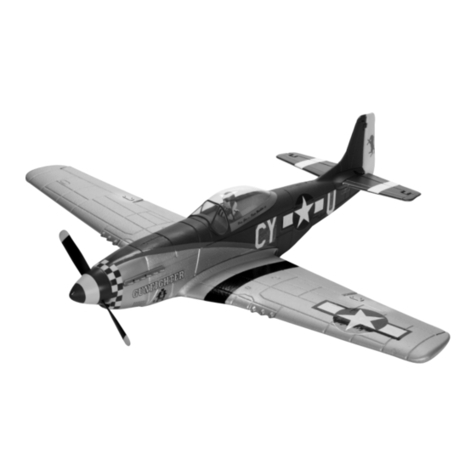
The ParkZone 3-channel control system is designed for
the experienced radio control pilot and is not intended
for the inexperienced yer. If you have successfully own
3-channel HobbyZone®airplanes, then you should be
ready for the P-51D Mustang. However, rst-time pilots
of the P-51D Mustang should seek the assistance of an
experienced RC yer. If you have not own an aircraft
with ailerons, it will be very helpful to have help from an
experienced pilot. First ights should always be own on
lower rates. Crash damage is not covered under the
warranty.
Control throws and Center of Gravity
Control Throws:
Low Rate High Rate
Aileron: 1/4 inch (6.4mm) 3/8 inch (9.5mm)
Elevator: 1/4 inch (6.4mm) 3/8 inch (9.5mm)
Center of Gravity:
2 3/4 inches (70.0mm) From leading edge of the wing at
the fuselage.
Note: The small oval panel line on the top of the wing
marks the correct CG location.
Step 16
Step 18
Step 17
Step 19
Range Test
You will need two people to perform the range test—one
to hold the plane and the other to give the transmitter
input. Refer to the instruction manual for your transmitter
for specic range test information.
Warning: The person holding the plane should hold
it in such a way that the propeller does not come into
contact with any part of their clothing or body.
1. One person should hold the transmitter, while the
other person walks 30 paces away from the
transmitter, with the airplane in hand.
2. Be sure the throttle stick is in the “off” (low throttle)
position.
3. Turn the transmitter on.
4. Slide the battery into the fuselage, attach it to the
lead from the fuselage and close the canopy.
Helpful Hints for Flight
1. After launching, your P-51D Mustang will climb at
full throttle. Keep the throttle full on until you have
reached an altitude of at least 50 feet (15 meters).
At the same time, make sure that you continue to
keep the airplane ying directly into the wind.
2. Make right and left adjustments, as necessary,
to keep the plane headed directly into the wind.
After you have reached approximately 100 feet
(30 meters) of altitude, you can begin to make
directional changes that you desire.
3. Do not allow the plane to get too far away from
you. When the plane is farther away it is harder to
see, and the higher you y, the more the airplane
will be affected by wind.
4. Always keep the plane upwind from you. This
way, it will not be carried away from you by the
wind.
5. Flying in winds that are too strong is by far the
number one reason for those who are less
experienced to crash or have yaways.
Step 15
Hand Launching the P-51D Mustang
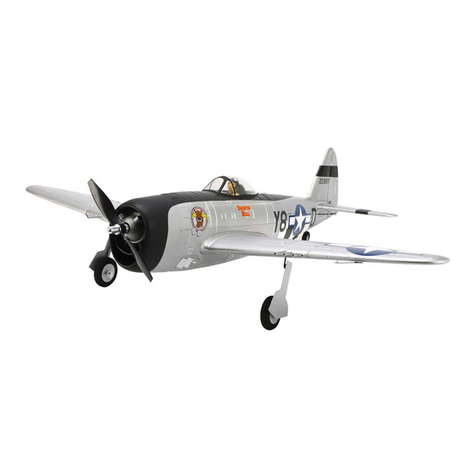
Your P-51D Mustang will need to be hand launched. To
do this, follow these instructions:
1. Make certain that the aircraft battery is fully
charged.
2. Turn on the transmitter, making certain you are in
Low Rate.
3. Insert the battery into the fuselage and plug the
battery lead into the lead coming from the
fuselage. Secure the battery with the hook and
loop straps.
4. While holding the transmitter in one hand, push
throttle stick to full on (up) with thumb.
5. Take a couple of steps and FIRMLY launch directly
into the wind while keeping the wings level. Do not
throw it up or down. Point it level (parallel) with
the ground when launching. THROW IT HARD until
you become accustomed to the amount of force it
takes to launch the plane.
6. Keep steering into the wind and hold at full throttle
in a slight climb until you have reached an altitude
of at least 50 to 70 feet (15 to 21 meters).
7. When you have reached this altitude, it is safe to
steer in the desired direction, as well as adjust the
throttle input, to help control altitude and speed.
6. Avoid holding the stick full right or left for more
than two seconds, as this will cause the plane to
enter a spiral dive that could cause you to crash
your plane.
7. Do not try to climb too fast by pulling all the way
back on the stick (up elevator), or your plane may
stall. Instead, climb by giving small amounts of
elevator.
8. Damage/bends to the wings or tail can greatly
affect flight control. Replace damaged parts
immediately.
9. Once you have become more experienced and
familiar with the Mustang, you can switch from
Low rate to high rate.
10. Trees, buildings and obstructions can cause
turbulence. Try to avoid launching or landing
downwind of obstructions to minimize the effect
of the turbulence.