567
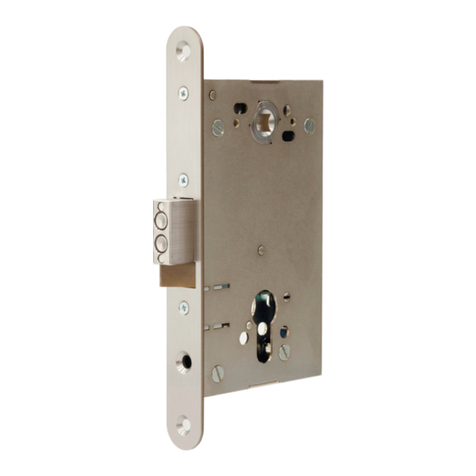
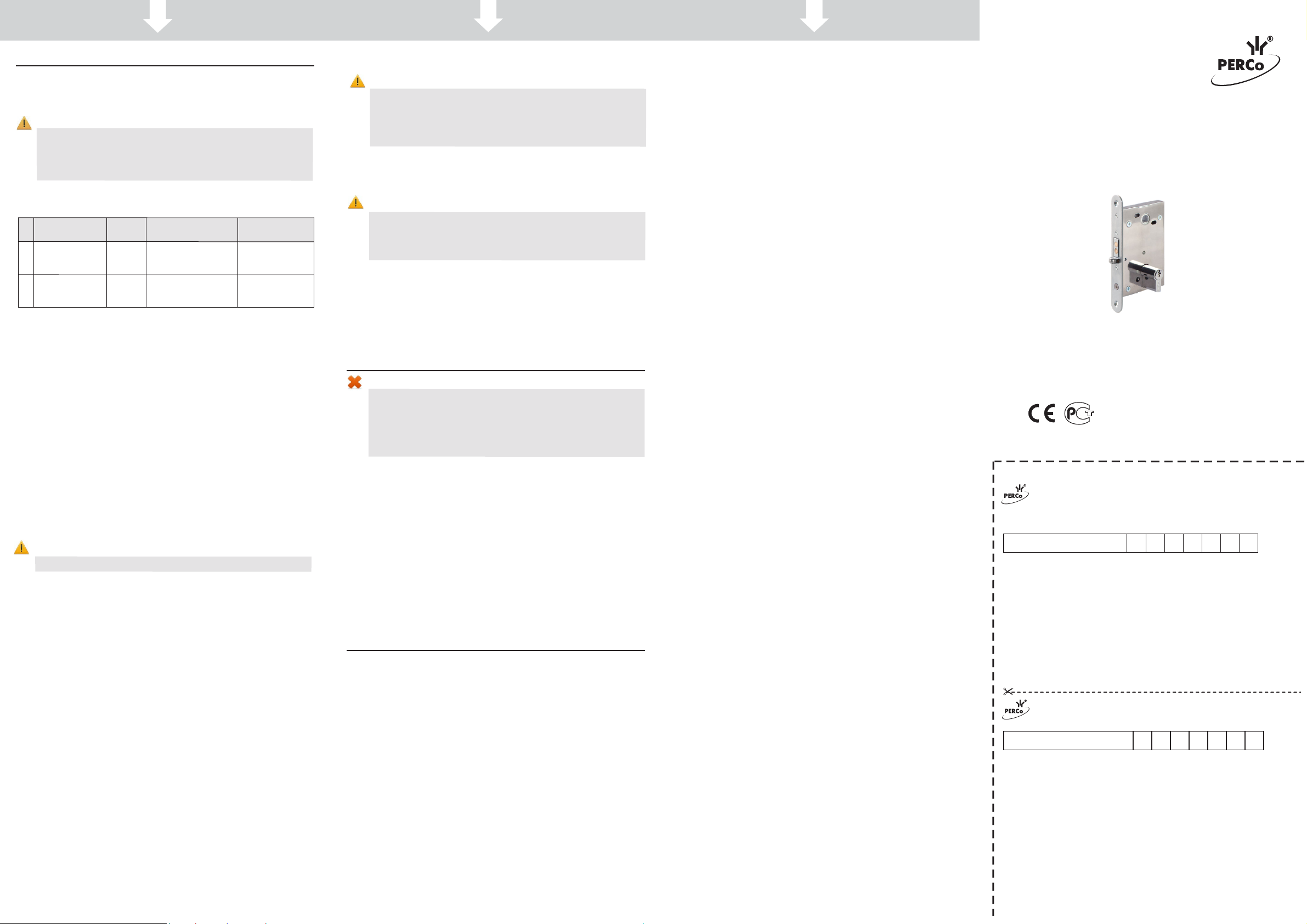
Electromechanical Lock LB-72.2
Serial number
Date of manufacture ________________201__
Quality Control Seal
_ _ _ _ _ _ _ _ _ _ _ _ _ _ _ _ _ _ _ _ _ _
Date of sale « » ________________201__
____________________________________
(signature, seal)
Cutting line
WARRANTY REPAIR COUPON
.2.27-BLkcoLlacinahcemortcelE
Serial number
Date of manufacture ________________201__
Quality Control Seal
_ _ _ _ _ _ _ _ _ _ _ _ _ _ _ _ _ _ _ _ _ _
Date of sale « » ________________201__
____________________________________
(signature, seal)
Certificate and Operation Manual
www.perco.com
5. MAINTENANCE
6. PERCo WARRANTY
Electromechanical
Mortise Door Lock
- 2.27BL
РОСС RU.СП26.Н
ТУ 4981-049-88226999-2014
03588
6 6 4
6 6 4
4.3 Installation order
ehttadesuselbaC.1erugiFhtiwecnadroccaninevigerasrebmunecnerefeR
installation are stated in table 1.
Install the lock in the following order:
1. Unpack the lock and check the delivery set.
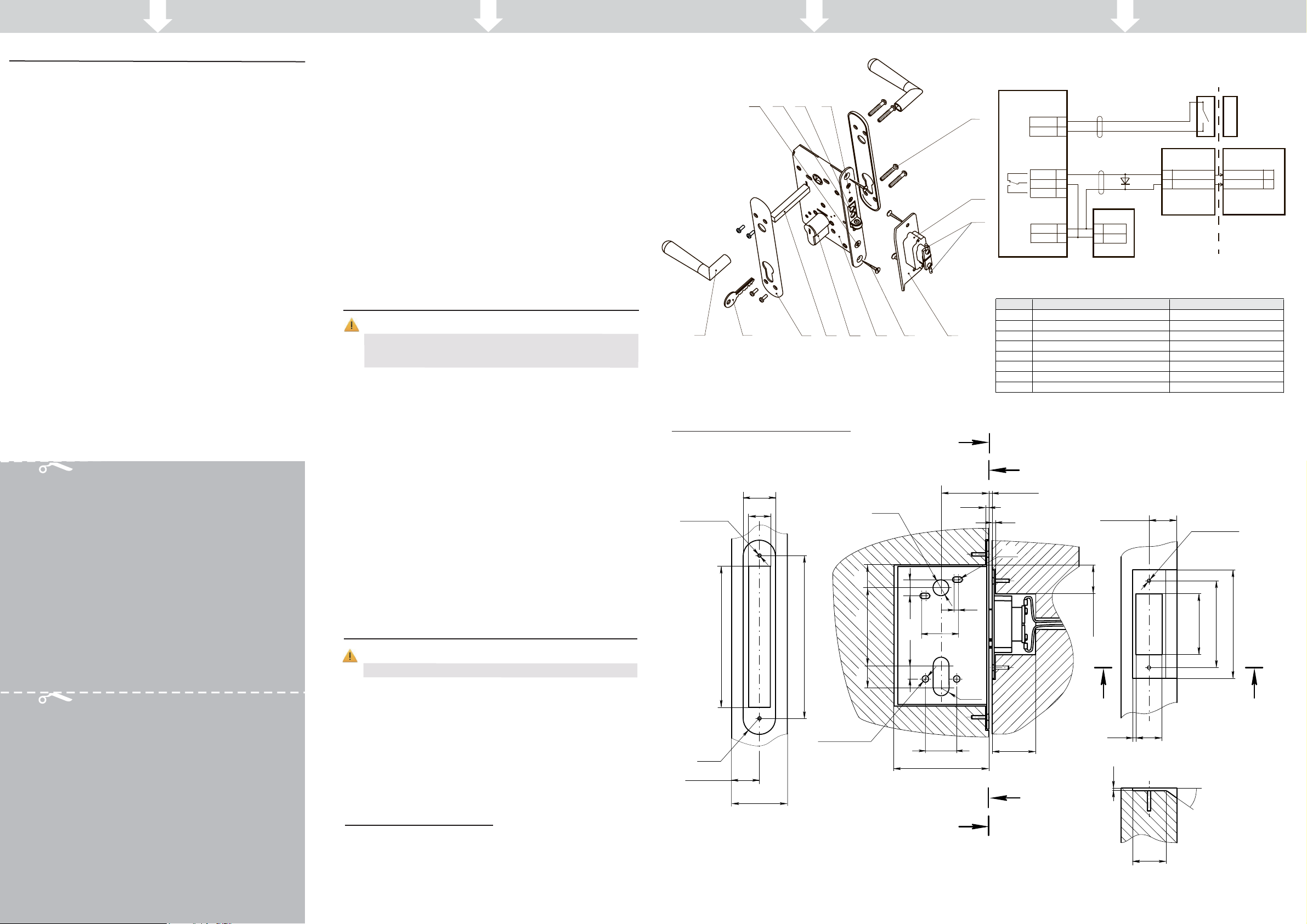
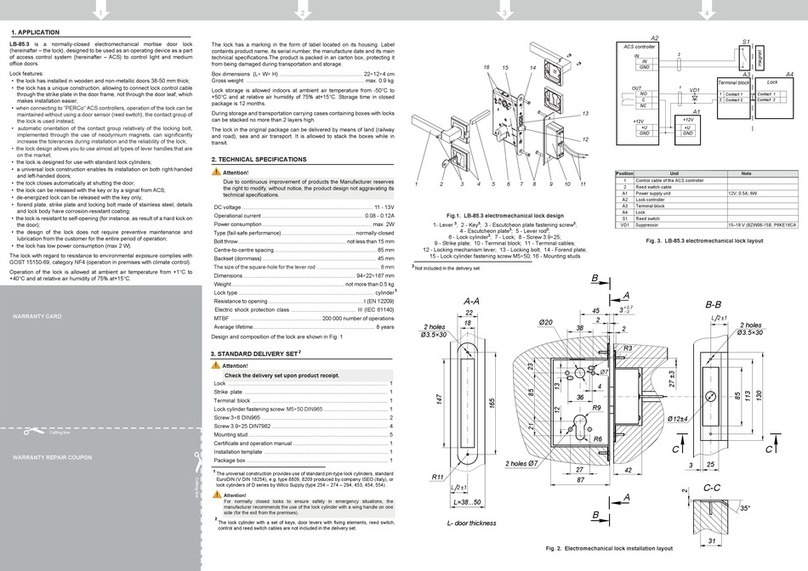
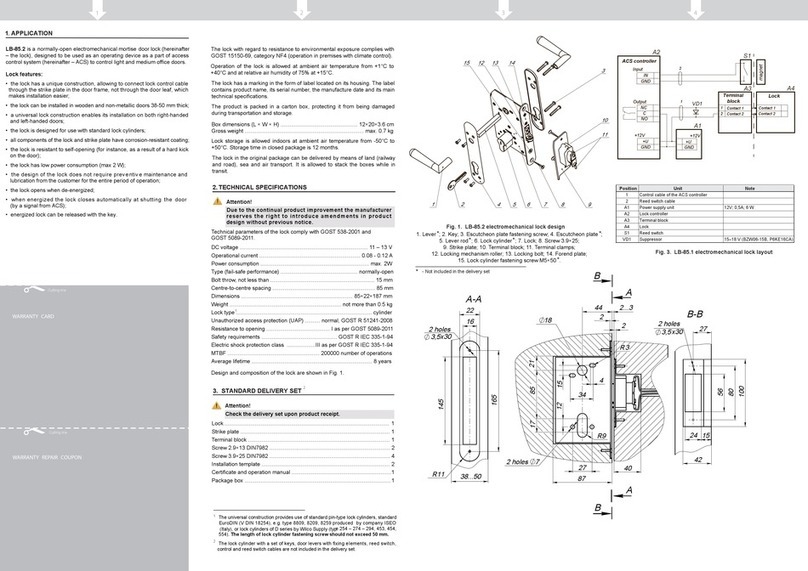
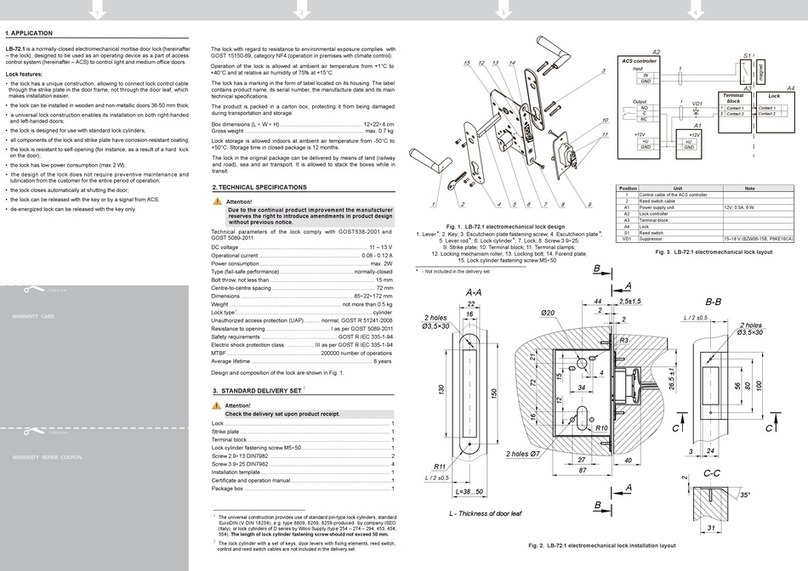
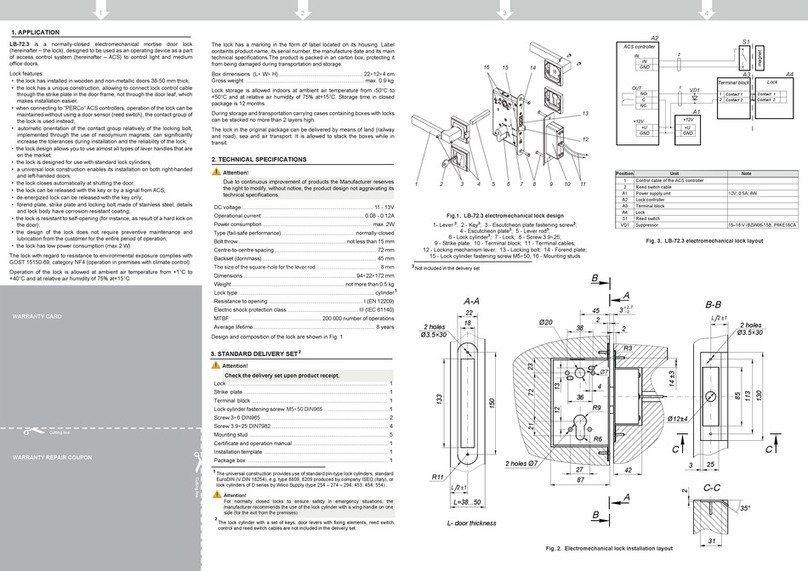
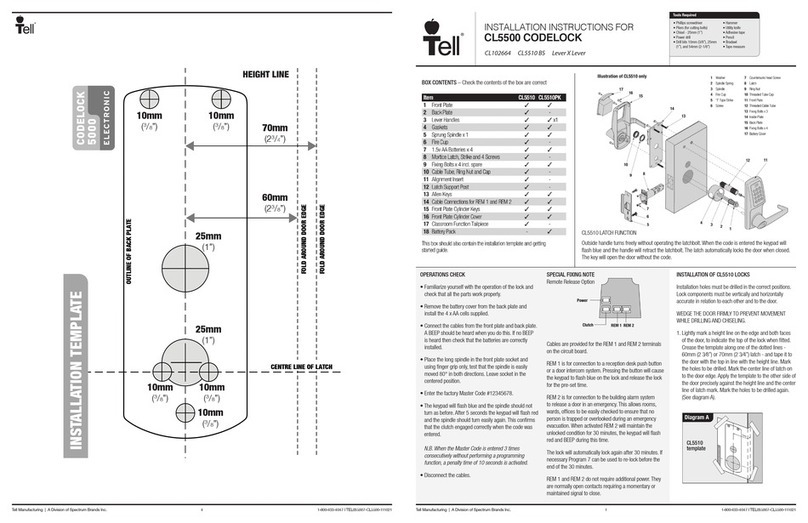
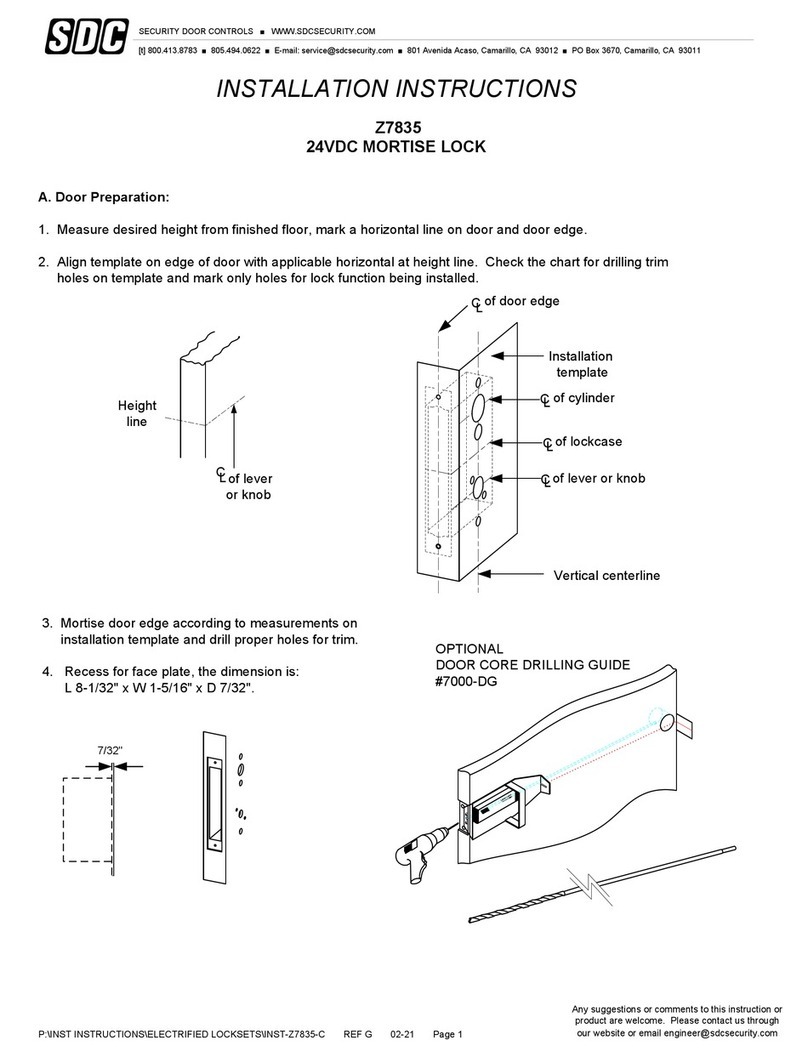
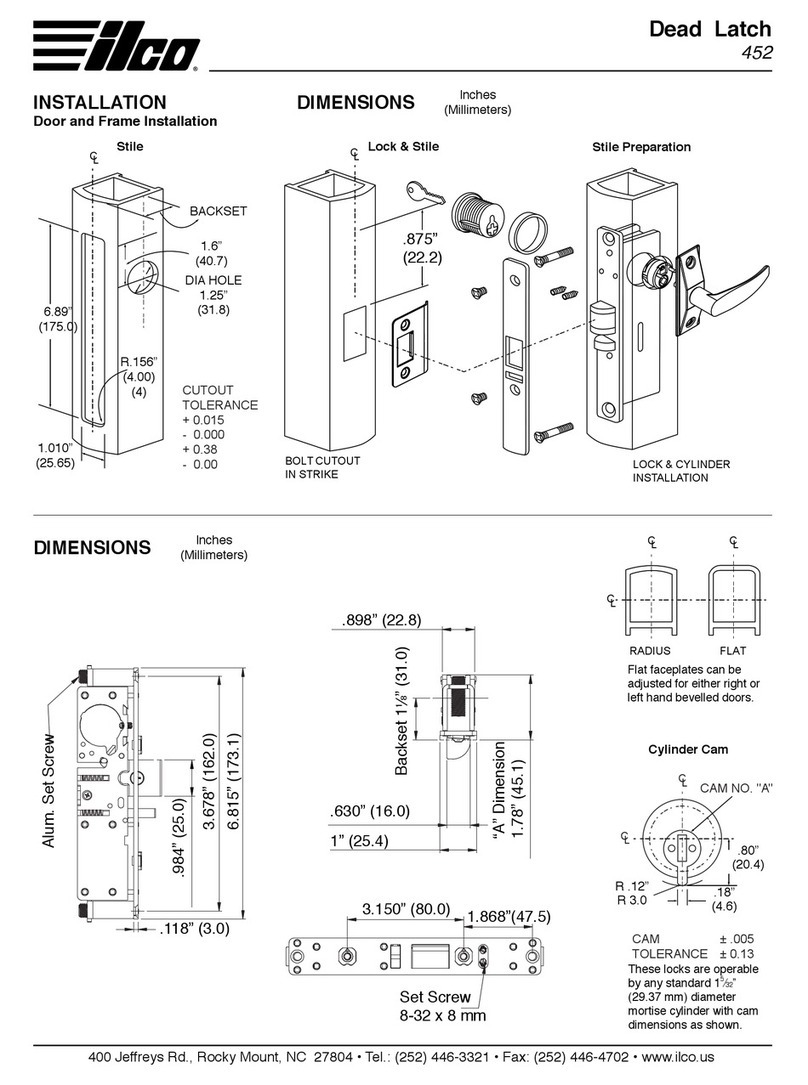
2. Carve out the installation template, which is included in the standard
delivery set. Make the hole marking for lock cylinder (6), lever rod (5) and,
if needed, of a location slot for lock forend plate (14) in the door leaf in
the place of lock installation using the template. Template marking
corresponds to the one in Fig. 2.
3. If necessary, select the locating pocket for the lock.
4. Carve out holes and choose the location slot for lock forend plate in
accordance with the marking.
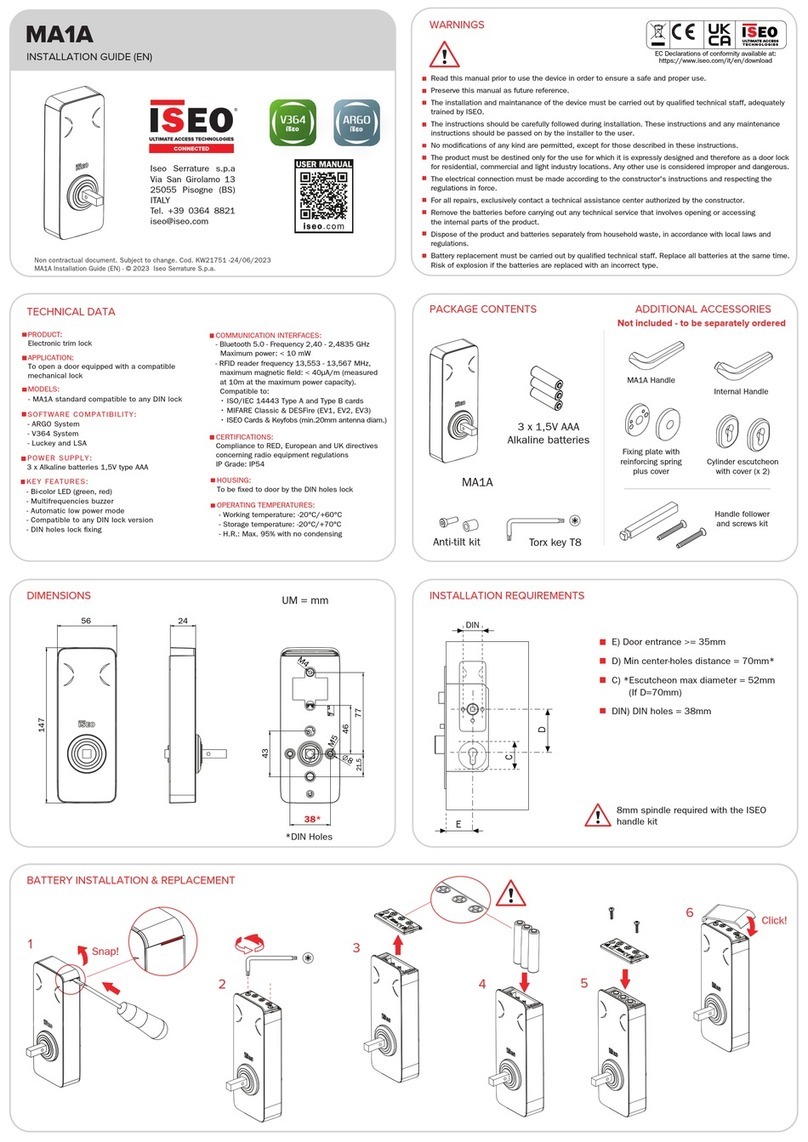
5. Install the lock (7) in the locating pocket of the door and fasten it with two
screws 3.9×25 DIN7982 from the delivery set.
6. Mount the lock cylinder inside the lock and fix it with the screw through
the hole on the lock forend plate.
Attention!
Lock cylinder fastening screw length should not exceed 50 mm.
7. Adjust the door levers (1) with escutcheon plates (4) in accordance with
manufacturer recommendations. Tighten them with the screws with
threaded bushing (3). After the installation levers are to turn easily.
8. Check the lock operation at the opened door.
• Sink the locking mechanism roller (12) inside the lock housing to check
the mechanical unlocking. The bolt will move out of the lock housing (13).
•Turn the lock lever against stop, keeping the locking mechanism roller
sunk. The bolt will return into an initial position inside the lock housing.
Release lock handle, keeping the locking mechanism sunk. The bolt will
move out of the lock housing.
• Release the locking mechanism roller. The bolt will return into an initial
position inside the lock housing. The lock will be closed.
• Sink the locking mechanism roller inside the lock housing to check the
9. Fix the strike plate (9) on the terminal block housing (10) with two screws
2.9×13 from the delivery set.
10. Make carving in the door according to the marking (Fig. 2).
11. Lay the control cable from the ACS to the terminal block installation place
inside the door frame. Use cable №1. The cable laying method is deter-
mined by lock installer and the Customer.
12. Connect the control cable with terminal clamps (11) from the terminal
block. In order to do that, tighten cable ends into terminal clamps.
13. Mount the strike plate with the terminal block in the door frame providing
2-3 mm spacing between the strike plate and the forend when the door is
closed. The channel of the strike plate must lay symmetrical to bolt’s cross
section.
Attention!
The locking mechanism roller should not get into the channel of
the strike plate! Otherwise, at closing the door, it can get locked
with the moving roller and then itwill beimpossible to open the
door without damaging the lock.
14. Mount the strike plate on the door frame with two screws 3.9×25 from the
delivery set.
15. Install and connect the reed switch. Use cable №2 in table 1 for connec-
tion. Installing the reed switch ensure firm contact closure at closing the
door.
Disassembling of the lock should be made in the reverse order.
Warning!
•Do not use the lock at power supply voltage other than specified
in its technical specifications.
• Do not use the lock in operation conditions other than specified
in the following Manual.
•Do not use the lock in hostile environment with atmospheric
content of acids, bases, oils, etc.
The lock is a normally-open device, which means that de-energized lock is
unblocked. The door is opened by turning the lever (approximately at 20º).
At that the bolt moves into the lock housing, the door opens and the locking
mechanism roller automatically moves out of the lock housing. At further
door closing the locking mechanism roller is sunk into the lock housing by
the strike plate and the bolt moves out automatically locking the door.
The locking is performed by terminal block clamps’ energizing. Inthis case
lever turning is blocked. Energizing is operated by the ACS controller. At that
ooD.tuptuolortnockcolroftesebdluohsedomnoitarepolaitnetopeht r
opening detection is performed according to the reed switch status.
Terminal block clamps should be de-energized in order to release the lock
The door will be opened by turning the lever.
PERCo (the Manufacturer) warrants that the LB72.2 electromechanical
mortise door lock (the Product) complies with applicable statutory safety
requirements, electromagnetic compatibility provided that the instructions on
storage, installation and operation, given in the Assembly & Operation Manual
are observed.
The warranty period is 5 (five) yearscommencing from the date of sale.
Should there be no date of sale on the warranty card, the warranty period
shall commence from the date of manufacture.
Within the warranty period the Product is repaired free of charge at the
Manufacturer’s site.
The Warranty does not cover Products with external mechanical damages or
disassembled by the Customer.
Transportation cost to and back from the place of repair shall be borne by the
Customer.
Upon lock purchase request the date of sale stamp in the warranty certificate
and check the completeness of the delivery set as per the Manual.
In case any questions arise during the Product assembly or operation,
PERCo Company is always ready to give you necessary technical support.
4. ASSEMBLY AND INSTALLATION
4.1 General recommendations
The lock shall be installed by qualified professionals who have studied this
Manual before the installation work.
Attention!
In order to provide stablelock operation an accurate ±1,5 mm
vertical mounting of the strike plate with terminal block
regarding locking boltis required. The lock operates normally
if the spacing between the forend plate and the strike plate is
2.5±1.5 mm.
4.2 Cable length
Table 1. Cables used
№Application Max
length Type of cable An example
of cable
1ACS controller
cable 30m
Twin cable with
0.75 mm
cross-section
2HO3VV-F,
HO5VV-F 2×0.75
2Reed switch
cable 30m
Twin cable with
0.2 mm
cross-section
2
RAMCRO
SS22AF-T
2×0.22 or CQR-2
automatic unlocking. The bolt will move out of the lock housing.
• Energize lock flank contacts with 12V power supply. The lock will be
closed.
• Check several times.
Attention!
If the lock isoperated as a part of access control system (ACS)it
is recommended to install voltage regulator diode BZW06-15B or
P6KE16CA, or another model with equal parameters on contact
clips(Fig. 3). The voltage regulator diodeisused for maintaining
the device which sends the control signal.
PERCo
Polytechnicheskaya str., 4, block 2
194021, Saint Petersburg
Russia
Tel: +7 812 247 04 64
www.perco.com