manuals.online logo
Brands
  1. Home
  2. •
  3. Brands
  4. •
  5. Pitsco Education
  6. •
  7. Test Equipment
  8. •
  9. Pitsco Education Wing Tester User manual

Pitsco Education Wing Tester User manual

Popular Test Equipment manuals by other brands

SMART KANAAD SBT XTREME 3G Series user manual

SMART

SMART KANAAD SBT XTREME 3G Series user manual

Agilent Technologies BERT Serial Getting started

Agilent Technologies

Agilent Technologies BERT Serial Getting started

Agilent Technologies N3280A user guide

Agilent Technologies

Agilent Technologies N3280A user guide

Lifeloc R.A.D.A.R. quick start guide

Lifeloc

Lifeloc R.A.D.A.R. quick start guide

Fluke T5-600 Service information

Fluke

Fluke T5-600 Service information

Mercury TSL01 user manual

Mercury

Mercury TSL01 user manual

MAHA MBT Series Original operating instructions

MAHA

MAHA MBT Series Original operating instructions

Fuji Electric P-61 instruction manual

Fuji Electric

Fuji Electric P-61 instruction manual

ETC SealerAtor user manual

ETC

ETC SealerAtor user manual

Skyfine ETHYWAY V2 user manual

Skyfine

Skyfine ETHYWAY V2 user manual

Appion G5 Twin Operation manual

Appion

Appion G5 Twin Operation manual

PCB Piezotronics 8159-0112A Installation and operating manual

PCB Piezotronics

PCB Piezotronics 8159-0112A Installation and operating manual

BW Technologies MicroDock II user manual

BW Technologies

BW Technologies MicroDock II user manual

Sun Nuclear 1027 user guide

Sun Nuclear

Sun Nuclear 1027 user guide

Biomark HPR LITE READER user manual

Biomark

Biomark HPR LITE READER user manual

Hioki 3169-20 instruction manual

Hioki

Hioki 3169-20 instruction manual

Ashcroft ATE-100 operating manual

Ashcroft

Ashcroft ATE-100 operating manual

Rohde & Schwarz RTA4000 user manual

Rohde & Schwarz

Rohde & Schwarz RTA4000 user manual

manuals.online logo
manuals.online logoBrands
  • About & Mission
  • Contact us
  • Privacy Policy
  • Terms and Conditions

Copyright 2025 Manuals.Online. All Rights Reserved.

57205 V0311
Wing
Tester
User Guide
Wing Tester User Guide 57205 V0311
Wing Tester Overview
The Pitsco Wing Tester is designed to visually
demonstrate the principle of lift and to evaluate
the design and performance of model wing airfoil
sections.
The Wing Tester accomplishes this by suspending
the wing in a moving airstream, simulating actual
flight. As the air moved by the tester’s fans passes a
properly constructed wing, lift is generated and the
wing rises. Weights representing cargo can be added
to the wing while it is in flight. The amount of weight
supported by a wing before it sinks is a measure of
its design efficiency. This visual demonstration is an
excellent way to introduce students to the hard-to-
grasp concepts of lift, drag, Bernoulli’s principle, and
Newtonian physics.
Students can design and build their airfoils using the
Pitsco Wing Caddy (57246) or the Pitsco Foam Wing
Cutter (17080) and test them on the Wing Tester to
see whose design is the most efficient.
Wing Tester Components
The Wing Tester comes with the components listed
below and shown above. If anything is missing, call
Customer Service at 800-358-4983.
• Wing Tester unit
• Balance arm
• Wing support bracket
• Brass washers
• Rubber bands
• Funnel
Figure 1
Wing Support
Bracket
Funnel
Brass micro coun-
terweight (left)
and counter-
weight (right)
Weight
Gauge
Fan Switch
Balance
Arm
Thumbscrew
Mounting Socket
Wing Tester User Guide 57205 V0311
Assembling the Wing Tester
1. Slide the balance arm into the mounting socket
on the top of the Wing Tester unit. Align the holes
in the balance arm with the mounting socket
thumbscrew and tighten the thumbscrew.
2. Place the funnel on the balance arm as shown in
Figure 1.
3. Raise the weight gauge on top of the tester to its
upright position.
Operating the Wing Tester
Place the Wing Tester on a flat, level surface and plug
it into a standard 120-volt electrical outlet. Advise
students to follow these safety precautions when
using and storing the Wing Tester:
• Do not place hands, loose clothing, books, or
other items within two feet of the fan intake or
exhaust while the Wing Tester is in operation.
• Use the Wing Tester only after watching the
instructor demonstrate its proper use.
• Unplug the Wing Tester when it is not in use.
• Store the Wing Tester in a safe, dry place.
Testing a Wing
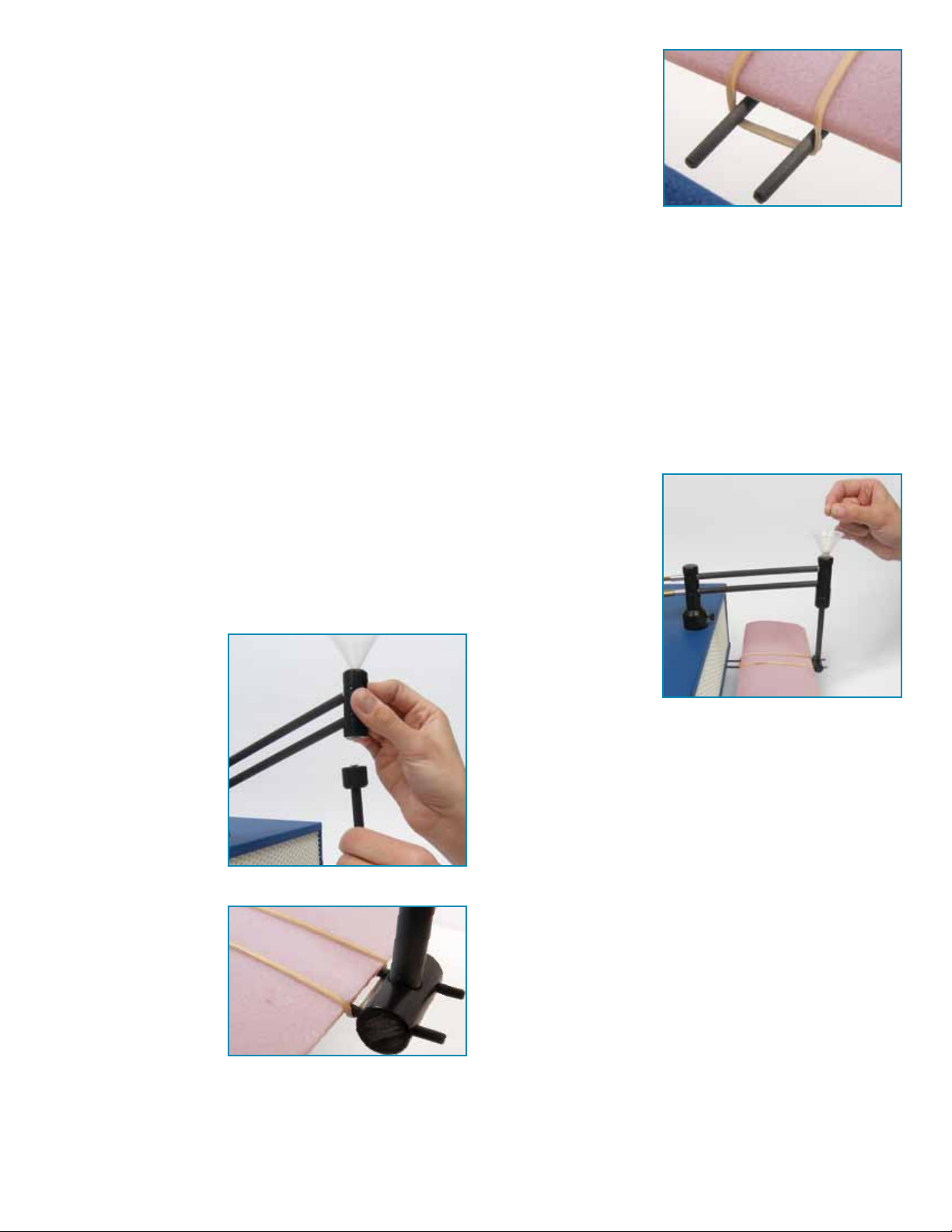
1. The wing support
bracket is held
on to the balance
arm by a magnet
– carefully, pull the
bracket at an angle
until it comes free
of the balance arm
(Figure 2).
2. Loop the rubber
band onto the
bracket (Figure 3).
Place the test wing
on the bracket so
the two bracket
ends are visible in
front of the airfoil.
Stretch the rubber
band over the top
of the wing and
loop it over the
bracket ends in front of the
test wing (Figure 4).
3. Reattach the
bracket to the
balance arm so the
bracket ends face
the tester.
4. Balance the wing,
which counters
the effect of
gravity on the
wing. Hold the wing so the pointer is at zero on
the weight gauge. Adjust the counterweight and
release the mechanism. Make adjustments to the
counterweight and then the micro counterweight
until the pointer stays at zero. To ensure the wing is
balanced, move it up or down and release it. When
released, the wing should not move. A properly
balanced wing can be moved to any position and
will stay in that position when released.
5. Turn on the fan
switch. If the wing
has an efficient
shape, it will rise.
6. While the wing
is in the raised
position, carefully
drop washers in
the funnel on the
balance arm until
the wing descends
to the original level
position (Figure 5).
7. Now, verify that the wing has lift. Turn off the
Wing Tester. After the motor has stopped, turn on
the Wing Tester to the previous setting. The wing
should rise to the zero point.
8. On a piece of paper, record the number of
washers the wing supported. This is the load
that your airfoil supported. Efficient designs
support the heaviest loads.
Tip
To securely attach the airfoil to the tester's wing
support bracket, tape two Launch Lugs (50071)
to the underside of the airfoil so you can slide the
bracket ends through the lugs to hold the airfoil
on the support. Before taping, make sure the lugs
are centered on the airfoil.
Figure 4
Figure 3
Figure 5
Figure 2

Wing Tester User Guide 57205 V0311
Ideas for Additional Activities
• Vary the angle of attack by placing a piece of
cardboard under the leading edge of the wing.
Rebalance the wing to compensate for the
additional weight of the cardboard. Does this
improve or impair the lift performance of the
wing?
• Demonstrate the concept of stall by gradually
increasing the angle of attack until lift is no longer
produced.
• Add a flap by taping a piece of card stock on the
trailing edge of the wing. Bend the flap up and
down to observe the aerodynamic effects.
Disclaimer
Pitsco, Inc., is not responsible for bodily injury
or property damage resulting from misuse of its
products. Always follow standard safety procedures
to ensure student safety.
P.O. Box 1708 • Pittsburg, KS 66762
www.pitsco.com
Toll-Free Orders 800-835-0686