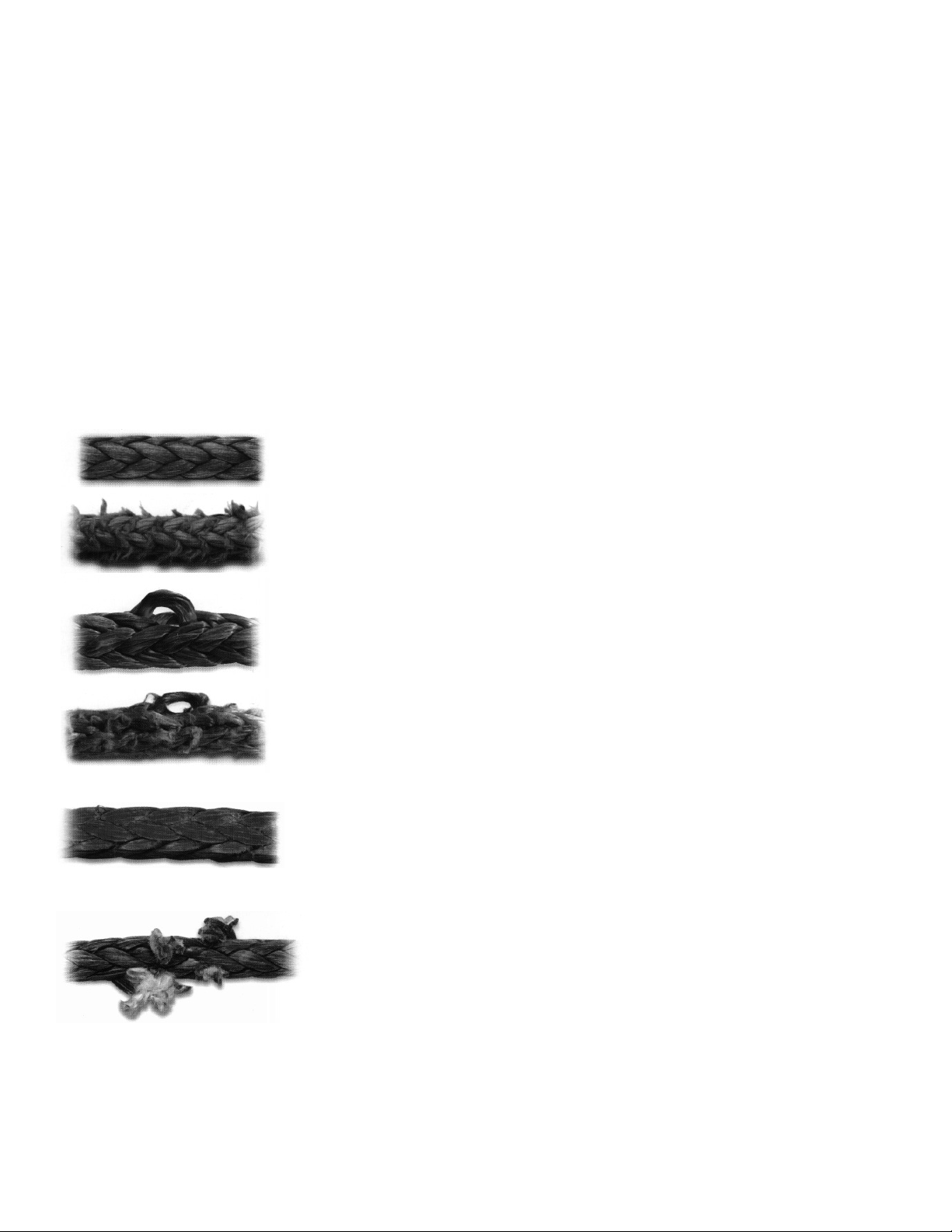
2
SAFETY PRECAUTIONS AND TIPS
Safety Precautions
To Guard against Possible Injury...
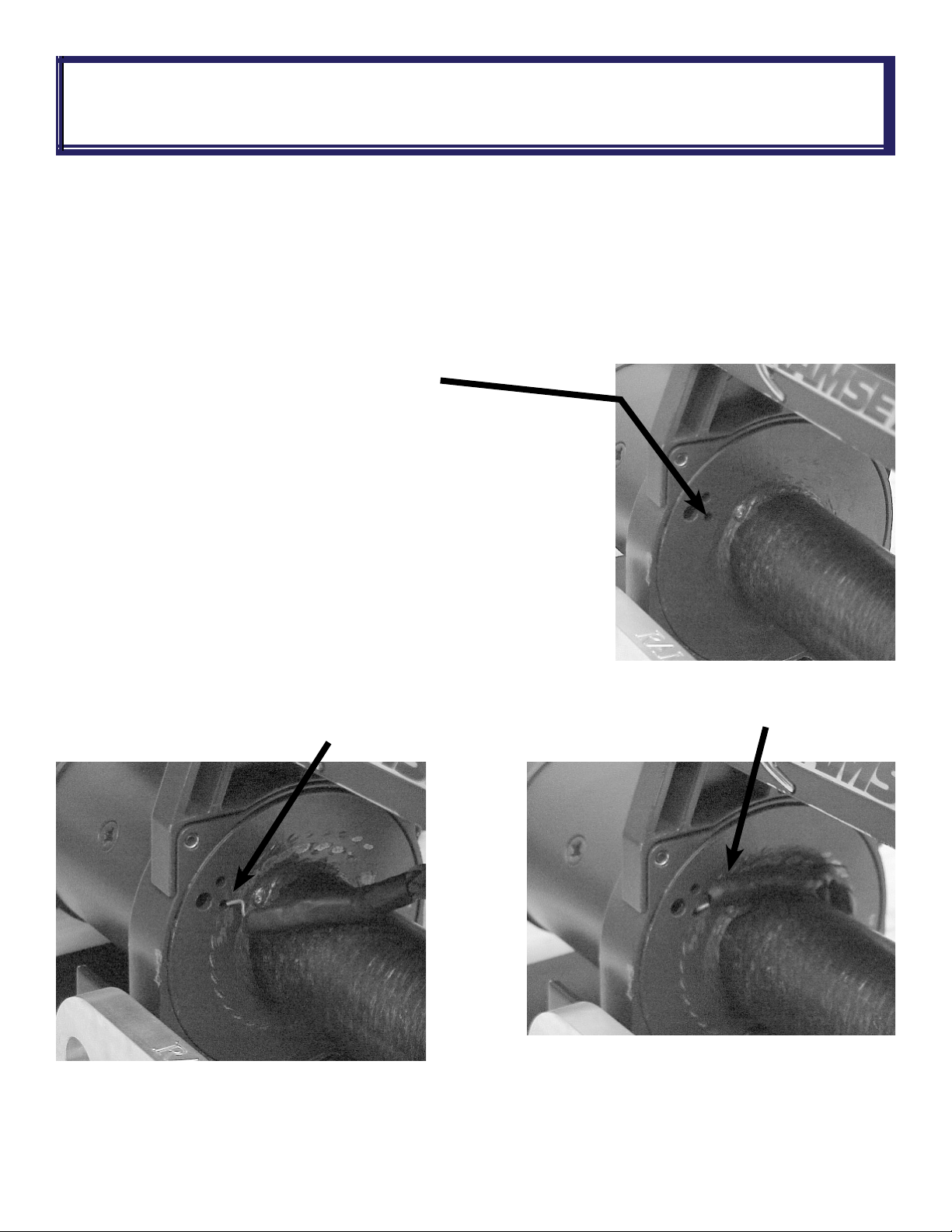
A minimum of eight wraps of rope around the
drum barrel is necessary to hold the rated load.
Rope anchor is not designed to hold the load.
A. Keep yourself and others a safe distance to the side of the rope
when pulling under load.
B. Do not step over the rope or near the rope under load.
C. Use supplied hook strap when handling hook for spooling rope.
D. Do not move the vehicle to pull a load on the winch rope. This
could result in rope breakage and/or winch damage.
E. Apply blocks to wheels when vehicle is on an incline.
F. Winch clutch should be disengaged when winch is not in use
and fully engaged when in use.
G. Modification, alteration, or deviation to the winch should only
be made by Ramsey Winch Company.
H. Keep the duration of your pulls as short as possible. If the motor
becomes uncomfortably hot to the touch, stop and let it cool for
a few minutes. Do not pull more than one minute at or near rated
load. Do not maintain power to the winch if the motor stalls.
Electric winches are for intermittent usage and should not be
used in constant duty applications.
I. Disconnect the remote control switch from the winch when not
in use. A Ramsey Part No. 282053 safety on-off switch in your
vehicle is recommended.
J. NOTE: Do not use winch in hoisting applications due to required
hoist safety factors and features.
K. Do not exceed maximum line pull ratings shown in tables.
Shock loads must not exceed these ratings.
L. To respool correctly, it is necessary to keep a slight load on the
rope. This can be accomplished by holding the rope with one
hand and the remote control switch with the other, starting as
far back and in the center as you can, walking up keeping load
on the rope as the winch is powered in. Do not allow the rope
to slip through your hand and do not approach the winch too
closely. Turn off the winch and repeat the procedure until all
the rope except a few feet is in. Disconnect the remote control
switch and finish spooling in rope by rotating the drum by hand
with clutch disengaged. On hidden winches, spool in rope
under power using supplied hook strap.
M.Avoid pulling rope over rough surfaces or sharp edges. Slide
the protective sleeve along the length of the rope to place it at a
location where the rope would encounter rough surfaces such
as a rock or tree branches.
Tips for Safe Operation
Don’t underestimate the potential danger in winching operations.
Neither should your fear them. Do learn the basic dangers and
avoid them.
Store the remote control switch inside your vehicle where it will not
become damaged. Inspect it before you plug it in.
When ready to begin spooling in, plug in remote control switch with
clutch disengaged. Do not engage clutch with motor running.
Never connect the hook back to the rope. This can cause rope
damage. Always use a sling or chain of suitable strength, as shown
in the illustration.
Observe your winch while winching, if possible, while standing at a
safe distance. If you use vehicle drive to assist, stop and get out
every few feet to assure the rope is not piling up in one corner.
Jamming rope can break your winch.
Do not attach tow hooks to winch mounting apparatus. They must
attach to vehicle frame. When double lining during stationary
winching, the winch hook should be attached to the chassis of the
vehicle. Since the greatest pulling power is achieved on the
innermost layer of your winch, it is desirable to pull off as much
line as you can for heavy pulls. If this is not practical, use a snatch
block and double the arrangement (see illustration).
Neat, tight spooling avoids rope binding which is caused when
a load is applied and the rope is pinched between two others. If this
happens, alternately power the winch in and out a few inches. Do
not attempt to work a bound rope under load free by hand.
Do not expose the rope to chemicals or heat sources.
Avoid prolonged exposure of synthetic rope to ultraviolet rays from
sunlight which can degrade rope strength over time. Use a winch
cover over winch and rope when not in use.
Any sharp bend in the rope under load decreases its strength sub-
stantially and may cause permanent damage or failure. Sheave
diameters on rotating snatch blocks should be at least eight times
the rope diameter (3” for 3/8” rope).
Observe the spooling of rope onto drum. Side pulls can cause rope
to pileup at one end of the drum. To correct uneven stacking, spool
out that section of the rope and move it to the other end of the
drum and continue winching. Uneven spooling which causes
rope pileup can interfere with the solenoid housing causing damage
to the winch.