CONTROLS / OPERATION
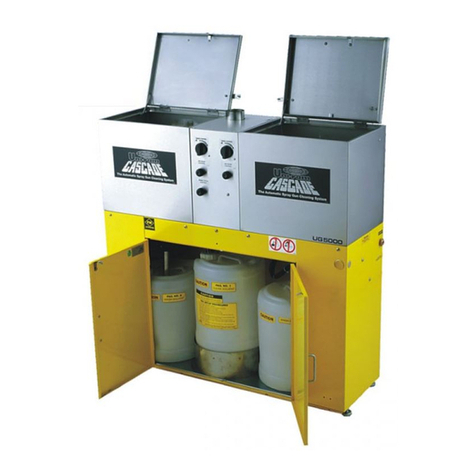
Your parts washer is designed to clean parts (removing
contaminants such as oil, grease, dirt, etc…) with a
recirculated detergent and water solution. The washer
cleans with a combination of mechanical force
(140-160F), and the chemical action of the detergent.
In the automatic mode, you simply place your parts on
the inside rack, shut the door and turn the 0-60 minute
“Wash” timer to initiate the cycle. (ALWAYS MAKE
SURE THE DOOR IS LATCHED BEFORE STARTING
THE WASH CYCLE). During the automatic cycle, the
parts are sprayed from the top and bottom with the hot
solution. The solution is continuously filtered through the
removable filter basket and recirculated. Generally,
anything that can come off will come off within a
15-minute cycle.
The electric heating element(s) is/are controlled with
an adjustable thermostat. Set the thermostat between
140-160F. The adjustment knob is inside the back cover.
Turn the heat breaker to the “on” position to keep the
machine hot. Allow 1 to 1 ½ hours for the solution
temperature to reach 140-160F. During the course of
the day, the heaters will automatically come on when
the thermostat senses a temperature significantly below
its set point. (NOTE: If the heat-up time is inconvenient,
install an automatic 7 day / 24 hour timer next to the
breaker switch on your wall.)
PARTS WASHER CONTROLS
0-60 MINUTE WASH TIMER: After latching the door,
set this timer for the length of the automatic wash cycle.
Do not open the door until the timer reaches “0”.
THERMOSTAT: Set for 140-160F.
DOOR SAFETY SWITCH: Prevents the spray pump
(used in the automatic cycle) from coming on when the
door is open. This is a safety switch that is not to be
used for purposely stopping the wash cycle.
The ideal water depth is 8”. Make sure there is always
water visible inside the filter basket. Check daily.
Do not use the washer until the solution has reached
160F. Otherwise, foaming may occur.
INSTALLATION
LOCATION: Consider the factors below when choosing
a location:
The unit will generate some steam. Make sure
this steam will have no adverse affects in the
surrounding area.
The process of removing wet parts from the machine
will inevitably result in some water or solution spilling
onto the floor. Consider traction mats around the
machine and avoid placing the machine next to a
walkway.
Allow room for your utility connections and for
service.
Make sure the site is level.
ELECTRICAL HOOK-UP: The voltage, phase, and
amperage draw of the machine are listed on the serial #
plate. The wiring diagram is either with this manual or
inside the control box (make sure the amperage draw listed
on the wiring diagram and serial number plate coincide).
After the electrician connects power, he should check
rotation for all motors. Hopefully, the electrician can
be present for “start-up” in case a problem arises. The
machine has its own power cord packed inside the unit.
Make sure your electrician installs a suitable breaker/
disconnect box.
DRAIN CONNECTIONS: The unit has a 2” drain on the
back wall. The drain is an inch off the tank bottom.
WATER AVAILABILITY: You will be adding water to the
tank daily. Make sure you have access to a water hose.
4
DANGER!
This machine utilizes high voltage. Have a certified
electrician do all electrical work. Always disconnect
power when opening an electric box.
CAUTION!
The vibration in route could have loosened one or
more wire connections. Before connecting power,
the electrician should check all screw connections in
the control and junction boxes.
The electrician must check rotation of all motors.
Don’t turn on the heaters until the tank is full.
However, to avoid rust; don’t fill the tank until you
are ready for “start-up”.