GF40-2 Pellet Stove | 5
HORIZONTAL EXHAUST THROUGH WALL INSTALLATION
Vent installation: install vent at clearances specified by the vent manufacturer.
A chimney connector shall not pass through an attic or roof space, closet or similar concealed spaces, or a floor, or ceiling. Where passage through
a wall or partition of combustible construction is desired, the installation shall conform to CAN/CSA-B365 Installation Code for Solid-Fuel-Burning
Appliances and Equipment. Only use venting of L or PL type with an inside diameter of 3 or 4 inches (7.6 or 10.1 cm).
1. Choose a location for your stove that meets the requirements stated in
this manual and allows installation with the least amount of interference
to house framing, plumbing, wiring, etc.
2. Install a non-combustible hearth pad (where necessary).
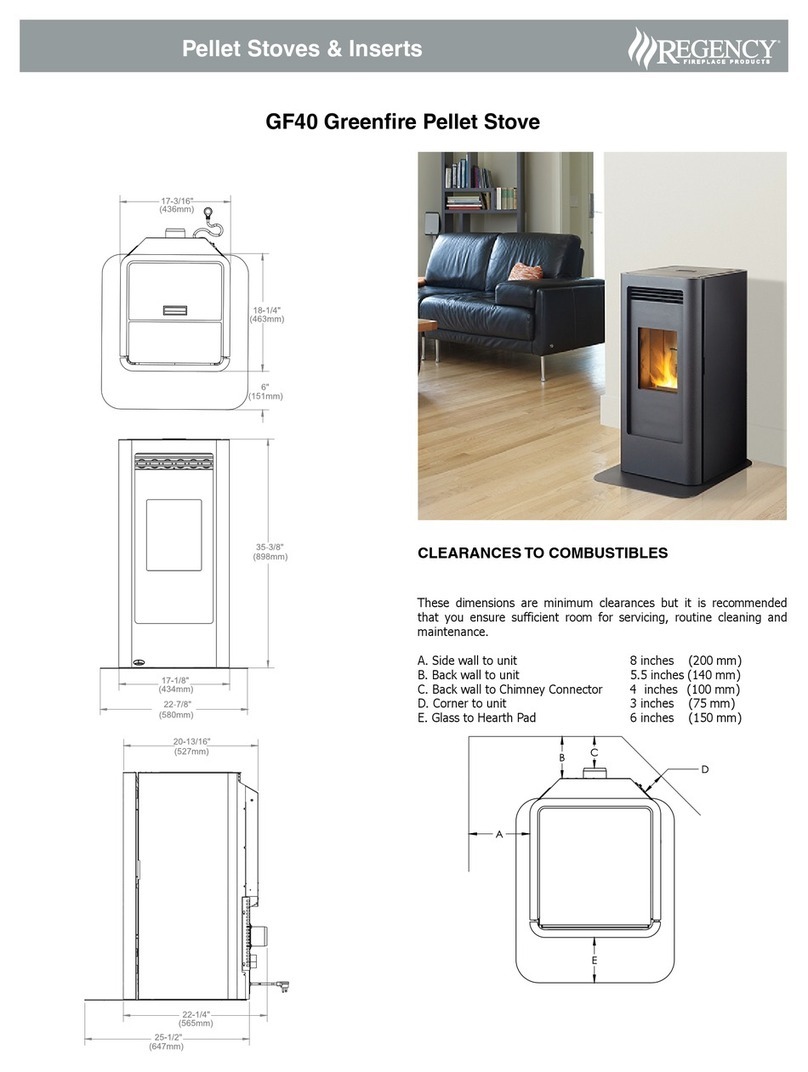
3. Place the appliance 15” (37.5 cm) away from the wall. If the stove is to
be set on a hearth pad, set the unit on it, and adjust the leveling legs.
4. Locate the center of the exhaust pipe on the stove. Extend that line to
the wall. Once you have located the center point on the wall, refer to
pellet vent manufacturer installation instructions for correct hole size
and clearance to combustibles.
5. Install the wall thimble as per the instructions written on the thimble.
Maintain an effective vapour barrier in accordance with local building
codes.
6. Install a length of 3” (75 mm) or 4” (100 mm) vent pipe into the wall
thimble. The pipe should install easily into the thimble.
7. Connect the exhaust vent pipe to the exhaust pipe on the stove. Seal
the connection with high temperature silicone.
8. Push the stove straight back, leaving a minimum of 5.5” (14 cm)
clearance from the back of the stove to the wall. Seal the vent pipe to
the thimble with high temperature silicone.
9. The pipe must extend at least 12” (30 cm) away from the building.
If necessary, bring another length of pipe (PL type) to the outside of
the home to connect to the first section. Do not forget to place high
temperature silicone around the pipe that passes through the thimble.
** Note :A termination cap is highly recommended however to keep
rodents, small animals, etc away as this can be easily accessed with
simply having a 45 degree elbow in place.
10. Install a vertical pipe, or if all requirements for direct venting are
met, install vent termination. The stainless steel cap termination
manufactured by the vent manufacturer is recommended. However,
when the vent terminates several feet above ground level and there
are no trees, plants, etc. within several feet, a 45° elbow can be used
as termination. The elbow must be turned down to prevent rain from
entering.
Straight through Wall Installation
Venting to Use with Straight through Wall Installation
Non-combustible
floor protection.
Existing floor
(combustible)
6"
(15 cm)
5.5”
(14 cm)
Wall
thimble
45°
elbow
12"
(30.5 cm)
**
**
NOTE:
• It is recommended that horizontal through wall installations have 3 to 5 feet (91 to 152 cm) of vertical pipe in the system to help naturally draft
the unit in the event of extreme weather or a power outage.
• Some horizontal through wall installations may require a “T” and 3 to 5 feet (91 to 152 cm) of vertical pipe outside the building to help draft the
unit. This may be required if a proper burn cannot be maintained, after the stove has been tested and the airflow set. This is due to the back
pressure in the exhaust caused by airflow around the structure.
• Follow vent manufacturer guidelines for installation of venting. High temp sealant must be used when connecting vent pipe to the unit’s starter
pipe. Improper seals at the vent joints may cause combustion by-products to leak into the room where installed - seal as required.