©2023 We reserve the right to errors, changes and improvements without prior notice.
REGULUS spol. s r.o.
Web: www.regulus.eu
v1.0-03/2023
6 - Installation and Commissioning
The installation of an electric heating element may be done by qualied staff only.
Defects caused by improper installation, use or handling are not covered by warranty.
Should the tank be equipped with an electric heating element, it is recommended to install it before
connecting the pipes of the heating system.
After the tank is installed and connected to an existing heating/cooling system, it is recommended to clean the
entire heating/cooling system using a suitable cleaning agent for heating systems.
It is recommended to add protective anti-corrosion uid into the heating system. The respective item codes can be
found in the Catalogue or at www.regulus.eu.
6.1 - Connection to sources of heat/cold
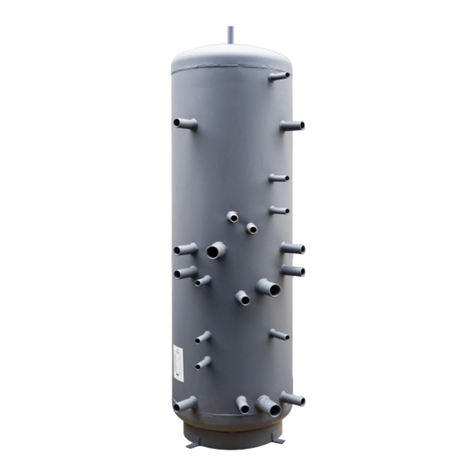
Place the tank on the oor as close as possible to the source of heat /cold and level it. Connect the source of heat/
cold and the heating/cooling system to inlets and outlets. Install an air vent valve at the highest point of the system.
Install a drain valve at the lowest point of the tank. Insulate all the connection piping.
When using the tank for storing cold or when using it alternately for storing either heat or cold, thoroughly insulate
all parts of the piping, including ttings and equipment connected to the tank (heating element, thermostats etc.)
with vapor barrier insulation to prevent condensation on the surface of these parts.
6.2 - Installation of an electric heating element
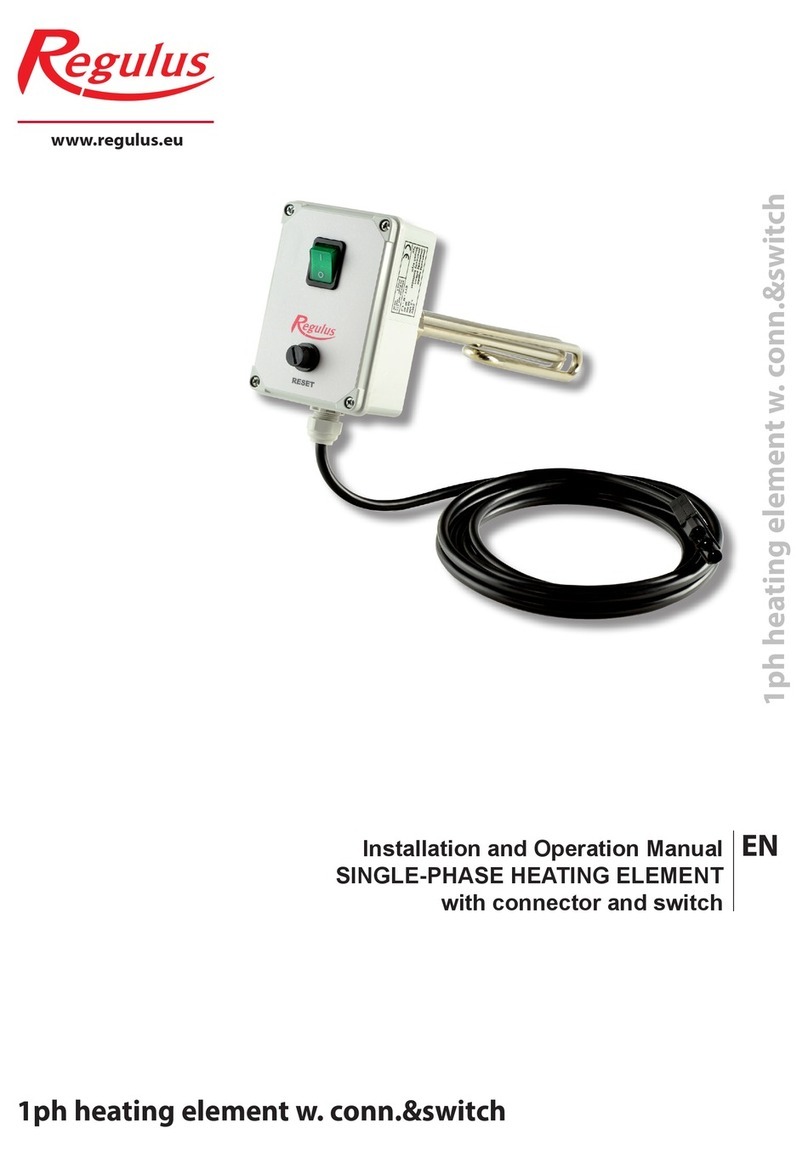
The thermal store can be equipped with electric heating elements with thermostatic head (e.g. ETT-D, F, P, M), max.
length 500 mm. Installing electric heating elements with no thermostatic head is possible only under the condition
of placing the thermostat sensors above the heating elements.
6.3 - Commissioning
Ground the tank before commissioning.
This tank is not designed for DHW heating.
The tank shall be lled up together with the heating/cooling system, respecting valid standards and rules. In order
to minimize corrosion, special protective additives for heating systems should be used (see the Catalogue). The
quality of heating water, of top-up water and the frequency of topping has a strong inuence on the lifetime of heating
systems. Poor quality of heating water may cause problems like corrosion and incrustation.
Fill the system with the appropriate uid and air-bleed. Check all connections for leaks and verify the system pressure.
Set the heating/cooling controller in compliance with the documentation and manufacturer’s recommendations. Check
regularly the proper function of all control and adjustment elements.
7 - Maintenance
If the tank is tted with a heating element, disconnect it from the mains before cleaning. Clean the exterior of the
tank with a soft cloth and a mild detergent. Never use abrasive cleaners or solvents.
Check all connections for leaks.
8 - Disposal
Packaging shall be disposed of in compliance with the valid rules. When the product reaches the end of its life, it
shall not be disposed of as household waste. It shall be dropped off at a Local Waste Recycling Center. Insulation
shall be recycled as plastic and the steel vessel as scrap iron.
9 - Warranty
This product is covered by warranty according to the conditions described in this Manual and according to the
Warranty Certicate. A Warranty Certicate is an integral part of the supply.