EnglishDeutsch
 logo
Brands
  1. Home
  2. •
  3. Brands
  4. •
  5. Robertshaw
  6. •
  7. Control Unit
  8. •
  9. Robertshaw Ranco C12 Installation and user guide

Robertshaw Ranco C12 Installation and user guide

This manual suits for next models

4

Other Robertshaw Control Unit manuals

Robertshaw Uni-Kit 720-079 Installation and user guide

Robertshaw

Robertshaw Uni-Kit 720-079 Installation and user guide

Robertshaw 780-704 User manual

Robertshaw

Robertshaw 780-704 User manual

Robertshaw Uni-Kit 780-001 Installation and user guide

Robertshaw

Robertshaw Uni-Kit 780-001 Installation and user guide

Robertshaw 720 Series Installation and user guide

Robertshaw

Robertshaw 720 Series Installation and user guide

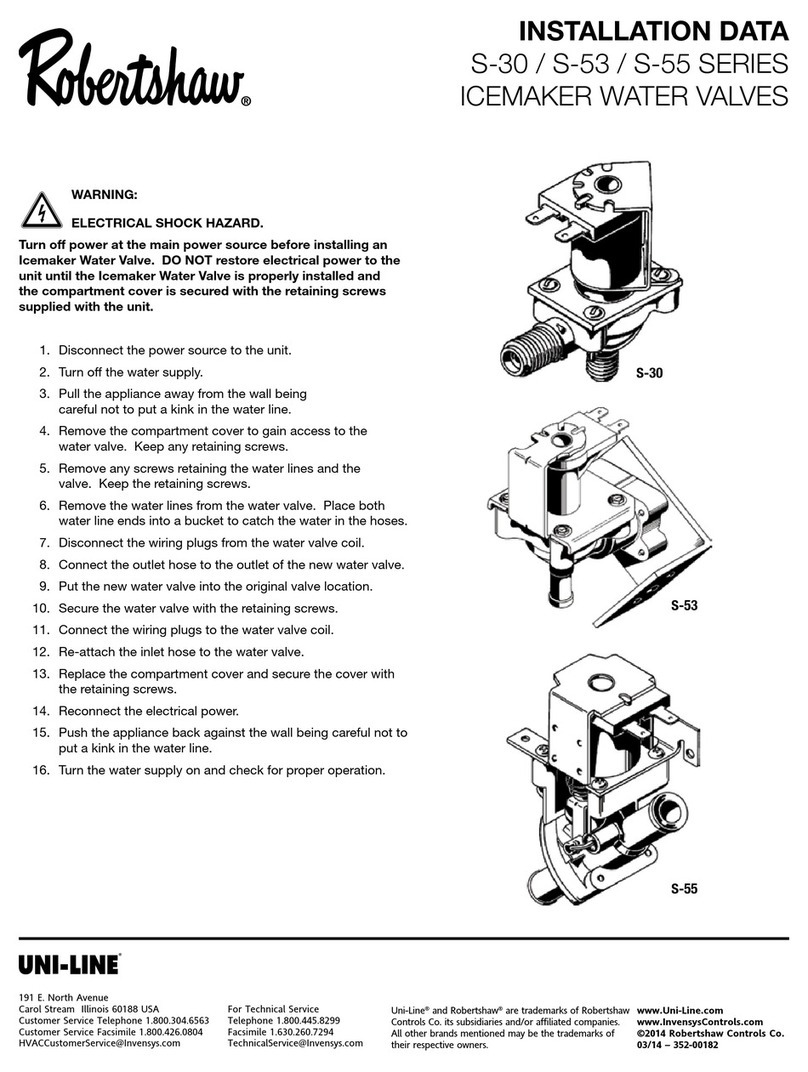
Robertshaw S-30 Series Installation and user guide

Robertshaw

Robertshaw S-30 Series Installation and user guide

Robertshaw N-86 Series Installation and user guide

Robertshaw

Robertshaw N-86 Series Installation and user guide

Robertshaw 720 SERIES Installation and user guide

Robertshaw

Robertshaw 720 SERIES Installation and user guide

Popular Control Unit manuals by other brands

Festo Compact Performance CP-FB6-E Brief description

Festo

Festo Compact Performance CP-FB6-E Brief description

Elo TouchSystems DMS-SA19P-EXTME Quick installation guide

Elo TouchSystems

Elo TouchSystems DMS-SA19P-EXTME Quick installation guide

JS Automation MPC3034A user manual

JS Automation

JS Automation MPC3034A user manual

JAUDT SW GII 6406 Series Translation of the original operating instructions

JAUDT

JAUDT SW GII 6406 Series Translation of the original operating instructions

Spektrum Air Module System manual

Spektrum

Spektrum Air Module System manual

BOC Edwards Q Series instruction manual

BOC Edwards

BOC Edwards Q Series instruction manual

KHADAS BT Magic quick start

KHADAS

KHADAS BT Magic quick start

Etherma eNEXHO-IL Assembly and operating instructions

Etherma

Etherma eNEXHO-IL Assembly and operating instructions

PMFoundations Attenuverter Assembly guide

PMFoundations

PMFoundations Attenuverter Assembly guide

GEA VARIVENT Operating	 instruction

GEA

GEA VARIVENT Operating instruction

Walther Systemtechnik VMS-05 Assembly instructions

Walther Systemtechnik

Walther Systemtechnik VMS-05 Assembly instructions

Altronix LINQ8PD Installation and programming manual

Altronix

Altronix LINQ8PD Installation and programming manual

Eaton Powerware Series user guide

Eaton

Eaton Powerware Series user guide

WAGO 750-407/040-000 manual

WAGO

WAGO 750-407/040-000 manual

Sony CCU-590 Operation manual

Sony

Sony CCU-590 Operation manual

Graco 25D614 instructions

Graco

Graco 25D614 instructions

Task Force Tips YE-RF-900 Instructions for installation, safe operation and maintenance

Task Force Tips

Task Force Tips YE-RF-900 Instructions for installation, safe operation and maintenance

Shini SPV-U Series manual

Shini

Shini SPV-U Series manual

https://manuals.online logo
https://manuals.online logoBrands
  • About & Mission
  • Contact us
  • Privacy Policy
  • Terms and Conditions

Copyright 2026 Manuals.Online. All Rights Reserved.

INSTALLATION DATA
C12 & O18
iCe bank COnTROLS
1
DESCRIPTION/APPLICATION
The Ranco®C12-1800 and the O18-100 are used to control the ice bank
size on beverage dispensers and other refrigeraon systems which use
an ice bank for thermal storage. The control bulb senses the ice bank
by having a water-based ll which expands upon freezing and contracts
upon thawing. This change in volume is transmied by a hydraulic
acon through the capillary to operate the control switch.
Both the C12-1800 and the O18-100 (which has a NEMA 1 enclosure)
have a single pole, single throw (SPST) switch. They may be used to
directly control a single phase compressor; to control the pilot duty
circuit of a contactor for single or three-phase compressors; or to
control a pilot duty circuit for a liquid line solenoid valve.
CONTROL OPERATION
(For both C12-1800 & O18-100)
The ice bank control is factory set and no eld adjustments are to be
made. It is designed to shut o the refrigeraon system when the ice
has built-up beyond the bulb by approximately 1/8 inch. The control
switch will reclose when the ice has melted back, exposing a poron of
the bulb.
1st Cycle Eect
When the system is rst put into operaon, or returned to service,
or aer a prolonged o cycle, there will be a long running period
to build the ice bank. During this rst cycle, the ice bank may build
approximately 1/4 inch larger than normal. However succeeding cycles
will operate at the normal dierenal of approximately 1/8 inch of ice
bank.
CAUTION To prevent possible electrical shock or equipment
damage, disconnect electrical power to unit before
and during installaon. DO NOT restore electrical
power to unit unl the control is properly installed
and grounded. DO NOT locate the control in an
explosive atmosphere as a safety hazard can result
due to possible spark generaon in the control.
Controls are not to be located in areas of splashing
water or extreme moisture, dirt or dust, or in
a corrosive or explosive atmosphere. These
environments can shorten control life.
CONTROL BODY MOUNTING
The C12 and O18 can be mounted in any posion. Mount the control in
a locaon that will permit proper capillary roung and bulb mounng
(see following secons) and is away from moisture and splashing
water. DO NOT twist or strain the control body as this may shi the
calibraon. Use only the mounng holes provided; no other holes are
to be added to the control frame.
C12 only
The ps of the mounng screws must not extend through the
mounng bracket so as to touch the control body. Make sure that the
mounng surface is at to prevent straining the control.
O18 only
Mount on an exisng bracket, on the at bracket provided, or surface-
mount without a bracket. When aaching the control to a bracket use
the 10-32 x 3/16 screws provided and the two tapped holes in the
back of the control. If other mounng screws are used, they must not
enter the control more than 1/8 inch to avoid damage. When surface
mounng the control, use the .20 inch holes in the back of the control
frame which can be accessed by removing the front cover. Make sure
the surface is at. Mounng to an uneven surface may cause improper
control operaon.
O18-100
C12-1800
1531080C.indd 1 3/13/15 3:58 PM
CAPILLARY CARE AND MOUNTING
1. Hold the capillary close to the control and carefully uncoil the
required amount. Minimize rebending which makes the capillary
more suscepble to breakage.
2. DO NOT cut the capillary or bulb. Avoid sharp bends, kinks, strains
or pinch marks in the capillary. Never allow the capillary to rest
against sharp edges or rub against metal surfaces.
3. Provide a drip loop in the capillary to prevent moisture from
reaching the control and causing an electrical short.
4. Don't immerse the excess capillary in the water bath or expose
it to temperatures above 120°F. Avoid exposing the capillary to
other extreme temperatures such as sucon or discharge lines.
5. Secure excess capillary in 3 inch coils to avoid damage from
vibraon or contact with electrical terminals. Sillicone adhesive
applied between the coils will prevent rubbing.
6. Although securing the excess capillary is important to dampen
vibraon, it is just as important to allow enough slack so the
capillary is not taut like a banjo string.
7. On startup of the equipment, observe the capillary for excessive
vibraon and make correcons as required.
BULB MOUNTING
1. Locate the bulb where the maximum build up of ice is to be
maintained since the enre bulb must be surrounded with ice to
stop the refrigeraon system.
2. A shorter cycle occurs when the bulb is located closer to the
expansion device; a longer cycle results when the bulb is located
closer to the outlet of the evaporator.
3. Using the strip clamp (when provided) or the original mounng,
aach the bulb to the evaporator coil at least 3 inches below the
water surface, away from a direct path of high velocity water.
The distance that the bulb is mounted from the evaporator coils
determines the ice bank thickness.
TYPICAL BULB MOUNTING
Figure 1 Using O18 Strip Clamp
CONTROL WIRING
1. Disconnect electrical power to the unit.
2. All electrical wiring should conform to the Naonal Electrical code
and local regulaons.
3. DO NOT exceed the listed electrical rangs.
4. Use copper conductors only.
5. Provide a drip loop in the wiring to prevent moisture from
reaching the control.
6. The terminals must not be bent, cut o, drilled or retapped.
Electrical leads should not be taut; allow slack for temperature
change and vibraon.
When mounng a conduit connector to the O18 control frame, take
care to not damage the switch or the control mechanism.
The cup washers furnished with the O18 are to be used when the
conductor wires are directly connected to the terminals. The stripped
end of the conductor should be made into a clockwise formed eye with
an inside diameter to slip over the shank of the terminal screw. The
clockwise forming will tend to wrap the eye of the conductor around
the screw shank as it is being ghtened. The cup washer, with its
anges outward, should be placed between the terminal and the screw
head to capture the eye of the conductor.
Figure 2 O18 Electrical Terminals
ELECTRICAL RATINGS
VAC FLA LRA PD VA HP
C12-1800 240 20 85 720
277 16 60 720
O18-100 120 17 102 720
240 17 102 720 3
241/600 — — 125
Hermec Compressor Motor
240 20 80
CHECKOUT
Inspect work to be assured that all the above steps were taken. Start
up the unit and arrange to observe at least one full cycle.
ALTITUDE ADJUSTMENT
The ice bank control is not aected by altude.
Customer Service Telephone 1.800.304.6563
Customer Service Facsimile 1.800.426.0804
[email protected]
Robertshaw®, Ranco®, Paragon® and Uni-Line® are
trademarks of Robertshaw, its subsidiaries and/or
affiliated companies. All other brands mentioned
may be the trademarks of their respective owners.
For Technical Service
Telephone 1.800.445.8299
Facsimile 1.630.260.7294
[email protected]
www.uni-line.com
www.robertshaw.com
©2015 Robertshaw
3/15 –153108 Rev C
1531080C.indd 2 3/13/15 3:58 PM