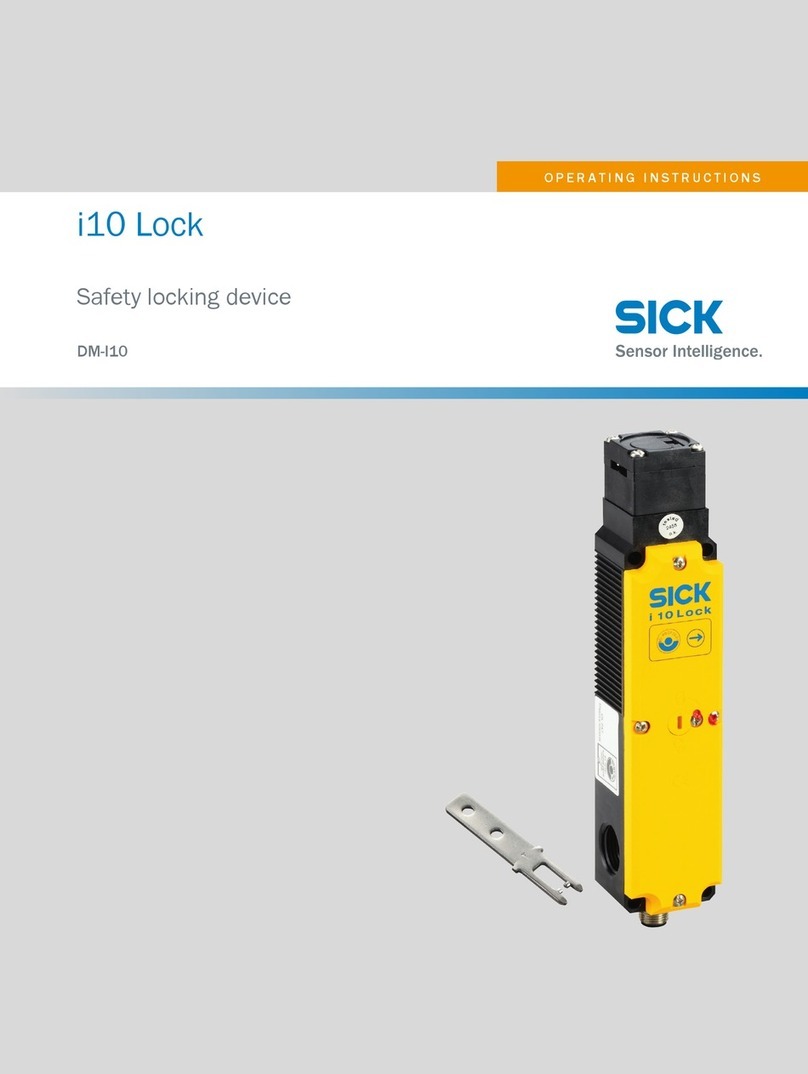
SICK i110 User manual

OPERATING INSTRUCTIONS
i110 Lock
Safety locking device

Described product
i110 Lock
Manufacturer
SICK AG
Erwin-Sick-Str. 1
79183 Waldkirch
Germany
Legal information
This work is protected by copyright. Any rights derived from the copyright shall be
reserved for SICK AG. Reproduction of this document or parts of this document is only
permissible within the limits of the legal determination of Copyright Law. Any modifica‐
tion, abridgment or translation of this document is prohibited without the express writ‐
ten permission of SICK AG.
The trademarks stated in this document are the property of their respective owner.
© SICK AG. All rights reserved.
Original document
This document is an original document of SICK AG.
2O P E R A T I N G I N S T R U C T I O N S | i110 Lock 8020543/17K9/2020-06-08 | SICK
Subject to change without notice

Contents
1 About this document........................................................................ 5
1.1 Scope......................................................................................................... 5
1.2 Additional information.............................................................................. 5
1.3 Symbols and document conventions...................................................... 5
2 Safety information............................................................................ 7
2.1 General safety notes................................................................................ 7
2.2 Intended use............................................................................................. 7
2.3 Requirements for the qualification of personnel.................................... 7
3 Product description........................................................................... 8
3.1 Setup and function................................................................................... 8
3.2 Product characteristics............................................................................ 8
3.3 Symbols on the product........................................................................... 9
3.4 Manual unlocking..................................................................................... 9
4 Project planning................................................................................ 11
4.1 Manufacturer of the machine.................................................................. 11
4.2 Operator of the machine.......................................................................... 12
4.3 Design........................................................................................................ 12
4.4 Integrating into the electrical control....................................................... 12
4.5 Testing plan............................................................................................... 12
5 Mounting............................................................................................. 14
5.1 Safety......................................................................................................... 14
5.2 Converting the actuating head................................................................. 14
5.3 Mounting................................................................................................... 15
5.4 Protection from environmental influences.............................................. 15
6 Electrical installation........................................................................ 16
6.1 Safety......................................................................................................... 16
6.2 Pin assignment......................................................................................... 17
6.3 System connection (M12, 8-pin)............................................................. 17
6.4 System connection (cable entry)............................................................. 18
7 Commissioning.................................................................................. 20
7.1 Testing....................................................................................................... 20
7.2 Recurring technical checks...................................................................... 20
8 Decommissioning............................................................................. 22
8.1 Disposal..................................................................................................... 22
9 Technical data.................................................................................... 23
9.1 Technical data........................................................................................... 23
9.2 Dimensional drawings.............................................................................. 24
CONTENTS
8020543/17K9/2020-06-08 | SICK O P E R A T I N G I N S T R U C T I O N S | i110 Lock 3
Subject to change without notice

10 Ordering information........................................................................ 26
10.1 Ordering information................................................................................. 26
11 Accessories........................................................................................ 27
11.1 Actuator..................................................................................................... 27
11.2 Additional accessories............................................................................. 27
12 Annex.................................................................................................. 28
12.1 Compliance with EU directives................................................................. 28
CONTENTS
4O P E R A T I N G I N S T R U C T I O N S | i110 Lock 8020543/17K9/2020-06-08 | SICK
Subject to change without notice

1 About this document
1.1 Scope
These operating instructions are valid for all i110 Lock safety locking devices.
This document is included with the following SICK part numbers (this document in all
available language versions):
8022219
1.2 Additional information
www.sick.com
The following information is available on the Internet:
•This document in other languages
•Data sheets and application examples
•CAD data and dimensional drawings
•Certificates (e.g. EU declaration of conformity)
•Guide for Safe Machinery Six steps to a safe machine
1.3 Symbols and document conventions
The following symbols and conventions are used in this document:
Safety notes and other notes
DANGER
Indicates a situation presenting imminent danger, which will lead to death or serious
injuries if not prevented.
WARNING
Indicates a situation presenting possible danger, which may lead to death or serious
injuries if not prevented.
CAUTION
Indicates a situation presenting possible danger, which may lead to moderate or minor
injuries if not prevented.
NOTICE
Indicates a situation presenting possible danger, which may lead to property damage if
not prevented.
NOTE
Indicates useful tips and recommendations.
Instructions to action
bThe arrow denotes instructions to action.
1. The sequence of instructions for action is numbered.
2. Follow the order in which the numbered instructions are given.
✓The check mark denotes the result of an instruction.
ABOUT THIS DOCUMENT 1
8020543/17K9/2020-06-08 | SICK O P E R A T I N G I N S T R U C T I O N S | i110 Lock 5
Subject to change without notice

Terminology
Dangerous state
A dangerous state is a status of the machine or facility, where people may be injured.
Protective devices prevent this risk if the machine is operated within its intended use.
The figures in this document always show the dangerous state of the machine as move‐
ment of a machine part. In practice, there are different dangerous states, such as:
•Machine movements
•Electrical parts
•Visible and invisible beam
•A combination of multiple hazards
1 ABOUT THIS DOCUMENT
6O P E R A T I N G I N S T R U C T I O N S | i110 Lock 8020543/17K9/2020-06-08 | SICK
Subject to change without notice

2 Safety information
2.1 General safety notes
The safety locking device must be configured and operated correctly by qualified safety
personnel according to the machine requirements.
2.2 Intended use
When used in conjunction with a movable physical guard and the machine controller,
the safety locking device prevents the protective device from being opened while a dan‐
gerous machine function is being executed.
The safety locking device may only be used on the machine on which it was configured,
mounted, installed, and commissioned by qualified safety personnel in accordance with
these operating instructions.
Incorrect use, improper modification of or tampering with the safety locking device will
invalidate any warranty from SICK AG; in addition, any responsibility and liability of SICK
AG for damage and secondary damage caused by this is excluded.
NOTE
The safety locking device is also suitable for process protection.
2.3 Requirements for the qualification of personnel
The safety locking device must be configured, installed, connected, commissioned, and
serviced only by qualified safety personnel.
Project planning
For project planning, a person is considered competent when he/she has expertise and
experience in the selection and use of protective devices on machines and is familiar
with the relevant technical rules and national work safety regulations.
Mechanical mounting, electrical installation, and commissioning
For the task, a person is considered qualified when he/she has the expertise and expe‐
rience in the relevant field and is sufficiently familiar with the application of the protec‐
tive device on the machine to be able to assess whether it is in an operationally safe
state.
Operation and maintenance
For operation and maintenance, a person is considered competent when he/she has
the expertise and experience in the relevant field and is sufficiently familiar with the
application of the protective device on the machine and has been instructed by the
machine operator in its operation.
SAFETY INFORMATION 2
8020543/17K9/2020-06-08 | SICK O P E R A T I N G I N S T R U C T I O N S | i110 Lock 7
Subject to change without notice

3 Product description
3.1 Setup and function
The safety locking device is an interlocking device consisting of a mechanically-actu‐
ated position switch and a coded actuator. The actuator has a lower coding level. The
position switch contains a rotating switching cylinder which the actuator grips during
closing. The switching cylinder is locked or unlocked electromagnetically (variant-depen‐
dent).
When inserting and removing the actuator, switching contacts for door monitoring are
opened and closed. When locking and unlocking the locking device, switching contacts
for locking device monitoring are opened and closed.
If the locking device is locked, the actuator cannot be removed from the actuating head.
The locking device can only be locked when the protective device is closed.
3.2 Product characteristics
3.2.1 Product variants
The safety locking device is delivered in different variants. You will find an overview of
important distinguishing features of the variants in the following.
•Locking principle: operating or standby current
•Connection type: M12 plug connector or cable entry
•Number and type of contacts for locking device and door monitoring
Complete overview of all variants: see "Ordering information", page 26
Standby current locking principle
i110-M
•Locking locking device: close protective device, no voltage on the magnet
•Unlocking locking device: apply voltage to magnet
If voltage is interrupted at the magnet, the locking device remains locked and the pro‐
tective device cannot be opened immediately.
WARNING
The locking device locks even when voltage is not present
People could get trapped.
bIf people are in the hazardous area, do not close the protective device even volt‐
age is not present.
Operating current locking principle
i110-E
•Locking locking device: apply voltage to magnet
•Unlocking locking device: disconnect voltage from magnet
If voltage is disconnected at the magnet, the locking device is unlocked and the protec‐
tive device can be opened immediately.
3 PRODUCT DESCRIPTION
8O P E R A T I N G I N S T R U C T I O N S | i110 Lock 8020543/17K9/2020-06-08 | SICK
Subject to change without notice

DANGER
Hazard due to lack of effectiveness of the protective device
In the event of a voltage drop, the safety locking device unlocks regardless of whether
the dangerous state of the machine has ended.
bAssess the risk of accident. Use for protecting people requires correct project plan‐
ning.
3.2.2 Locking device monitoring
All variants feature at least 1 positive opening normally closed contact for locking
device monitoring. The output state changes when locking or unlocking the locking
device.
Variants with 2 positive opening normally closed contacts for locking device monitoring
are recommended to protect people.
3.2.3 Door monitoring
All versions feature at least 1 positive opening normally closed contact for door monitor‐
ing. Depending on the product variant, the contacts can be positive opening normally
closed contacts, normally open or normally closed contacts. The output state changes
when opening or closing the protective device.
Variants with 2 positive opening normally closed contacts for door monitoring are rec‐
ommended for process protection.
3.3 Symbols on the product
Table 1: Symbols on the product
Symbol Meaning
Positive opening normally closed contact for locking device moni‐
toring
Positive opening normally closed contact for door monitoring
Mechanical unlocking mechanism actuated, safety locking device
unlocked
Mechanical unlocking mechanism not actuated, safety locking
device functions normally
3.4 Manual unlocking
In some situations, it necessary to unlock the locking device manually (e.g. is faults are
present). After unlocking, a function test must be performed.
Mechanical unlocking mechanism
With the mechanical unlocking mechanism, the safety locking device can be unlocked
regardless of the status.
When actuating the mechanical unlocking mechanism, the contacts for locking device
monitoring open. A stop command must be generated.
Actuating the mechanical unlocking mechanism
bEnsure tensile stress is not applied on the actuator.
bLoosen safety screw with the screwdriver.
bUse the screwdriver to rotate the mechanical unlocking mechanism in the direc‐
tion of the arrow to the following symbol:
PRODUCT DESCRIPTION 3
8020543/17K9/2020-06-08 | SICK O P E R A T I N G I N S T R U C T I O N S | i110 Lock 9
Subject to change without notice

✓The locking device is unlocked.
WARNING
Permanent actuation of the mechanical unlocking mechanism
Hazard due to lack of effectiveness of the protective device
bAfter use, put back the mechanical unlocking mechanism, screw in the safety
screw and seal (e.g. with locking varnish).
3 PRODUCT DESCRIPTION
10 O P E R A T I N G I N S T R U C T I O N S | i110 Lock 8020543/17K9/2020-06-08 | SICK
Subject to change without notice
This manual suits for next models
2
Table of contents
Other SICK Lock manuals