CURRENT MONITORING INSTALLATION GUIDE
Z201167-0D page 2 ©2006 Veris Industries USA 800.354.8556 or 503.598.4564 / support@veris.com 10061
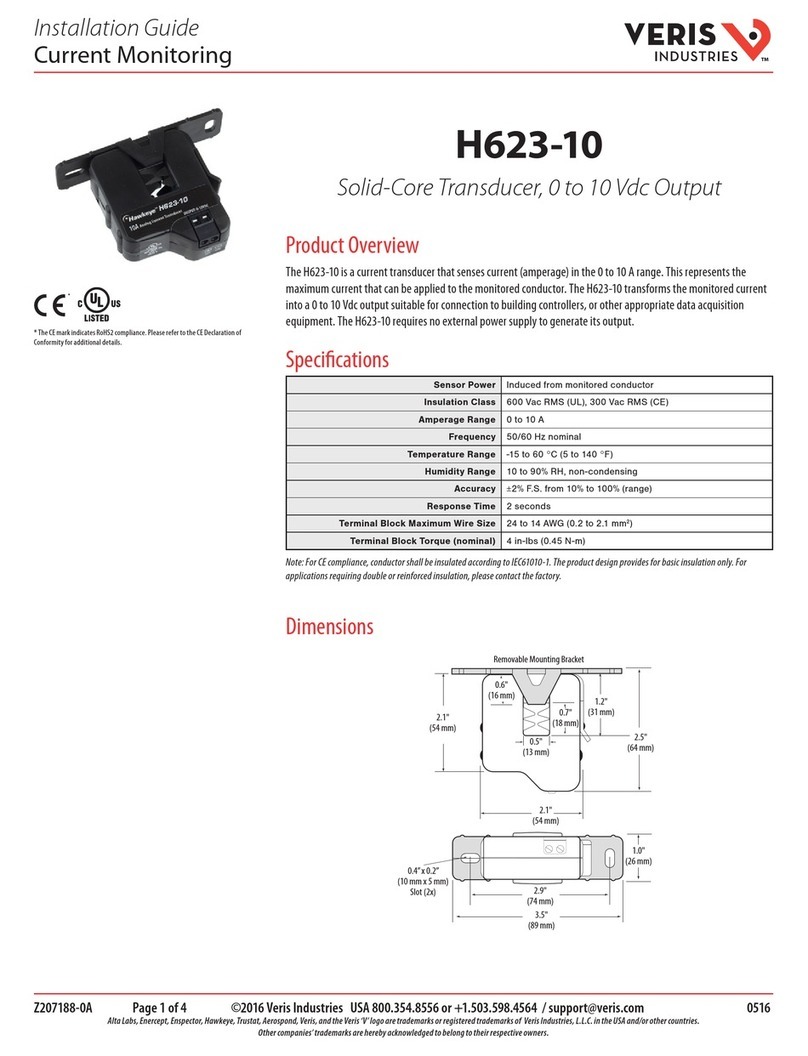
The H922 is a current transducer which senses current (amperage) in any of three
field-selectable ranges; zero-to-thirty, zero-to-sixty, or zero-to-one hundred twenty
amperes. These ranges represent the maximum current which can be applied to the
monitored conductor. The H922 transforms the monitored current into a zero-to-five
volt DC output suitable for connection to building controllers, or other appropriate
data acquisition equipment. The H922 requires no external power supply to generate
its output.
OPERATION
NOTES
TROUBLESHOOTING
CALIBRATION
DIMENSIONS
For load currents less than sensor minimum rating:
Wrap the monitored conductor through the center hole and around the sensor body
to produce multiple turns through the "window." This increases the current measured
by the transducer.
• Controller must be
programmed to account
for the extra turns. e.g., if
four turns pass through the
sensor (as shown) the normal
controller reading must be
divided by 4.
1.0 A
DANGER: 5A CTS CAN PRESENT HAZARDOUS VOLTAGES.
INSTALL CTS IN ACCORDANCE WITH MANUFACTURER'S
INSTRUCTIONS.
TERMINATE THE CT SECONDARY BEFORE APPLYING CURRENT.
H6800-5A CT
300 A
> 120A (H922 max.)
For load currents greater than sensor maximum rating:
Use a 5 Amp (H681x series) Current Transformer (CT) as shown.
Problem Solution
No Reading at Controller • Check polarity of sensor output connections
• Check for output voltage at sensor
• Check for amperage in monitored conductor
• Assure that sensor core mating surfaces are clean and
that the core clamp is completely closed
Adjust controller to apply correct scaling factor for the application. See graph on page 1.
CAUTION
RISK OF EQUIPMENT DAMAGE
• Derate the product’s maximum current for the number of
turns through the sensing window using the following
formula.
Rated Max. Amps ÷ Number of Turns = Max. monitored Amps
e.g. : 30A ÷ 4 Turns = 7.5 Amps max. in monitored conductor
Failure to follow these instructions can result in overheating
and permanent equipment damage.