● Reduce the load power, or turn on the
appliance first, then turn on the inverter.
● Choose a bigger inverter
● Change a bigger battery and ensure fully
charged.
No output voltage,
buzzer whistles
continuously
Problem Reason Solutions
Low Input DC Voltage
High Input DC Voltage
Overload
Over temperature
● Do not use it when the battery is charging
● Check the rated voltage of the battery and
make sure that it is in the allowable range
ofthe input voltage.
Reduce the load power
● Cut off the load and let it cool naturally for
10 to 30 minutes.
● Restart it after it resumes to normal
temperature. Reduce the load. avoid
blocking the vent and improve the
ventilation condition.
No AC outputvoltage? 1.The power switch is off.
2.Poor contact with battery.
● Press the power switch for 1-2 second to
turn it on. it is a long press type switch
●Check the cables and make sure they are
tightly connected.
Output voltagebelow
100 V AC?
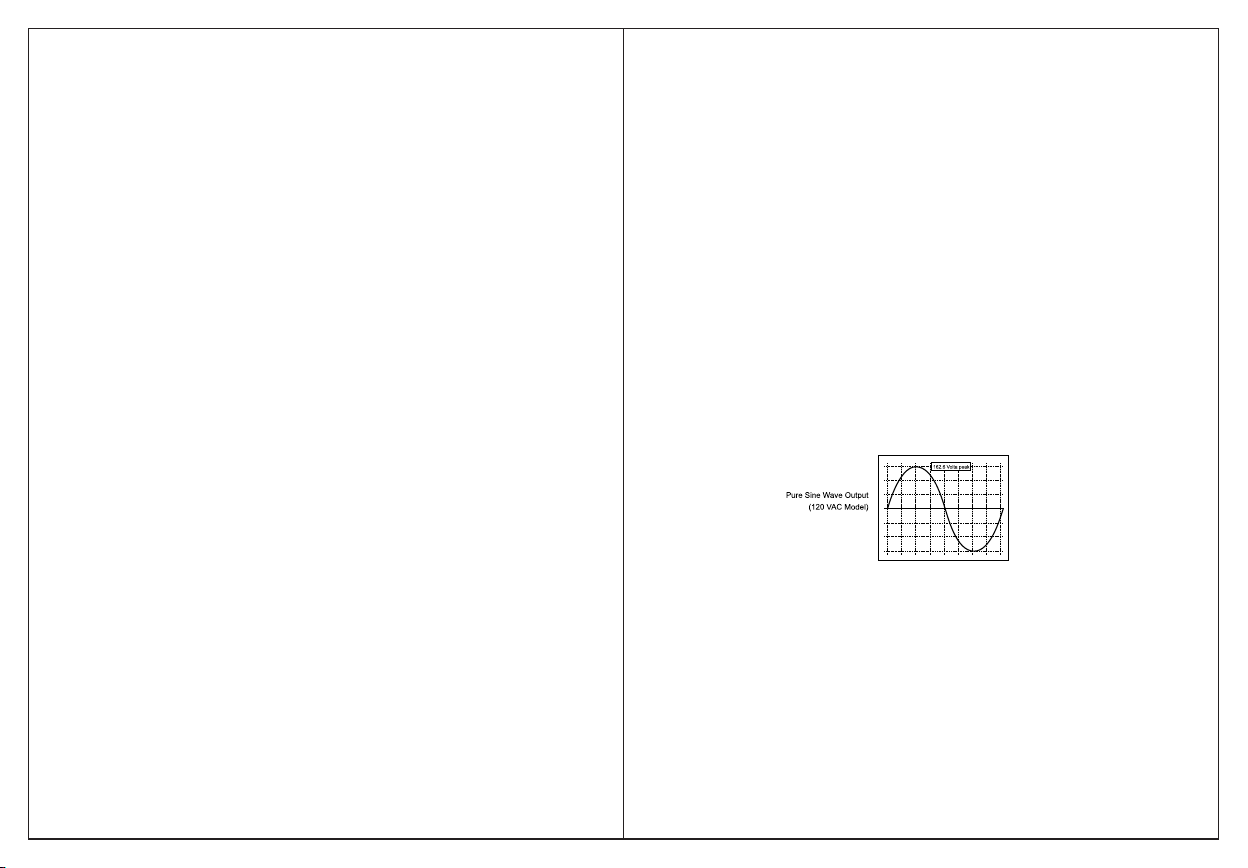
“True RMS”voltage meter is
required to properly measure
outputvoltage of modified
wave inverter
Cannot drive theload?
Tester indicated
"Open Ground"?
This is because it is not connected
to a"true Earth ground ", meaning
it is not connected to a metal rod
stuck in theEarth. it would be
impossible to do so in a boat or
car while moving. The power
inverter DOES NOT and cannot
create a true Earth ground on its
own.
● Test output voltage with a True RMS meter
● Try to maintain the input voltage in the
range of rated power
● Change the battery of the meter then test
again.
1.Load power is too large. Or the
actualpower of the appliance
exceedsnominal power.
2.The starting power is larger than
ratedpower (especially for
appliances withmotor)
3.Battery is too small.
● Don't need the tester to do the Grounding
Test.
● Refer to the manual to do the Grounding
Starting alarm ?
The main reason is that ths
instantaneous current is too large,
which leads to the detection of low
voltage and trigger under-voltage
alarm.
Please restart the inverter several
times.
Got 40V or so while
testing inverter's
ground wire and
zero line?
This valtage has no
meaning, zero line can
be ground.
This is normal, there is no current
leakage.
Low Input DC Voltage
If the unit still doesn't work normally after using all the methods above, it maybe the
internal faults of the circuit. Please contact us: usvoltworks@gmail.com
B. TROUBLESHOOTING TIPS
910
11. PROTECTIONS IN THE INVERTER
1. Input under-voltage alarm: When the input DC voltage is lower than 9.8V (19.6V),the
buzzer will whistle intermittently to remind that the inverter will go into the under
voltage protection. If you are operating a computer or other equipment, you should
pay attention to the timely preservation of data
2.Input undervoltage protection: When the input DC voltage is lower than 9.5V/19V, the
inverter will automatically shut down. The buzzer beeps for a long time,and the LCD
on the inverter displays "UNDERVOLTAGE".The user should turn off the inverter
power switch and recharge the battery in time before using it.
3. Input overvoltage protection: When the input DC voltage is higher than 16V/32V, the
inverter will automatically shut down.The buzzer beeps for a long time,and the LCD
on the inverter displays "OVERVOLTAGE".The user should turn off the inverter power
switch and adjust the input voltage to the allowable range before using it.
4. Short circuit protection:When the output is short circuit, the inverter will automatically
close the AC output and the LCD will display "OVERLOAD", and the AC output will be
automatically restored after the short circuit fault is removed.
5. Short-circuit protection: The AC output will be automatically shut down when short
circuited. It will automatically reset after the problem is solved.
6. Temperature protection: The product will heat up during use. If the temperature
exceeds 65°C, the inverter will automatically shut down. At this time, the buzzer will
beep and the LCD on the inverter will display "OVERHEAT". The user should turn off
the power switch of the inverter and continue to use it when the inverter is naturally
cooled to normal temperature. The user should also check the reasons for the
temperature protection, such as whether the ventilation conditions are good, whether
the ambient temperature is too high, whether the vent is blocked, whether the load
power is too large, etc., solve the above problems to avoid recurring temperature
protection. power etc. It can avoid similar things from happening again.
12. QUICK KNOWLEDGE ABOUT INVERTER
! Ensure Your Battery Size Is Big Enough And Voltage Is Correct.
A. CORRECTLY CONNECTING THE INVERTER FOR FIRST USE.
1) Secure the provided Negative (black) DC cable connect to the Negative (-) bolt on
the inverter, and the other end to the Negative (-) post on the battery.
2) Secure the provided Positive (Red) DC cable to the Positive (+) bolt on the
inverter, and the other end to the Positive (+) post on the battery.
3) The nuts of the connection posts must be tightened to ensure well connected.
4) Press the power switch for one second, because it is a long press type switch.
WARNING: REVERSE CONNECTED THE CABLES WILL DAMAGE THE INVERTER
AND AVOID YOUR WARRANTY!