Design Parameters
Type of dryer: Refrigerated
Power supply: 115, 230, 460 Volt / single or three
phase / 60Hz
Refrigerant.type: R-134A
R-404A
ChemicalComposition:HFC
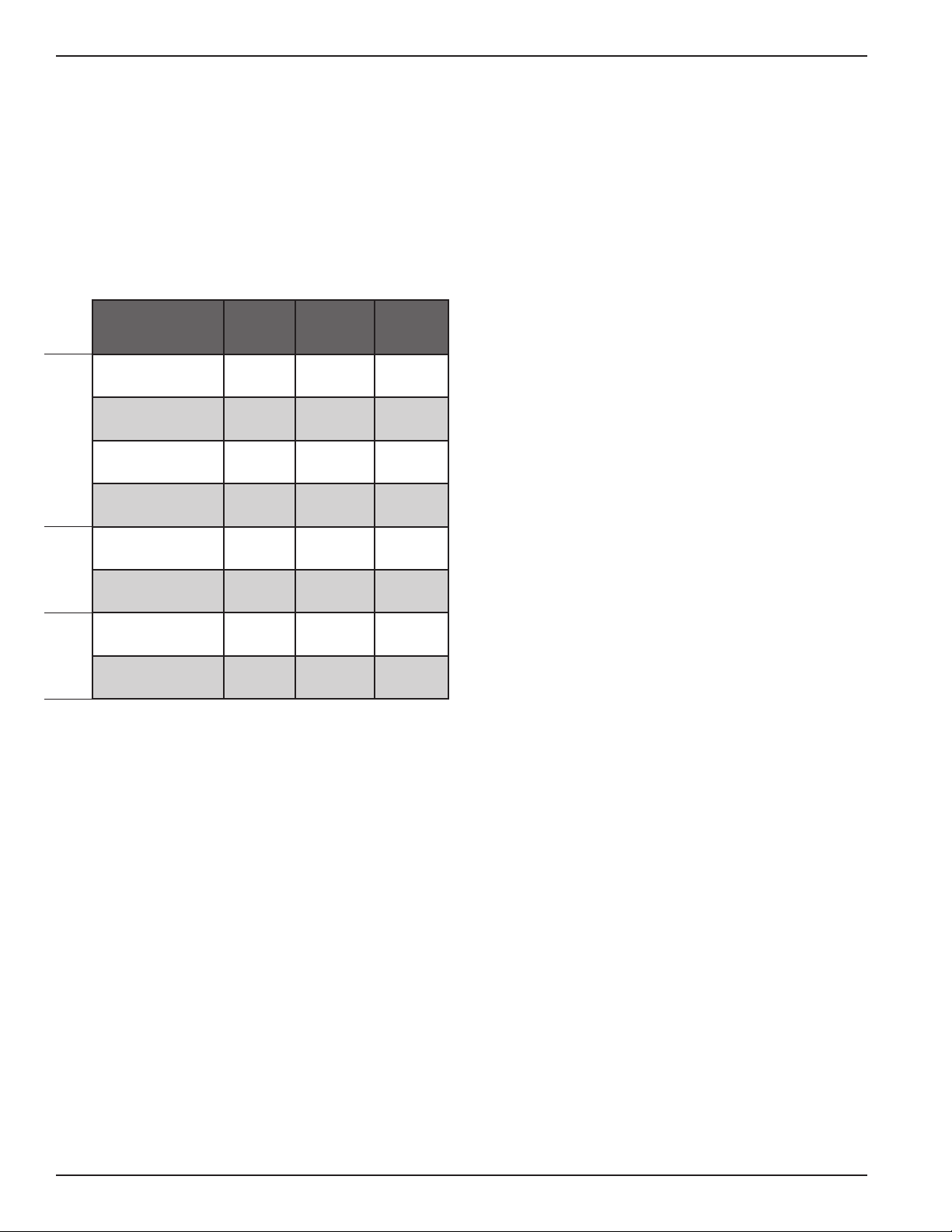
Parameter
Description
Optimum Maximum Minimum
AirPressure(psig) 100-125 *See Data
Label 225
AirInlet
Temperature(°F) 80-100 140 40
Ambient
Temperature(°F) 75 120 35
Evaporation
Temperature(°F) 35-42 60 33
SuctionGauge
Reading(psig) 28-40 60 28
DischargeGauge
Reading(psig) 160-230 260 80
SuctionGauge
Reading(psig) 75-90 130 75
DischargeGauge
Reading(psig) 290-400 450 160
Description
System
The non-cycling refrigerated air dryer product covers
the flow range listed on the manual front cover and
provides reliable dew point performance in most flow
conditions. Through optimization
of critical dryer components – heat exchanger,
separator, and condensate removal – the system
ensures the highest performance at full- and partial-
load conditions. R-134a refrigerant is used in dryer
models AR-45 through AR-1000 while R-404A is used in
the AR-1400 and higher models. R-134a is a pure
refrigerant providing consistent performance (zero
temperature glide) and easy service (no mixture of
different refrigerants). R-404A is a blend of three pure
refrigerants: 52% R-143A, 44% R-125, and 4% R134A
(by mass). This blend is nearly azeotropic meaning it
has a negligible temperature glide. R404A is well suited
to larger equipment as the higher operating pressures
and improved heat transfer properties allow for smaller
condensers, which leads to air dryers with smaller
footprints.
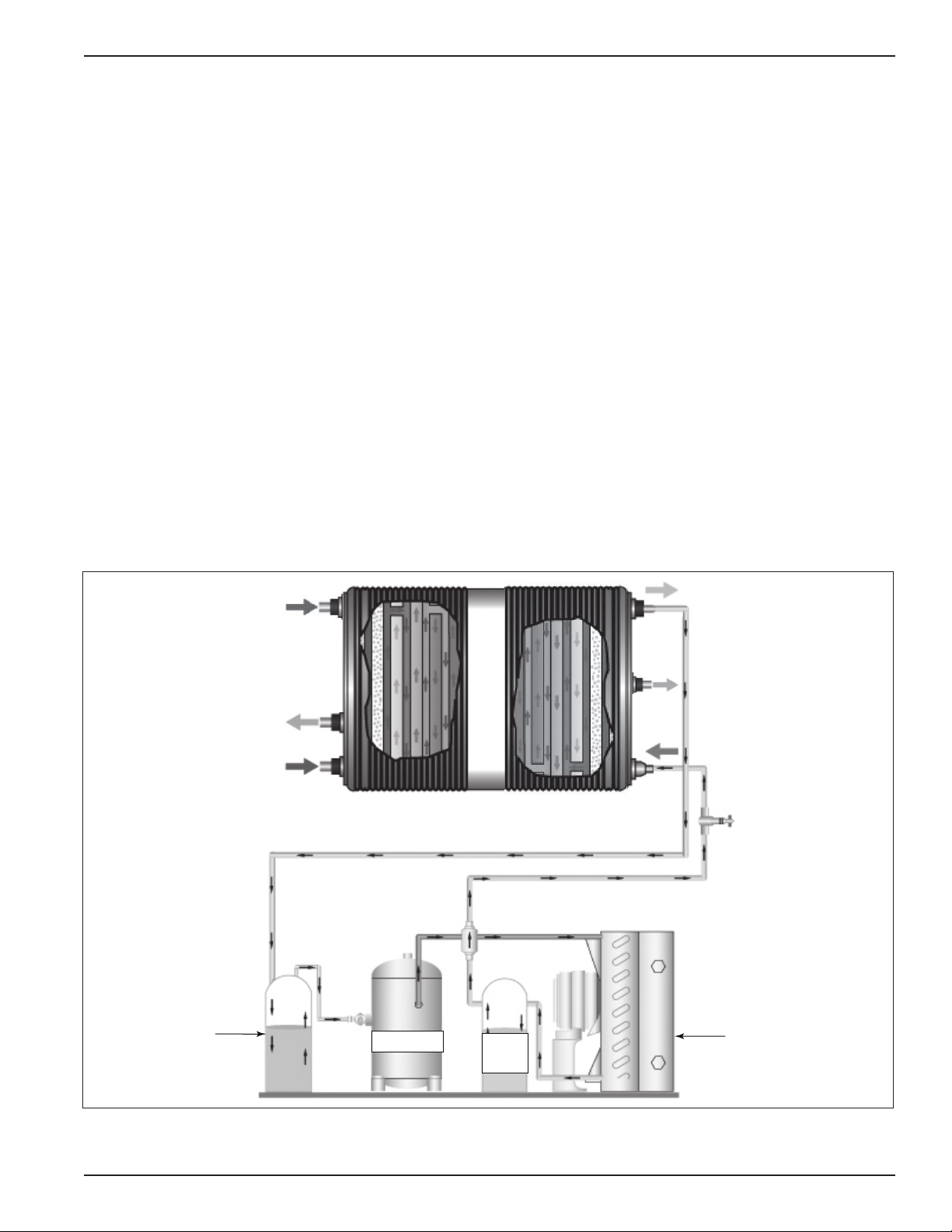
Hot saturated air enters the air-to-air heat
exchanger of the Non-Cycling Refrigerated Air Dryer
and is precooled by the outgoing dry air.
Precooling saves energy by reducing the heat load
on the dryer’s compressor. The cool saturated air
enters the air-to-refrigerant heat exchanger where
air temperature is lowered to the 38 to 42°F range.
This dramatic temperature drop condenses water
and oil.
The mixture of cold air and condensation then
flows into the two-stage separator filter where
liquids and contaminants are removed by
centrifugal action, directional flow change, and
velocity reduction. Once bulk liquids have been
removed, the compressed air goes through a
stainless steel mist eliminating filter that coalesces
oil aerosols and oil vapors within the 100-micron
range, and then separates and removes them. At
this point, the compressed air is dry and virtually
oil-free.
Cold, dry air exits through the precooler heat
exchanger and is reheated by incoming hot air.
Reheating restores energy and also prevents
condensation from forming on the outside of air
distribution piping. In the refrigeration unit, the
compressor pumps hot, high-pressure gaseous
refrigerant to the condenser where it is cooled
and liquefied by ambient air. From the condenser,
liquid refrigerant first flowsthrough the receiver,
then through a filter/dryer, and finally through the
expansion valve where pressure and temperature
are reduced. This reduction in pressure causesthe
liquid refrigerant to boil until it reaches the s
aturation temperature that corresponds to its
pressure. As the low-pressure refrigerant passes
through the evaporator, heat flows from the
compressed air to the refrigerant, causing the
boiling to continue until all refrigerant is vaporized.
Refrigerant gas is returned to the compressor and
the cycle is repeated. A hot gas by-pass valve is used
to control temperature in the evaporator.
6
Aircel HP Series
All Models
R-134AR-404A