UA-MAN-3000-19RN Page 7of 17
5.0 Description and Principle of Operation
5.1 Application
The Universal Analyzers 3000 Series Gas Sample Coolers are designed to be installed in a sample system
where the gas sample contains moisture to be removed. They have an option to be installed in hazardous
locations or unclassified locations.
The 3000 Series Coolers are designed as standalone equipment that does not require integration onto a
panel. They are also designed for minimal maintenance.
The 3000 Series Coolers have mounting holes for 1/4" hardware and may be installed into a protected shelter
or enclosures that are designed to remove the exhaust heat.
Ambient Temperature, Required Flow Rate, and Moisture Content will determine the specific model required
for a specific application.
The use of a Heated Filter and Heated Sample Line are highly recommended to be installed between the
sample extraction location and the input to the 3000 Series Gas Sample Cooler. They are recommended to
keep the temperature of the sample above the boiling point of water or above the dew point of any chemical
reactions that would skew the desired analytical results.
5.2 Description
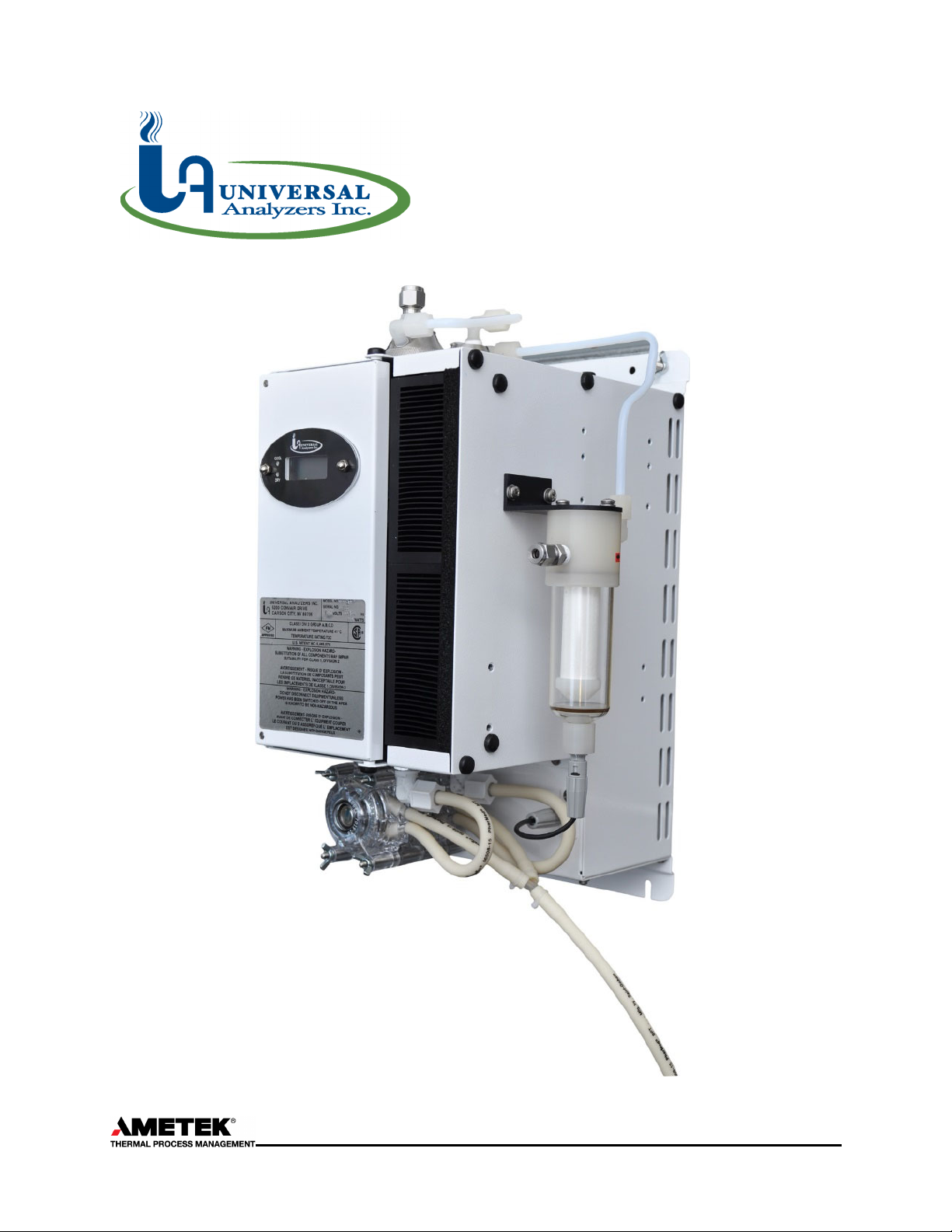
The 3000 Series Gas Sample Coolers are Thermoelectric Coolers consisting of Peltier Thermoelectric
Elements, control electronics, a heat sink, peristaltic pump motor, and blower fan assembled in a NEMA Type
1 Enclosure designed for mounting of optional equipment. The optional equipment consists of drain options,
water carry over sensor, sample pump, flow meters, as well as different materials for the impingers (water
removal columns) depending on the application.
The 3000 Series Coolers operate by condensing the water from a wet gas sample to a dew point of 4°C with
a minimal loss of water-soluble gas due to the design of the impingers. The impinger is composed of an
insulated tube enclosed in a highly polished cylinder that is then cooled. The hot wet sample is brought to the
bottom of the cylinder through the insulated tube and is then allowed to rise through a narrow annular area at
a relatively high Reynolds number to ensure the entire sample is influenced by the cold surface. The
condensate falls down the cold polished surface in the form of a sheet (as opposed to droplets or the bubbling
of the gas sample through the condensate) which minimizes the surface area in contact with the gas sample.
The temperature of the impinger is maintained through contact with a heat transfer block. Depending on the
model the heat transfer block will either be ambient temperature or be actively cooled to 4°C through the use
of Thermoelectric (Peltier) elements. A model 3040 has a single transfer block with two thermoelectric
elements, a model 3050 has an ambient temperature transfer block and an active transfer block with two
thermoelectric elements, and a model 3080 has two active transfer blocks for a total of four Thermoelectric
Elements. The temperature is measured using an AD592 semiconductor temperature sensing device. This
temperature is controlled to 4°C with a variance of one degree.
The Thermoelectric Elements create a temperature differential between the two sides of element when power
is applied. This creates a cool side that cools the impinger and a hot side where the heat is discharged
through a heat sink with a centrifugal drum blower forcing air through the heat sink.
The 3000 Series Sample Coolers have a digital display on the front panel indicating the operating
temperature (in degrees C) of the heat exchangers. In addition, there are two green LED lights to indicate the
status of the cooler. The 'COOL' light will shine yellow when the operating temperature is between 0°C and
10°C (32°F and 50°F) and otherwise be unlit. The "DRY" light will shine if there is no condensate sensor
installed or if the installed condensate sensor sees water carry over past the impingers.
There are two alarm relays in the 3000 Series Sample Coolers. There is a relay with wetted contacts that will
have the system voltage present and a relay with dry contacts for customers to provide their own signals.
They are both triggered by either the moisture alarm or the temperature alarm.