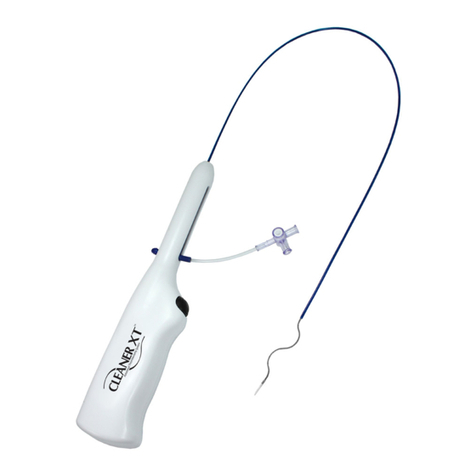
8) Clamp only the red (arterial) extension tubing using the color coded in-line clamp provided and remove
syringe. Attach stainless steel tunneler to the UltraStream’s venous tip. Avoid damage to the catheter tip
during placement. Slide the protective sheath onto the UltraStream to fully cover the catheter tip. Advance
the flexible stiffener into the venous luer until the stiffener tip gently contacts the stainless steel tunneler.
NOTE: Stiffener luer and UltraStream venous luer will not be connected during catheter tunneling.
9) Using the tapered tip of the tunneler to perform blunt dissection, create a subcutaneous tunnel starting at
the exit site and ending by exiting at the site of the venotomy/dilator.
CAUTION: Do not tunnel through the muscle. The tunnel should be made with care to prevent damaging
surrounding vessels and nerves.
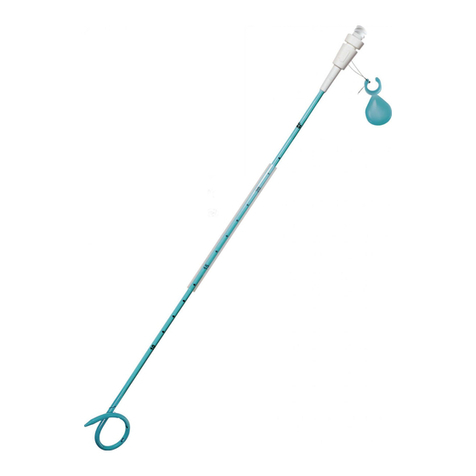
10) Pull the UltraStream through the subcutaneous tract. Position proximal catheter allowing for standard
polyester cuff placement (approx. 2cm within the tract).
11) Gently remove the tunneler from the UltraStream. Advance the stiffener until the luer connection with the
UltraStream can be tightened and secured.
12) Maintaining pressure over the vascular access site to prevent bleeding, remove the dilator leaving the
0.035/0.038in. guidewire in place. Backload the guidewire into the UltraStream distal stiffener lumen.
13) Advance the UltraStream and flexible stiffener over the proximal portion of the 0.035/0.038in. guidewire
through the subcutaneous tissue and into the vessel until proper catheter tip positioning is confirmed with
fluoroscopic visualization. If resistance is encountered, further blunt dissection may facilitate insertion.
It is recommended that the arterial lumen, indicated by the red luer-lock connector, be oriented cephalad
when the catheter is placed on the patient’s right side. If the catheter is placed on the patient’s left side,
then the venous lumen, indicated by the blue luer-lock connector, be placed cephalad. This would ensure
that the arterial lumens are positioned in the right atrium towards the mediastinum per the 2006 NKF/KDOQI
Guidelines.
CAUTION: Do not advance the catheter and stiffener past the tip of the guidewire as this could cause vessel
perforation, and or bleeding.
14) When the UltraStream and the stiffener are properly located within the vessel using fluoroscopic visualization,
unlock and gently remove the stiffener and guidewire from the catheter.
15) Attach a 20 ml (cc) syringe to one extension and open clamp. Blood should aspirate easily. Once adequate
blood flow has been established, flush the lumen(s) and then re-clamp the extension tube and remove syringe.
Repeat this step for the other catheter extension.
CAUTION: Avoid air embolism by keeping the catheter tubing clamped at all times when not in use and by
filling the catheter with sterile, normal or heparinized saline solution prior to use. With each change in tubing
connections, purge air from the catheter and all connecting tubing and caps.
CAUTION: Clamp only the extension tubes with the in-line clamps provided with the UltraStream catheter.
Do not use forceps and do not clamp the distal portion of the catheter.
NOTE: If excessive resistance to blood aspiration exists, the catheter may need to be rotated, flushed or
repositioned to sustain adequate blood flow. A pre-existing fibrin sheath may also be present.
16) Fill a 20 ml (cc) syringe with sterile, normal or heparanized saline solution, attach to one of the catheter
extensions, open clamp, and irrigate the lumen. Once the lumen has been irrigated, re-clamp the extension
tube and remove the syringe. Repeat this step for the other catheter extension.
17) Attach both injection caps to the catheter luers post placement.
18) If the catheter is not used immediately for treatment, follow standard protocol for establishing a heparin lock
in each catheter. Refer to the Heparinization section for additional notes.
19) Immediately after insertion, confirm proper placement of the tip of the catheter with fluoroscopic visualization.
The catheter tip should be positioned at the level of the caval atrial junction or into the right atrium to ensure
optimal blood flow (as recommended in current NKF/KDOQI Guidelines). ALWAYS ATTACH BOTH INJECTION
CAPS TO CATHETER LUERS POST PLACEMENT.
CAUTION: Failure to verify catheter placement may result in serious trauma or fatal complications.
20) Suture the tunnel exit site and vein insertion site if necessary. Suture the catheter to the skin using the fixed
suture wings. Do not suture the catheter tubing.
21) Apply provided dressings per hospital policy.
NOTE: It is particularly important to immobilize cuffed catheters for 7 days to prevent cuff dislodgment.
NOTE: Before dialysis begins, all connections to the extracorporeal circuit should be checked carefully.
During all dialysis procedures, frequent visual inspection should be conducted to detect leaks and prevent
blood loss or entry of air into the extracorporeal circuit.
Directions for Catheter Insertion (Standard Kit with Peel Away Sheath)
The 15.5F UltraStream Chronic Dialysis Catheter should be inserted, manipulated, and removed only by a qualified,
licensed physician or other healthcare practitioner authorized by and under the direction of such physician. Medical
techniques and procedures described in these instructions do not represent all medically accepted protocols, nor are