6
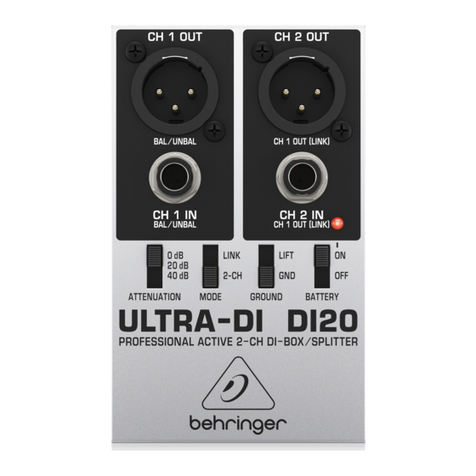
ULTRA-DI PRO DI4000
1. INTRODUCTION
Whether ou are on the stage or in the studio, ou often find that ou need to connect an audio source to
our mixing console, but ou dont have the appropriate connectors. For example, onl few ke boards
feature balanced outputs; guitars should not be connected directl to the console; and placing a microphone
in front of an amp is not alwa s an ideal solution, because the mic will pick up unwanted signals from other
instruments, too. Low frequenc signals (e.g. produced b a bass guitar) are particularl difficult to handle
using these techniques.
DI is short for Direct Injection. A Direct Inject box allows ou to use a high-impedance, unbalanced source,
e.g. the signal between guitar and guitar amp, and feed it directl into an input channel on our console,
without having to use a microphone. And thats far from being all. There are plent of situations in which oud
like to input unbalanced source signals into our console, and possibl convert them to balanced signals
before. As ou can expect, the DI4000 offers ou a reliable solution.
The following explanations will give ou an introduction to the complex performance-impedance issue:
impedance is defined as the dependence of a device's electrical resistance and phase response on the
frequenc processed. Thus, impedance is one of the criteria that distinguish good DI boxes from poor ones.
Much like in a power amp and its connected speakers, impedance determines the performance of the device.
With a good power amp, the load impedance will have little influence on the maximum output power, but it can
considerabl affect other properties. With a passive DI box, the connected load impedances (ins and outs)
alter the bandwidth, frequenc response, distortion, etc. of the DI box.
B the wa : there are two basic t pes of DI boxes, passive and active. Both can be connected to one of the
consoles mic inputs. Passive DI boxes offer the advantage that the are less expensive than active models
(less electronics, no power suppl ), however, their performance depends on the connected impedance. With
a passive DI box connected, an impedance change on the console side will also modif the input
impedance. The frequenc response will alwa s depend on the impedances connected. An passive DI box
will onl perform properl with accuratel specified impedances (high on the input side, low at the output), i.e.
it will onl work in standard situations.
Active DI boxes such as our ULTRA-DI PRO, however, do not suffer from such restrictions, because the use
an amplifier circuit to buffer the input signal. Since the ULTRA-DI PROs input impedance is ultra-high, the
signal remains unaffected as it passes through the DI box. Additionall , the ULTRA-DI PRO features
balanced impedances on the output side, making the signal less susceptible to hum and noise interference. In
this wa , the signal as source impedance is completel independent of the console used (and vice versa),
which means that the sound remains totall unaffected. The ULTRA-DI PRO uses our proven OT-1 transformer
which ensures a clear and distortion-free sound and linear frequenc response. Additionall , the
ULTRA-DI PRO comes with a built-in power suppl .
Future-oriented BEHRINGER technology
The ULTRA-DI PRO is based on SMD technolog (Surface Mounted Devices). These subminiature
components known from aerospace applications ensure both extreme packing densit and greater reliabilit .
High-quality components and design
The philosoph behind BEHRINGER products guarantees a no-compromise circuit design and emplo s the
best choice of components. The op-amps, t pe 4580, used in the ULTRA-DI PRO are chosen for their
superior signal-to-noise ratio, low distortion and linear performance. Additionall , the ULTRA-DI PRO uses
high qualit resistors and capacitors with ver tight tolerances, high-grade switches as well as other selected
components.
+This manual first describes the terminology used, so that you can fully understand the
ULTRA-DIPRO and its functions. Please read the manual carefully and keep it for future
reference.
1. INTRODUCTION