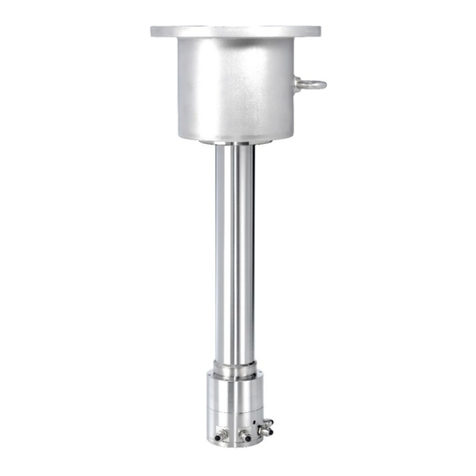
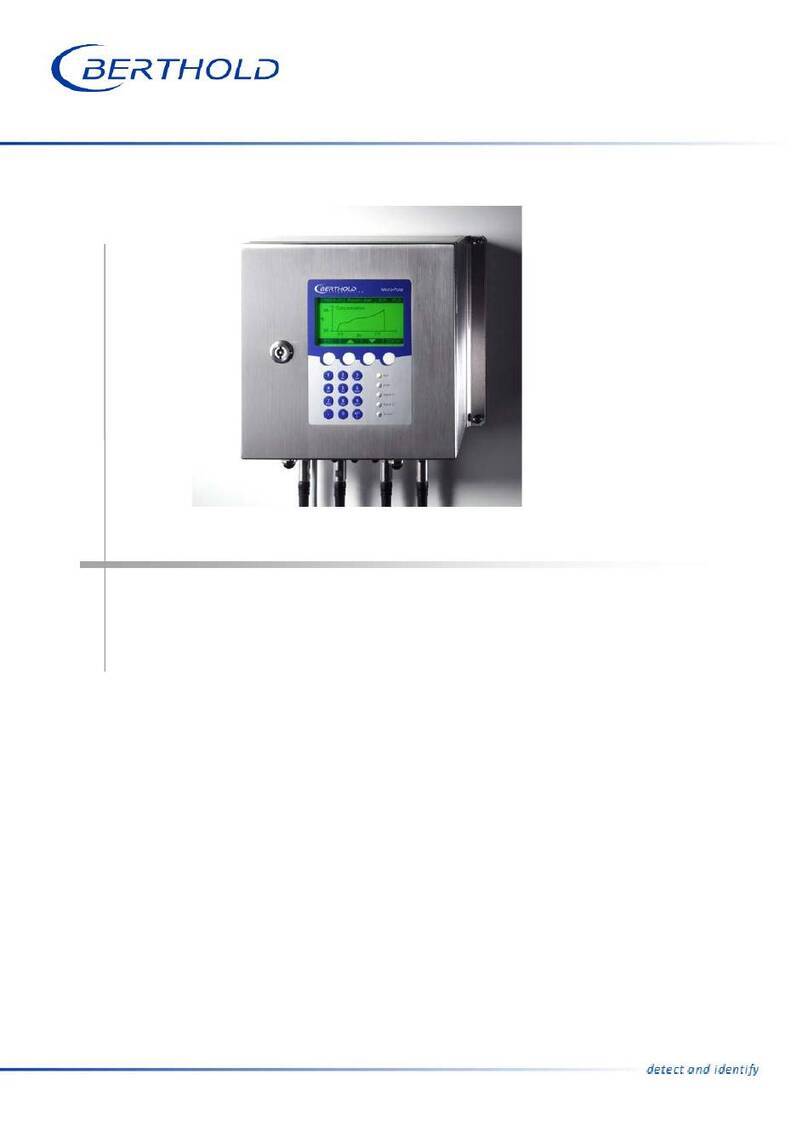
Berthold MicroPolar LB 566 User manual

Concentration Meters
MicroPolar (++)
LB 566
User’s Guide
Hardware Manual
41986BA2
Rev. Nr.: 08, 07/2023


MicroPolar (++) LB 566
The units supplied should not be repaired by anyone other than Berthold Tech-
nologies Service engineers or technicians by Berthold Technologies.
In case of operation trouble, please address to our central service department
(address see below).
The complete user’s guide consists of the hardware manual and the soft-
ware manual.
The hardware manual comprises:
mechanical components
installation
electrical installation
technical data
electrical and mechanical drawings
The software manual comprises:
operation of the evaluation unit
parameter description
basic setup
calibration
error messages
The present manual is the hardware description.
Subject to change without prior notice.
BERTHOLD TECHNOLOGIES GmbH & Co. KG
Calmbacher Str. 22 ⋅D-75323 Bad Wildbad
Switchboard: Service:
Phone +49 7081 177 0 Phone +49 7081 177 111
Fax +49 7081 177 100 Fax +49 7081 177 339
www.Berthold.com

Table of Contents
MicroPolar (++) LB 566 5
Table of Contents
Page
Safety Summary 7
Symbols and Warnings 7
General Information 8
General Safety Instructions 9
General Information 11
Use and Function 11
Frequency License 12
Intended Use 14
Explanation of Terms 15
System Description 17
Principle of Measurement 17
Calculation of Measured Values 18
Temperature Compensation 19
Throughput Calculation and Output 20
Mechanical Components 21
3.5.1 Evaluation Units 23
3.5.2 FlowCell 25
3.5.3 Container Probe 28
3.5.4 High-frequency Cable 32
Assembly on a Pipeline 34
Assembly on a Container 35
Getting Started 36
Transport 36
Commissioning the FlowCell 37
4.2.1 Installing the FlowCell 37
4.2.2 Installing the Evaluation Unit 40
4.2.3 Connecting the HF Cable 41
Commissioning the Container Probe 43
4.3.1 Installing the Container Probe 43
4.3.2 Setting Up the Evaluation Unit 45
4.3.3 Connecting the HF Cable 45
Connecting the Evaluation Unit 47
4.5.1 Pin Configuration of the Connector Strip 48
4.5.2 Digital Outputs, Relay 50
Service instructions 53
General Information 53
Wear Parts 54
Instrument Cleaning 56
Battery 57
Fuse Replacement 58

Table of Contents
6 MicroPolar (++) LB 566
Technical Data 60
Technical Data Evaluation Unit 60
Technical Data Sensors 63
Technical Data HF Cable 69
Format of Serial Data Output RS232 and RS485 71
Certificates 73
EC Declaration of Conformity 73
Frequency License 76
Technical Drawings 85
Dimensions Drawings Evaluation Unit Wall Housing 85
Electrical Wiring Diagram 87
Dimensional Drawings FlowCell 88
8.3.1 Type LB 5660-102-00X FlowCell DN 50 Flange, FDA 88
8.3.2 Type LB 5660-202-00X FlowCell DN 65 Flange, FDA 89
8.3.3 Type LB 5660-302-00X FlowCell DN 80 Flange, FDA 90
8.3.4 Type LB 5660-402-00X FlowCell DN 100 Flange, FDA 91
8.3.5 Type LB 5660-502-00X FlowCell DN 125 Flange, FDA 92
8.3.6 Type LB 5660-602-00X FlowCell DN 150 Flange, FDA 93
8.3.7 Type LB 5660-112-00X FlowCell DN 50 G-BS/M 94
8.3.8 Type LB 5660-212-00X FlowCell DN 65 G-BS/M 95
8.3.9 Type LB 5660-312-00X FlowCell DN 80 G-BS/M 96
8.3.10 Type LB 5660-412-00X FlowCell DN 100 G-BS/M 97
8.3.11 Type LB 5660-512-00X FlowCell DN 125 G-BS/M 98
8.3.12 Type LB 5660-612-00X FlowCell DN 150 G-BS/M 99
8.3.13 Type LB 5660-132-00X DN 50 100
8.3.14 Type LB 5660-232-00X DN 65 101
8.3.15 Type LB 5660-332-00X DN 80 102
8.3.16 Type LB 5660-432-00X DN 100 103
8.3.17 Type LB 5660-532-00X DN 125 104
8.3.18 Type LB 5660-632-00X DN 150 105
Dimensional Drawings Container Probes 106
8.4.1 Type LB 5650-01 106
8.4.2 Type LB 5650-02 107
8.4.3 Type LB 5650-03 108
8.4.4 Type LB 5650-04 109
8.4.5 Type LB 5650-05 110
8.4.6 Type LB 5650-09 111
8.4.7 Installation Situation in Pipelines 112
Dimensional Drawings Container Flush Probes 113
8.5.1 Type LB 5651-01 113
8.5.2 Type LB 5651-02 114
8.5.3 Type LB 5651-03 115
8.5.4 Type LB 5651-04 116
8.5.5 Type LB 5651-05 117
8.5.6 Installation Situation in Pipelines 118
Assembly sheets for LB 5650 (Container probe) 119
Assembly sheets for LB 5651 (Container flush probe) 121

Chapter 1. Safety Summary
MicroPolar (++) LB 566 7
Safety Summary
Symbols and Warnings
In this user manual, the term Berthold Technologies stands for
the company Berthold Technologies GmbH & Co.KG.
To rule out bodily injury and property damage, please keep in
mind the warning and safety instructions provided in this user
manual. They are identified by the following sings: DANGER,
WARNING, CAUTION or NOTICE.
Indicates imminent danger. If it cannot be
avoided,
death or most severe personal injuries may be the
consequence.
Indicates a possibly dangerous situation. The consequences
may be death or most severe personal injuries.
Indicates a possibly harmful situation The consequences
may be minor
or medium personal injuries.
Indicates a situation that may cause material damage
if the
instructions are not followed.
IMPORTANT
Paragraphs with this symbol
provide important information on
the product and how to handle it.
TIP
Contains user tips and other useful information.

Chapter 1. Safety Summary
8 MicroPolar (++) LB 566
Other symbols used in this documentation:
Warning: No intervention, do not alter anything
Requirement: Disconnect power
Requirement: Wear safety boots
General Information
The most important safety measures a summarized in this user
manual. They supplement the corresponding regulations which
must be studied by the personnel in charge.
Please pay attention to:
the national safety and accident prevention regulations
the national assembly and installation directions
the generally recognized engineering rules
the information on transport, assembly, operation, service,
maintenance
the safety instructions and information in these operating in-
structions
the enclosed technical drawings and wiring diagrams
the characteristic values, limit values and the information on
operating and ambient conditions on the type labels and in the
data sheets
the signs on the devices
the country-specific licensing schemes

Chapter 1. Safety Summary
MicroPolar (++) LB 566 9
General Safety Instructions
IMPORTANT
The equipment housings have IP 65 protection and are suitable
for outdoor applications. The units are factory tested and are
delivered in a condition that permits safe and reliable operation.
For outdoor applications, the measuring
systems must be pro-
tected from direct sunlight and rain, for example by a suitable
shelter.
IMPORTANT
Never change the installation and the parameter settings with-
out a full knowledge of these operating instructions, as well as
a full knowledge of the
behavior of the connected controller and
the possible impact on the operating process to be controlled.
The systems may only be used in perfect technical condition
and only for the intended use!
Only let persons work with the systems who are
mandated to
do this and are suitably qualified and adequately trained! In-
stallations and modifications on the systems which may affect
the operational safety are not permitted!
IMPORTANT
All system components require
non-corrosive ambient condi-
tions during transport, storage and operation.
IMPORTANT
If liquid gets inside the instrument, cut off the power supply.
The equipment must be inspected and cleaned by an authorized
service center.
Ambient
conditions

Chapter 1. Safety Summary
10 MicroPolar (++) LB 566
Electrical hazards
Disconnect power to ensure that contact with live part is
avoided during installation and when servicing.
Disconnect the power supply before opening the instrument.
Work on open and live instruments is prohibited.
Caution! Potential hazards, material damage!
Device type:
LB 566
-12 MicroPolar ++ (ID no. 51833-02)
When connecting the 24
V DC power supply, the + and – poles
must be connected correctly. There is no reverse polarity pro-
tection!
Spare fuses must match the rating specified by the device
man-
ufacturer. Short
-circuiting or manipulation is not permitted.
IMPORTANT
The LB 566 and all additional equipment must be connected to
mains via grounded connection.
IMPORTANT
The concentration meter LB 566 may be installed, serviced and
repaired only by qualified specialists.
Qualified persons Qualified specialists are persons who through professional train-
ing have acquired sufficient skills in the respective field and who
are familiar with the relevant national industrial safety regula-
tions, accident prevention directions, guidelines and accepted en-
gineering standards. They must be able to safely assess the re-
sults of their work and they must be familiar with the contents of
these user manual.

Chapter 2. General Information
MicroPolar (++) LB 566 11
General Information
Use and Function
The MicroPolar LB 566 has been designed as a concentration
measuring system and may be used only for this purpose. If the
devices are used in a manner that are not described in this user
manual, the protection of the devices is compromised and the
warranty will be lost.
Berthold Technologies is liable and guarantees only that the de-
vices comply with its published specifications. The LB 566 may
only be installed in an undamaged, dry and clean condition. Al-
terations and modifications to the system components are not
permitted.
The LB 566 is not qualified as a "safety-related measurement".
The standards and guidelines the LB 566 complies with are item-
ized in these device instructions in chapter 2.2 Frequency License
and chapter 7.1 EC Declaration of Conformity.
The FlowCell and the container probe has been classified as pres-
sure equipment acc. to art. 4 sect. 3 of guideline 2014/68/EU.
Before use, check whether the case of use corresponds to this
classification. In particular, the media compatibility of the com-
ponents in contact with the fluid must be checked.
The protection type of the LB 566 to IEC 60529 is max. IP 65.
The following use is inappropriate and has to be prevented:
The use under conditions other than the terms and conditions
stated by the manufacturer in their technical documentation,
data sheets, operating and installation manuals and other
specifications.
The use after repair by persons not authorized by Berthold
Technologies.
The use in a damaged or corroded state.
Operation with open or inadequately closed cover.
Operating with insufficiently tightened adapters and cable
glands.
Operation without the manufacturer’s recommended safety
precautions.
Manipulating or bypassing existing safety facilities.
Authorized persons are those who, by law, are permitted to per-
form the respective activity, or who have been approved by
Berthold Technologies for certain activities.
Conformity to
standards
Protection type
Warning
against misuse
Authorized persons
Pressure equipment
directive

Chapter 2. General Information
12 MicroPolar (++) LB 566
Frequency License
This device complies with Part 15 of the FCC Rules and with In-
dustry Canada licence-exempt RSS standard(s).
Operation is subject to the following two conditions:
(1) this device may not cause harmful interference, and
(2) this device must accept any interference received,
including interference that may cause undesired
operation.
Le présent appareil est conforme aux CNR d'Industrie Canada ap-
plicables aux appareils radio exempts de licence.
L'exploitation est autorisée aux deux conditions suivantes:
(1) l'appareil ne doit pas produire de brouillage, et
(2) l'appareil doit accepter tout brouillage radioélectrique
subi, même si le brouillage est susceptible d'en
compromettre le fonctionnement.
This equipment has been tested and found to comply with the
limits for a Class B digital device, pursuant to part 15 of the FCC
Rules. These limits are designed to provide reasonable protection
against harmful interference in a residential installation. This
equipment generates, uses and can radiate radio frequency en-
ergy and, if not installed and used in accordance with the instruc-
tions, may cause harmful interference to radio communications.
However, there is no guarantee that interference will not occur in
a particular installation. If this equipment does cause harmful in-
terference to radio or television reception, which can be deter-
mined by turning the equipment off and on, the user is encour-
aged to try to correct the interference by one or more of the fol-
lowing measures:
- Reorient or relocate the receiving antenna.
- Increase the separation between the equipment and re-
ceiver.
License labels

Chapter 2. General Information
MicroPolar (++) LB 566 13
- Connect the equipment into an outlet on a circuit different
from that to which the receiver is connected.
- Consult the dealer or an experienced radio/TV technician
for help.
Changes or modifications made to this equipment not expressly
approved by BERTHOLD TECHNOLOGIES may void the FCC au-
thorization to operate this equipment.
The MicroPolar and MicroPolar ++ comply with the R&TTE Di-
rective 1999/5/EC and thus meet all the requirements for this
type of high-frequency devices. As a mark of conformity in ac-
cordance with the CE mark, the devices bear the no. 0682 of the
certification body. The certificate can be found in chapter 7.3 Fre-
quency License.
IMPORTANT
The frequency approvals and conformities
are only applicable
in combination with the container probes and
the FlowCell.
To comply with ETSI (European Telecommunications Standards
Institute), the LB 56
6 ++ in combination with horn and spiral
antennae may only be operated with a 10dB attenuator pa
d in
the sending path (MTX).
IMPORTANT
The LB 566 has been manufactured in compliance with the
safety requirements for microwave devices. It will be the user’s
responsibility to adhere to any special legal provisions regard-
ing the use of microwaves.
IMPORTANT
Any change in the frequency or otherwise tampering with the
microwave device will lead to a loss of the frequency license
and may result in criminal consequences.
The microwave modules do not include any replaceable com-
ponents and must not be
opened.

Chapter 2. General Information
14 MicroPolar (++) LB 566
Intended Use
The LB 566 can be used to determine the water or moisture con-
tent and the concentration of virtually any material. The following
sensors and evaluation versions are available:
1. The container probes have been designed for installation into
containers and pipelines with a nominal width of ≥200 mm.
The probe is mounted so that both measuring rods (trans-
mitter and receiver) are immersed into the product being
measured.
2. The The flow cell is a tubular probe that is either installed
into the existing pipeline system inline or into a bypass.
The evaluation unit is available in two versions: The standard
model MicroPolar and the high dynamic version MicroPolar ++.
The Micro Polar ++ requires a microwave signal attenuation of at
least 40 dB. The MicroPolar must be used for lower microwave
attenuation.
During operation, the concentration meters MicroPolar and Mi-
croPolar ++ emit electromagnetic radiation in the frequency
range between 2.4 GHz and 2.5 GHz (range limitations depending
on local regulations in your country). Microwaves are not danger-
ous to human beings and the environment (power radiation
< 10 mW). The microwaves are emitted directed from the micro-
wave window; the product is not altered by the microwaves.
To ensure proper function of the measuring system, please pay
attention to the following:
TIP
The material to be measured may be electrically conductive
only to a limited degree.
The product must not contain any
gas bubbles or gas bubbles have
to be compressed with adequate
pressure when carrying out meas-
urements in pipelines.
The ion concentration, for exam-
ple, salt content
must be nearly
constant.

Chapter 2. General Information
MicroPolar (++) LB 566 15
Explanation of Terms
Attenuation
Weakening of microwave signals, microwaves measuring effect.
EVU
Evaluation Unit
Factory setting
In the factory setting all parameters have been set to default
values. In most cases this considerably facilitates the calibra-
tion of the instrument. Despite factory setting, calibration al-
ways has to be performed.
FlowCell
Tubular probe for simple integration into the existing pipeline
system.
Flush probe
Container probe with flushing device.
HF cable
High frequency cable
Microwaves
Designation for electromagnetic waves in a specific frequency
range.
Phase
Phase or phase shift, microwave measuring effect.
Quad cable
Combination of four HF cables of equal length in a corrugated
tube.
Softkeys
Software associated keys.
TC
Temperature compensation


Chapter 3. System Description
MicroPolar (++) LB 566 17
System Description
Principle of Measurement
As the microwaves pass through the product, their propagation
velocity is slowed down (= phase shift) and their intensity is at-
tenuated (= attenuation). Figure 3-1 illustrates the principle of
measurement: Compared to a reference signal, the propagation
velocity of microwaves passing through the product is slowed
down (phase shift) and their intensity (attenuation) is reduced.
The prerequisite is that the product being measured shows die-
lectric properties. Generally, water is a very distinct dielectric
fluid. The water or dry mass concentration can therefore be de-
termined by measuring the phase shift and/or attenuation.
The concentration to be detected in the product is therefore in
good approximation linearly dependent on the phase shift and
the attenuation. For this reason, we can measure the concentra-
tion or the dry matter content of the product using a linear cali-
bration (see chapter 3.2 Calculation of Measured Values).
Figure 3-1:
Schematic diagram:
Change in
microwave by
product
Phase shift
Product
Phase comparison
--> Phase
Amplitude comp.
--> Attenuation
Reference path
Reference signal
Measurement signal
Measured value:
Concentration %TS
HF- sources
Transmitter Receiver

Chapter 3. System Description
18 MicroPolar (++) LB 566
Calculation of Measured Values
The microwave parameters phase and attenuation are calibrated
according to an automatic plausibility analysis.
During calibration, the phase and/or attenuation of a concentra-
tion value (or density value) are assigned through sampling. The
calibration is done automatically and the sampling process is sup-
ported by the evaluation unit.
Which of the parameters (phase, attenuation or both) will be used
for the calibration depends on the size and interference of the
measuring effect. For example, the attenuation is significantly
more sensitive to electrolytic conductivity (salt content).
In many cases, the pure phase measurement is recommended
and the measured value is calculated as follows:
Measured value = A ∙ Phase + C Eq. 3-1
where:
Measured value Concentration / Moisture / Dry matter
A, C Coefficients of the respective calibration
function
The LB 566 allows you to calibrate, display and output two con-
centrations: Con1 and Con2. You have to enter the calibration
coefficients separately for concentration 1 and 2. For more infor-
mation please refer to the Software Manual.
Limitations
Weakly bound water can be detected depending on the
strength of the binding. Thus, the measuring effect may be
dependent on the grain size distribution and the chemical
properties of the product being measured, provided this
changes the binding of water to the solid matter.
Walls made of plastic, rubber or insulation materials with fairly
low dielectricity hardly affect the measurement and are cali-
brated at a constant level.
Ice and crystal water cannot be measured because the water
molecules cannot rotate freely (ice and crystal water are dry).

Chapter 3. System Description
MicroPolar (++) LB 566 19
Conductive materials such as graphite or coke cannot be trans-
mitted by microwaves. Metal walls can also not be transmitted by
microwaves.
Compensation In addition to the water content, the product temperature,
product density and a varying material load (varying microwave
irradiation path) may have an influence on the phase and atten-
uation. This influence has to be compensated for during calibra-
tion.
Temperature Compensation
Temperature compensation (TC) is required for fluctuating prod-
uct temperature. It is generally advisable to provide a tempera-
ture compensation, i.e. a temperature signal (0/4...20 mA or
PT100) to be connected to the evaluation unit and, optionally, to
enable the compensation in the evaluation unit. The evaluation
unit is designed so that the required TC’s can be calculated auto-
matically. The variation in temperature where TC becomes abso-
lutely essential is dependent on the product and on the water
content. In the first approximation, ±2° C should be set as fluc-
tuation limit.
For example, if the product temperature is measured via the
PT100 input, then Eq. 3-1 is expanded as follows:
Measured value = A · Phase + D · Tmeas + C Eq. 3-2
where:
Measured value Concentration / Moisture / Dry matter
A, D, C Coefficients of the calibration function
Tmeas Product temperature
How to work with the temperature compensation is described in
detail in the Software Manual.

Chapter 3. System Description
20 MicroPolar (++) LB 566
Throughput Calculation and Output
For pipeline applications, the LB 566 allows you to calculate the
throughput (mass flow) and to output the result via a current
output.
The calculation is based on the microwave measured value; if this
value correlates with the product density, one can calculate the
throughput, if some additional information is available. The addi-
tional information needed is: internal pipe diameter/cross section
and the product speed. The product speed has to be fed via cur-
rent input.
For details, please see the Software Manual, chapter 4.2.12 Mass
Flow.
Other manuals for MicroPolar LB 566
1
This manual suits for next models
31
Table of contents
Other Berthold Measuring Instrument manuals

Berthold
Berthold LB 442 User manual

Berthold
Berthold DUO XPERT LB 470RID User manual
Berthold
Berthold Duo XPERT LB 470 Level User manual

Berthold
Berthold Duo Xpert LB 478 MPLM User manual

Berthold
Berthold LB 134 User manual
Berthold
Berthold Uni-Probe LB 491 User manual

Berthold
Berthold LB 444 User manual

Berthold
Berthold BTwave LB 571-02 User manual

Berthold
Berthold DuoXpert LB 476 Level+ User manual

Berthold
Berthold LB 444 K-40 User manual