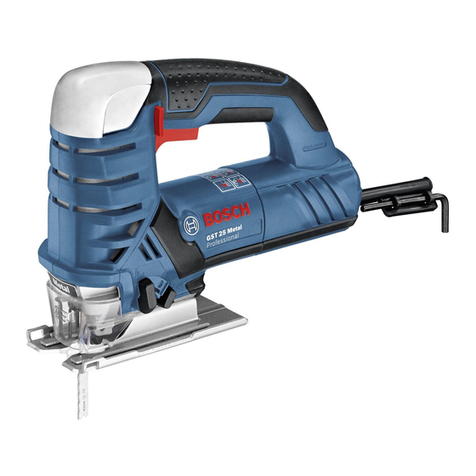
It is not possible to reduce the stroke rate while the on/off
switch (2) is locked.
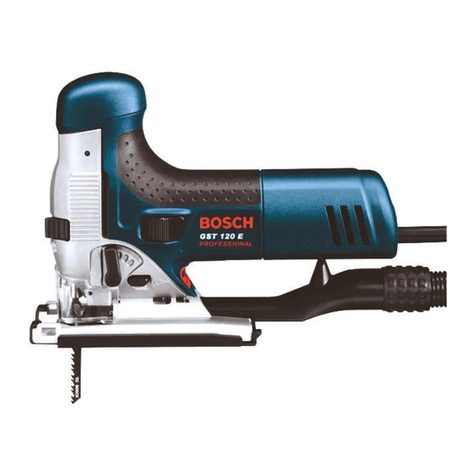
You can also preselect the stroke rate and change it during
operation using the stroke rate preselection thumbwheel
(3).
The required stroke rate is dependent on the material and
the work conditions and can be determined using practical
tests.
It is recommended that you reduce the stroke rate when
placing the saw blade on the workpiece and when sawing
plastic and aluminium.
During prolonged periods of use at a low stroke rate, the
power tool may heat up significantly. Remove the saw blade
and let the power tool run at the maximum stroke rate for
around three minutes to cool down.
Practical advice
uPull the plug out of the socket before carrying out any
work on the power tool.
uSwitch the power tool off immediately if the saw blade
becomes blocked.
uWhen machining small or thin workpieces, always use
a stable base or saw table (accessory).
Before sawing into wood, chipboard, building materials,
etc., check for and remove any foreign objects such as nails,
screws, etc.
Plunge cutting (see figureE)
uPlunge cuts may only be applied to soft materials,
such as wood, gypsum board, etc.
For plunge cutting, use only short saw blades. Plunge cutting
is possible only with a mitre angle of 0°.
Place the power tool so that the front edge of the base plate
(4) rests on the workpiece, without the saw blade (6) touch-
ing the workpiece, and switch it on. On power tools with
stroke rate control, select the maximum stroke rate. Press
the power tool firmly against the workpiece and allow the
saw blade to plunge slowly into the workpiece.
As soon as the base plate (4) rests fully on the workpiece,
continue sawing along the required cutting line.
Parallel guide with circle cutter (accessory)
When working with the parallel guide with circle cutter (18)
(accessory), the workpiece must be no more than 30mm
thick.
Parallel cuts (see figureF): Loosen the locking screw (17)
and slide the scale on the parallel guide through the guide
(16) in the base plate. Adjust the desired cutting width as a
scale value on the inside edge of the base plate. Retighten
the locking screw (17).
Circular cuts (see figureG): Drill a hole large enough to push
the saw blade through on the cutting line within the circle to
be cut. Machine the drill hole with a router or file so that the
saw blade can lie flush with the cutting line.
Position the locking screw (17) on the other side of the par-
allel guide. Slide the scale on the parallel guide through the
guide (16) into the base plate. Drill a hole in the workpiece
in the middle of the section to be cut out. Insert the centring
tip (19) through the inner opening of the parallel guide and
into the drilled hole. Adjust the radius as a scale value on the
inside edge of the base plate. Retighten the locking screw
(17).
Coolant/lubricant
As the material heats up along the cutting line when cutting
metal, you should apply coolant or lubricant.
Maintenance and Servicing
Maintenance and cleaning
uPull the plug out of the socket before carrying out any
work on the power tool.
uTo ensure safe and efficient operation, always keep
the power tool and the ventilation slots clean.
If the dust outlet becomes blocked, switch off the power
tool, disconnect the dust extraction system and remove the
dust and chips.
Clean the saw blade receptacle regularly. For this, remove
the saw blade from the power tool and lightly tap out the
power tool on a level surface.
If the power tool becomes very dirty, this can lead to serious
faults. For this reason, do not cut materials which generate
large quantities of dust from below or overhead.
uIn extreme conditions, always use a dust extractor if
possible. Blow out ventilation slots frequently and in-
stall a residual current device (RCD) upstream. When
machining metals, conductive dust can settle inside the
power tool, which can affect its protective insulation.
Apply a drop of oil to the guide roller (5) from time to time.
Check the guide roller (5) regularly. If worn, it must be re-
placed by an authorised Bosch after-sales service agent.
In order to avoid safety hazards, if the power supply cord
needs to be replaced, this must be done by Bosch or by a
customer service centre that is authorised to repair Bosch
power tools.
After-sales Service and Advice on Using
Products
Our after-sales service can answer questions concerning
product maintenance and repair, as well as spare parts. You
can find exploded drawings and information on spare parts
at: www.bosch-pt.com
The Bosch product use advice team will be happy to help you
with any questions about our products and their accessor-
ies.
In all correspondence and spare parts orders, please always
include the 10‑digit article number given on the type plate of
the product.
Cambodia
Robert Bosch (Cambodia) Co., Ltd
Unit 8BC, GT Tower, 08th Floor, Street 169,
English | 9
Bosch Power Tools 1 609 92A 4BW | (22.10.2018)